• This thread is just the tip of the iceberg.The people ahead of the curve aren't Googling for answers — they're already in here, having the conversations you haven't found yet. DealerRefresh is free.Get the full picture →

Why Don’t They Want to Learn?

Jeff,
"“My how perfect this world would be, if everybody thought just like me”. The day I understood that the bulk of my frustration stemmed from not realizing that everyone didnt think the way I did(SHOCKER!) was the turning point in my career. Is this where I’m suppose to quote the Serenity Prayer?
I will ask that you do this… LET THE OTHER GUYS KEEP DOING WHAT THEY’RE DOING!!! and help those that want to be helped."

This is a huge part of what holds many Managers back.....you need to realize you can't have a team who all have the exact same strengths and weakness'. Even more so you can't have a team with all the same strengths and weakness' of the coach.

So many rookie managers remain a rookie manager their whole career because they can't get past this hurdle. Sometimes letting some things go empowers your salespeople to want to be more for themselves instead of being ordered to be more from above.

I attended Toyota training yesterday, not because I need to be Certified for Toyota.....I need to be Certified for myself and our salespeople who we require to be Certified as well.

Joe, Thanks as always for the kind words......anytime you want to take your own advice you're welcome to swing in.

Why Don’t They Want to Learn?

I agree with you Joe but understanding the psychology behind mediocrity will minimize anxiety and frustration in any leadership role. Are you giggling? BTW its Welch not Welsh. I have attended several of Jack's seminars and again you are right. Pace of the leader pace of the pack. I don't think that Mikes frustration stems from morale as much as it does from attitude. There's a reason why people like yourself and Mike are where you are in your careers. It's the way you think.

"My how perfect this world would be, if everybody thought just like me". The day I understood that the bulk of my frustration stemmed from not realizing that everyone didnt think the way I did(SHOCKER!) was the turning point in my career. Is this where I'm suppose to quote the Serenity Prayer?

I will ask that you do this... LET THE OTHER GUYS KEEP DOING WHAT THEY'RE DOING!!! and help those that want to be helped.

Why Don’t They Want to Learn?

Jeff,

You speak of how an individual stands out (in every industry), yet, you don't address why Mike sees a plague of apathy all around.

Ooops, I did it again Jeff, your giggling! Sorry, let me rephrase that. Mike sees a lot of players with their heads up their asses.

The overachievers are not the problem, it's the players in the middle of the pack. Its the sales team as a whole. When the team is bad, I trace it to lazy leadership.

Watch a snippet of Jack Welsh's famous Six Sigma management techniques where he talks about the role of leadership: Login to view embedded media View: http://www.youtube.com/watch?v=aNMULFcLuIM
Success for a team starts at the top and trickles down (aka lifts everyone up).

If you have a team of grumpy, pissed off under-performers that you don't fire, understand they are grumpy and pissed off because you're a shitty manager.

It's part of our auto-dealer culture. How many killer sales reps are upgraded to management status and SUCK at being a manager??! Managers need training too!

Why Don’t They Want to Learn?

Normally I choose to observe vs post. Mike, I enjoy your postings you speak from the heart. Joe, I must say you make me giggle.(It all traces to culture in our vertical??)

Mike you referenced the the Pareto Principle. Overachievers in the 20 percent category are just wired different. You see them in every industry. Take athletes for example. Jerry Rice is arguably the best WR ever to play. His work ethic and attention to detail is what he attributes his success to. Drive, purpose, desire and mental discipline are properties that these individuals have and the avg "Joe" lacks. I highly recommend a book named "Overachievment" by John Eliot .www.overachievement.com A very good read. Mike I hope you take the time to read this book. It's one of those Aha! kinda books.

Why Don’t They Want to Learn?

Mike,

I am NOT from this industry, but, I've been in this industry for 8 years now. Your problem is complex and so are the answers.

It all traces to culture in our vertical. If you want to freshen up your senses, step out and find a friend in the Real Estate industry, mill about and be prepared to be amazed at the differences.

IMO, here is why sales reps can get old and crusty. It all traces to leadership (or lack there of)

PROBLEM: Franchise protections isolate owners/management from stresses other industries are forced to face (e.g. aggressively cutting the dead wood)

This is compounded by...

PROBLEM: Everyone needs to drive and cars wear out. Ups are everywhere. (compare that to hot tub sales)

PROBLEM: Bitch Circles. Why is it the 20 a month car guys are never in them? Bitch Circles are a hallmark of relaxed management.

PROBLEM: Too many dealerships, too little profits (as compared to days of old), yet old school techniques are used daily (see Franchise protections).

PROBLEM: Sales fatigue. Customers lie, cheat and grind and grind and grind (go to the grocery store, ring up 220$ in food, present your coupons and THEN and ask for a manager for a better price!)

PROBLEM: Sales fatigue. Managers can grind shoppers and put reps in the middle. Reps can endure 10-12 hours of mind numbing and emotionally exhausting posturing... and not get paid.

Mike, our business is a team sport. Great teams set high goals don't allow bad attitudes. The malaise your seeing starts at the top and trickles down.

When a sales rep qualifies a customer they access needs and suggest solutions. In your business, when you qualify your customers for your program, find ways to create a score on the managements desire to find and train WINNERS.

Maybe your campaign should shift to training managers how to win!

Book a flight to Acton Toyota or AuctionDirectUSA or CityAuto and see how amazing leadership can percolate all the way down to the guys in cleanup. Then, you'll have found why you see so many reps that are all crusty and down.

It's a product of Poor leadership.

Also... Consider your program's "hook".
PROBLEM: What is free has no value. Your free offer may be a door opener, but, it's a poor qualifier. Present your amazing stats, you testimonials and referrals and make management buy in, they are the problem (and they know it), they need skin in the game!

Why Don’t They Want to Learn?

lightbulb.jpg

I’m sitting in my living room right now, possibly feeling a little melancholy. As with any person who lives their business, my thoughts turn to training, which I love more than anything.

To set the stage for my rantings, you should know that I’m not new to the business. I spent 10 years in the dealership as a salesperson and manager, where I won awards for every car line I sold, and won a national walkaround competition for a major manufacturer. I will be celebrating my 20th year in the vehicle sales training business, so I feel I’ve stood the test of time, and know a little of what I’m speaking. Over the past 22 years, I’ve developed successful sales websites for my company (autosalestraining.us), performed numerous large group seminars for manufacturers and major training companies, developed products that have successfully sold around the world, and worked with dealerships to train their salespeople and managers and develop their internet departments. In essence, I love this business and everything I do for the industry.

Throughout my career, I’ve experienced many of the frustrations other trainers in our industry have, mainly on how can we get our salespeople and managers to want to learn more. Now as I begin speaking about this, keep in mind that I have met many salespeople and managers who actually want to learn and are excellent examples for our industry. But as with any industry, the Pareto Principle (80-20 Rule) probably applies. We have 20% of our salespeople who do 80% of the work. So we likely have 20% of our salespeople and managers who I would consider truly professional. So if you are one of the 20%, please don’t take this article personally because it has nothing to do with you.

So my thought begins; why don’t most salespeople and managers want to learn more than they already know?

They resent it when they are sent to training away from the dealership, they won’t buy a sales book or audio with their own money, they won’t go to the library to check out a book, they won’t even search Google for free articles on sales and management. Is it that they already know everything there is regarding their jobs, or do they feel it’s just not important to learn more?

This year I developed a program called, “How You Can Make $100,000 Per Year in Auto Sales.” I created this program because I got tired of salespeople making $40,000 per year in an industry where they were promised an “unlimited income potential.” This program, which I’m very proud of, comes packaged with a 289 page workbook which incorporates selling skills, business skills and internet skills training, and 6 audio cd-roms that talks about “running their business like a business” as well as hours of training on negotiating, closing and handling objections. It is the most complete program I have ever seen and would help every salesperson reach new levels of sales and financial success.

I sell this program in a sales meeting format. We offer a dealership a free 30-minute sales meeting that’s motivating and inspiring. The only requirement for the sales meeting is anyone who wishes to purchase this program, which I currently sell for only $129, the dealership will agree to payroll deduct their investment over the next couple of pays, making it easier for them to acquire.

Now I must admit, I’m proud of the way I present. My training is high energy, my message is real world, and I do have credentials. I’ve been an NADA and RVDA presenter, so I know how to work a room and keep their attention for an entire day. And in 30 minutes, I’ll leave them with enough solid information to at least start thinking about how to earn more money than they currently make, even if they don’t buy the program. So you would think with all this going for me, salespeople and managers who were interested in their careers would want to hear from someone who is a solid contributor to our industry.

When I look out at the group, what do I see? Closed minds, eyes down, salespeople looking at their watches, some even have their backs turned to me, and some even create an excuse to leave the meeting. Don’t get me wrong, I will have some devotees in the meeting that do buy my products; people who smile and nod their heads in agreement, people who are looking at me straight in my eyes, those who take notes and sign the payroll deduct forms before the meeting is even finished, and those who even productively comment on issues I’m speaking of. These are the ones that keep me going and make the meeting worth-while. But what about the other ones? Why would they take such a negative approach to learning? Am I an imposition on their time? Do they think they know more than I do? Do they think they’re already successful that they don’t need to learn more?

As I’m writing up the invoice in the manager’s office for those who purchased the program, I overheard one of the salespeople say as he passed, “If he really knew how to sell, he wouldn’t have to be a consultant!” Is that really the way they see us, as failures rather than successes? Is the adage, “Those that can, do - those that can’t, teach” really the rule?

So as I looked at the attitudes of some of these salespeople, I was wondering what the trickle- down effect could be that may cause them to think that way. So I went back to the initial call to the dealership to setup the free sales meeting. Aside from those managers who treat us rudely or hang up on us, only 10% of the managers we call welcome the opportunity to have their salespeople listen to an outside trainer. Why do 90% of managers turn the sales meeting down? Do they not want their salespeople to learn anything more? Are they afraid we’ll say something that goes against what they believe? Could it be that they don’t believe that training and motivation works? These sales meetings are absolutely free, there’s no financial risk to the dealership. Plus it’s done before the dealership opens, so it’s not even an imposition on their time. If I walk out with a few sales, great. If I don’t, then I know I’ve left them with some good information, and a motivating and hopefully inspiring sales meeting to start their day. That alone sounds like a win-win situation to me!

So, we setup a sales meeting. When I walk into the dealership, I normally will sit with the manager for a few minutes and explain the program so he/she knows exactly what I’m going to talk about. I’ll always ask the manager if the dealership has a policy of splitting the cost of the program with the salespeople as an educational perk. Sixty percent of the dealerships will say no. Why wouldn’t they want to help with a training investment? It really doesn’t cost the dealership that much, and it would show the salespeople that they believe in them enough that they’re willing to help with their education. But some of the reasons I’ve heard include: “Why should I invest it my salespeople when I’m not sure that they’ll even be here tomorrow.” And, “If they want to learn they can purchase it on their own.” Some managers won’t even come to the sales meeting. I wonder what message that sends?

I do some management training for a state automotive association. I wrote the book, “Under New Management: Sharpening Your Skills as an Auto Sales Manager”, but I don’t bring it with me. I simply provide the training workbook. But what I will do is offer all the managers in the seminar a free ebook if they’ll just email me and ask for it. If I have 20 managers in the seminar, only two will email me for the free ebook. 99% of the managers won’t even take learning if it’s free. I’m sure you won’t be surprised to know that most managers have never received any training on how to be a successful leader. So if they don’t believe in education, I would imagine that mentality would trickle down to their salespeople.

Sometimes I ask myself why I continue to stay in an industry that doesn’t want to learn. Well, here’s why. Every so often you get to be a part of a life changing experience. You trained a green- pea that went on to have a successful career. You receive an email from a despondent manager who’s ready to quit. And because of something you said, and the way you made him feel, he took a new approach to his career and continued his good work. Or you get a call from a salesperson that was #6 in the dealership, and because you taught her how to run her business like a business, she is now #1. Or you developed an Organizational Planbook that helped someone become better organized and therefore, increased sales. And the countless many other success stories that keep me wanting to help that one additional person achieve a rewarding career in auto sales.

My job as a trainer was created the moment one of my salespeople asked me a question when I was a sales manager. To respond to that person who made the “consultant” remark, all I can say is I was an excellent salesperson. But being in sales was way too autocratic for me. I’m the type of person who loves helping other people succeed. My degree is in Education and Speech Communication. So after learning the auto sales and management business, training was the next logical step for me. Along with being a trainer, I’m also a writer, product developer and instructional designer. These talents provide a way for me to give back to an industry that has been so very good to me. It’s a career I have a great passion for. It’s the same type of passion I wish for everyone who pursues a career in vehicle sales.

“To be successful, you must always remain a student of your craft.”

So I ask you, why don’t most salespeople and managers want to learn more than they already know?

SALES INTEGRATION: Online Are You Advertising Or Selling?

Thanks to Brian, Joe, and Kevin for the kind words!

I hope the book can help retailers understand what they need from vendors and help vendors and manufacturers understand what dealers need from them. Most of all, I hope it can help everyone understand the consumer is in charge of the shopping process and what that means to the future of retail.

I needed to go beyond automotive to see the future. Most consumers don't buy vehicles very often, so many shopping expectations will be developed and solidified elsewhere. That said, there is a reason why someone from the auto industry was the first to wright about the very important concept of sales integration. This is a pretty amazing business!

SALES INTEGRATION: Online Are You Advertising Or Selling?

All great info from Dennis in this book - and I believe he is right on the future of where we are going. Of course, for those who have been in this industry for a long time, change is difficult and slow at the dealership level, and it will take more time and effort to embrace many of Dennis' observations and recommendations - all the more reason our jobs with eCommerce are so challenging...

SALES INTEGRATION: Online Are You Advertising Or Selling?

TY Brian, I haven't read the book, but it looks like I am traveling down Dennis Galbraith's path. It's nice to know that I'm not alone. This dialogue is waayyy out there; few people will be interested in my findings, but, that's never stopped me before ;-)

IMO, these changes are not going to come from the dealers, they'll come from the vendors. Dealers need Vendors to invest time and resources to produce a product that shoppers want. Once vendors have it producing significant results, they'll offer it as packages/upgrades or as entirely new platforms to offer to the dealers.

Now onto the Vendors...
When it comes to the VIN/Trim/Options SNAFU, it all traces back to the Inventory system that all dealers interface with daily. Every day my team deals with the world’s largest automobile inventory hosting company, Homenet. Thru no fault of HomeNet, the VIN/Options data that HomeNet resells us comes from Chrome and Chrome gathers it verbatim from the manufacturers and the manufactures often pass it right from the factory floor. This VIN/Options data is the so full of noise that it's no wonder no web aggregator can produce a clean match up of 2 used Chevy's and compare prices. It takes a mammoth effort to clean it up for retail merchandising use.

There are several tasks to make this VIN/Options info ready for the next level.

Rename the options.
The option names are a mess. For example, 2010 Chevy Suburban has 100 options, here is ONE:

COOLING, EXTERNAL ENGINE OIL COOLER, HEAVY-DUTY AIR-TO-OIL integral to driver side of radiator (Included and only available with (K5L) Heavy-Duty Trailering Package on 1/2 ton models. Included on all 3/4 ton models.)

Where options are generic (e.g. delayed wipers) set default names for all makes, reduce length of Options descriptions where needed.

Create Trim Maps.
If Unit has trim level "LX", then it comes with option 23, option 24, option 56, option 87, etc... Likewise, when out in the field, the majority of Data Entry Persons (DEP) do not know the trims and if vehicle being recorded has year/make/model with option 23, option 24, option 56, then the collection device should assist the DEP to look for option 87. Although its simple logic, this is NOT an easy task to choreograph.

I am a gigantic fan of HomeNet; there is nothing they won't do if it'll improve the platform. I've been pushing HomeNet since 2002 to build us tools to "tame the Options beast".

After a killer PowerPoint presentation I made for HomeNet about this Options SNAFU many years ago, HomeNet added the "Strikeout and Rename" feature in its inventory management area. They also followed my lead and added a feature where I could assign each option to a custom category (i.e. electronics, safety, comfort) AND they added the weighting system to allow us to assign weights to specific options. Weights are a way to identify or label what options are HOT and which are not (Navigation is HOT, Delayed Wipers are not).

The combination of categories and weights are used for many merchandising tasks. Because each option has a category and weight, and the vehicle itself belongs to a segment (i.e. minivan or sports car), you can use the vehicle segment to prioritize the options (minivan buyers don’t care about engine and tranny specs where as sports car buyers do. Sports car buyers don’t care about number of seats, where are minivan buyers do).

We use these features to self-populate window stickers with the highest weighed options, to run our automatic comment Generator in our highlighting of options in bullet lists and more.

Even though we've seen time and time again, early adopters are rewarded, the dealer body as a whole does not drive change; shoppers are thrusting change upon the dealers. Vendors need to use their singular focus and resources to take dealers to the next level.

SALES INTEGRATION: Online Are You Advertising Or Selling?


Since “retiring” from JD Power and Cars.com, Dennis Galbraith has been writing  a book titled, Sales Integration.

The book is about online consumer sales with an emphasis on automotive examples since that is both Dennis’ background and an industry he sees poised on the edge of massive change.

In my experience with him, Dennis has always had a gift in looking past the way things are today and by studying how the rest of the world works, concisely capturing and communicating looming macro-trends into actionable steps any industry can take today.

But don’t take my word for it.  Below are some examples from the book.

Example #1  ADVERTISING is attracting the shopper, SALES is interacting with them.


When a shopper interacts with vehicle inventory, a website is listening, matchmaking, and demonstrating, just as a salesperson does in the store. These are sales functions, and those who think about them as advertising mistakenly focus on what they want to tell the shopper rather than how to interact with them.  Telling isn’t selling and "call or email me" is not ecommerce and not what the consumer wants as an online experience with convenience and transparency.

Example #2 We’re not going to take it any more!

The online shopper is in charge of the sales process. Shoppers spend hours online interacting with the computer with no one in the store even knowing they are in market. Only the shopper decides when they are going to transfer from the online sales process to the offline sales process and how they will do it – by phone, email, chat, or walk-in. The shopper steps into the store with more control than ever.  Your competitor's inventory is on the iPhone in their pocket. The point here is that those who learn to work with Internet empowered shoppers will succeed better than those who fight against it.  Think you are not fighting against it?  Read on.  Dennis thinks the whole industry is and isn’t all that aware that they are even doing it, “since it has always been that way" and "we have showrooms full of salespeople so we use the Internet to get consumers into them” still seems to be the prevalent thinking.

Service-Retention-150x150.jpg


Example #3 Customers For Life.

Selling includes delivery and account management. Automotive success is not just a function of how many sales are made today, but how well those sales are managed after delivery. Future sales through parts, service, repeat business, and referral business have always been the sweet spot of profitability in any industry. If it truly is easier and more profitable to keep the customers you already have vs. perpetually prospecting, how does your website stack up in its role of facilitating this?  Is your website so functionally useful that your current customers view that as a reason to keep doing business with you?  Have you asked them?

Example #4 Workflow, workflow, workflow.

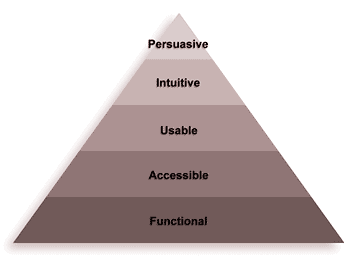
Hierarchy-of-Usability.gifGalbraith’s law of website design states, “Every decision asked of the shopper requires the immediate availability of information to facilitate that decision.” For example, sites asking the shopper to select a trim level on a vehicle without providing a method of comparing the available choices are just daring the shopper to abandon the site.

Then of course there is the overall site design question, “Who decided that every Call To Action needed to go on your home page?”  Consumers arrive with a purpose and it isn’t to watch your TV commercial.   Car shoppers want to see what you have, understand what it will cost them, and determine if you are worthy of being on the short list of dealers they will consider doing business with.  Does your home page shove every departmental thought at them at once, plus value your trade, instant online credit approval, a $500 popup coupon, instant chat, and so on?  Other than car dealers, what online retailers allow this to be their website design?  Do you have any idea what the impact on your total conversion rate is vs. structuring your site around the consumer’s purpose with such “Calls To Action” layered in at the appropriate time in the workflow?

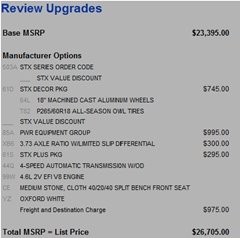
Example #5 Your online automotive merchandising sucks.Online-Window-Sticker.jpg

Most automotive websites do not do enough to demonstrate vehicles online, new or used. As an example, automotive websites do a fair job of listening to the shopper and matching them with the right model of vehicle, but they fail to provide sufficient online merchandising of the vehicle (i.e. the differences among trim levels or specific vehicle upgrade equipment.  Monroney stickers on new vehicles are a legal requirement on the lot.  How many websites have them?  How many of your used vehicles are not of the correct trim level online (VIN decoders can’t always do it by themselves)?  How do your online customers experience the differences is seat fabrics available?  How do they see what the moonroof looks like or what the upgraded wheels look like?  You can do this for a $200 pair of ladies shoes at Nordstroms, so why not for a car that costs 100+ times as much?  Such a lack of serious online merchandising screams “old-school sales practices.”  Think you’ll get the chance to show them how great you are with your follow up processes when they get to your showroom?  Really?  How many online consumers do you lose before you even know who they are?

Anyway, the book - Sales Integration has just been released and should be a good read for anyone in the industry serious about online vehicle sales success.  Buy it, download it, read it, love it, hate it, blog it, tweet it, post your thoughts.

It is an online world.

Automotive Website Awards Expanded By PCG Digital Marketing

Brian Pasch, CEO of PCG Digital Marketing, announced that the company will be expanding the scope of the PCG Automotive Website Awards (AWA). Starting with their 2010 Awards Program in October, PCG will add coveted industry awards in a total of three categories: Search, Design, and Technology.

The new award categories are a result of the industry’s response to the popular Automotive Search Marketing Awards (ASMA) which will continue under the AWA “search” category. The ASMA awards are the standard for recognizing website platforms that excel in organic search.

In the Automotive Website Design category, awards will be given for three classifications of automotive website platforms: dealership websites, manufacturer websites and third party automotive advertising websites.

In the Automotive Website Technology category website platforms will be evaluated on innovative core technology that stands above their peers. In the past year the automotive industry has witnessed numerous technological advancements in car dealer websites. Mobile integration, geo-targeted marketing, chat, CRM, and advances in search advertising all will be considered.

The awards will be presented at an invitation only industry breakfast sponsored by PCG Digital Marketing in Las Vegas on October 12, 2010. The award presentation was selected to coincide with the start of the 9th Digital Dealer Conference and Exposition which attracts automotive website companies to Las Vegas each year.

Members of the press and automotive industry who would like to attend the 2010 PCG Automotive Website Awards presentation should contact Carrie Hemphill at 732.450.8200, ext 2.

About the ASMA Awards
Started in 2008, the ASMA Awards are designed to provide car dealers with an independent view of website platform technology as it relates to organic search marketing. The report assists car dealerships in evaluating new website platforms. The ASMA awards also recognize the best platforms that allow consumers and car dealers to connect on the Internet. The 2010 ASMA study book will be over 150 pages this year and review 45 website providers. The report will be the industry’s reference guide for the best in automotive website technology.

Brian Pasch is a recognized authority in automotive digital marketing and a noted speaker in the field of Automotive SEO. He has compiled a team of experts at PCG Digital Marketing who are qualified leaders in the field of automotive digital marketing, website design and technology.

Submit Website Design Candidates
Members of the Automotive Industry are encouraged to submit their recommendations for the three awards that fall under Automotive Website Design (AWD) this year. Automotive website companies are asked to limit their submissions to four car dealership websites.

Recommendations must be received by September 20th and can be submitted online

About Brian Pasch
Brian Pasch, CEO and Founder of PCG Digital Marketing (http:// www.pcgdigitalmarketing.com) is a popular speaker and writer on automotive digital marketing strategies. He is an active blogger on the most visited social networks and forums for car dealers who seek to learn more about SEO, SEM, social media and leveraging the Internet to grow dealership sales.

Contact PCG Digital Marketing

Carrie Hemphill
Media Contact
PCG Digital Marketing
Carrie.hemphill@pcgdigitalmarketing.com
732-450-8200 ext 2

Google Instant. Are we in Trouble?

The Headline is accurate, but, is that the real story?

--53% Like

--47% Unsure or Don't like

The results are mixed at best AND the poll results exactly mirror the "hot and cold" thread we have here.

If I was the lead project manager on Google Instant and saw these Mashable Poll results I would be looking for other signs of discontent in the stats to confirm/refute the poll.

In this classic DR debate, Google will tell us which debaters were right. There are 2 outcomes. Instant Search remains the default, or, Google sets the default back to "old school" and let Instant Searchers "opt in".

It'll take Google several weeks to pour over the data and make the call. It took Google a few months to tun off the "fade in links".

Google Instant. Are we in Trouble?

Joe you have the perspective of an old school car guy, but it's about Internet stuff not car stuff. Kind of a holy than thou because you have some technical expertise behind how search works. Good for you. Calling everybody stupid because they can't tell the difference between a browser and a search engine is disparaging to the consumer. No error here. Instant is going to be a huge hit and already is. The average surfer see the words pop up and is fascinated by what comes up. Saying that 98% of people are too stupid to have to look at their key board to type is just condescending.

Google Instant. Are we in Trouble?

@Joe Pistell - loved the example of people looking at the keyboard and the video - it's awesome that you know your customer but is there ever a point where you think you could be losing some higher quality customers by this?

I am not saying that your customers aren't high quality, I'm just saying why not specifically seek out the influencers on the web who can tweet about your service, or a blogger that writes a post that gets seen by thousands. Perhaps you do, and you were just generalizing the majority of the population and their computer usage.

Its just surprising to me that more and more dealers aren't building relationships with those who could lead to a lot more sales through word of mouth.

Google Instant. Are we in Trouble?

Alex, great post and I agree it comes down to the content.

SEO is secondary to content, but doesn't necessarily mean it has to come in that order.

Yes it is true you need content in order to perform SEO, but if you don't consider SEO prior to creating the content then you could be missing many opportunities.

I've found the best way to start is with an overall analysis or audit of what you currently have in terms of content. Then you can look at your stats, primarily keywords driving traffic and rankings of those keywords tracked weekly.

If you are ranking highly for 2011 Lexus IS 350 then your reports should be showing many different variations and modifiers of this query.

Ideally, you'd have one page for each major keyword term (word or phrase) and it would be optimized for that query. So you may have 2011 Lexus IS 350 in the title tag but your h1 tag has 2011 Lexus Models - IS 350

After you've done well with the onpage stuff the real work comes from link building, and simply looking at who you're trying to beat and what their onpage and offsite SEO looks like.

If all this sounds like too much work, now you have an idea of why it's important to rank for the terms that actually convert and engage the user because if you rank really well but everyone just bounces don't expect to maintain or improve until your quality and page structure (site nav) improves.

Google Instant. Are we in Trouble?

Gilbert says: "...Joe Pistell’s idea is without merit. I think that is a very narrow and cynical point of view... Most people click in the search bar and wait to see what words come up..."

Gilbert, I'm blushing! I LOVE to look in the face of popular opinion and dare to speak out of place. If you want to call that cynical, ok... I rather like that label. :)

Now it's my turn with your myopia... ahem, sorry, your observations. Gilbert, you've mistaken anecdotal evidence for fact.

You say "... most people click in the search bar and wait for the words to come up..." MOST PEOPLE Gilbert? You've made an error sir. One in 10 people use the search bar. FYI: http://chitika.com/research/2010/firefox-2nd-most...

Gilbert, you mention that people don't get wrapped around the axle about technical stuff, and I TOTALLY AGREE.

Here is a great sample of the audience that I try to serve every day: Login to view embedded media View: http://www.youtube.com/watch?v=o4MwTvtyrUQ


I love that video. It keeps me grounded and helps me every day when I design solutions to sell more cars.

Google Instant. Are we in Trouble?

Great article as usual Alex! I think this also re-blues the theory in having a dynamic web site so that once a consumer lands, they stay!

Joe Pistell's idea is without merit. I think that is a very narrow and cynical point of view. 98% is huge number even as an estimate. Most people click in the search bar and wait to see what words come up. Google is not going to engineer this without data and research behind it. People don't get wrapped around the axle about all the technical aspects behind a search like we do. They type in a few letters and see the other stuff follow and look at what they are searching for.

Keep up the great work and get ready for winter in Vermont!

Google Instant. Are we in Trouble?

Wow, today was my first experience with Google Instant search, and I was amazed. I thought it worked pretty quickly and liked the way it predicted what I was looking for.

True, it may change the way people search, but I don't think it would kill the long tail search. People who use those long tail search terms usually have something specific in mind before they begin a search anyway. They know what they are looking for, and they are searching to find it.

Alex is right on the SEO too. Content is king. Especially if you can find a way to keep your content fresh. With that, like you said, everything else is secondary.

As far as most people looking at their keyboards when they type, I feel that may change. The younger generations, especially Gen Y, have grown up with computers and the internet and began learning to type in the first few years of grade school without looking at the keyboard. As this generation continues to come up and get into the market, they are also the ones who will be the mass online shoppers.

I, for one, am very excited and am looking forward to seeing what impact this will have on search.

Google Instant. Are we in Trouble?

Google named it wrong. It should be called:

IHAYWLIBOACDI

"It's Here And You Will Like It Because Our Architects Can Do It".

The idea has value, but at what cost? What were they thinking?

I'll tell you what they're thinking, it's yet another opportunity to shove Organic SERPs below the fold and raise PPC revs. They use the excitement of a new tool to hide their true intent.

I'm with Ed and I've created a post in the forum yesterday titled "Google Gone Wild". I stuck my flag in the sand to mark the first day I ever thought Google has Gone Wild and lost its way.

http://forum.dealerrefresh.com/f40/google-gone-wi...

Google Instant. Are we in Trouble?

I have to agree with Joe on this one, many folks type in what they are looking for and then look up... Even if this starts narrowing down the search phrases that folks are searching for, imho it makes it easier to search engine optimize to those phrases. Content will always be important, as well as the importance of back-links (which Google sees as others users' recommendations) pointing back to your site...

Google Instant. Are we in Trouble?

I don't like it and I turned it off today, just a mere 24 hours after release. It is annoying and does nothing more than list a bunch of junk I have no interest in seeing before I actually get the results I want. I have a feeling it will go from being a default to something you have to opt in for. Kind of like the Binged up background image feature they released and so many people hated. Seriously doubt it will last.

Filter