• This thread is just the tip of the iceberg.The people ahead of the curve aren't Googling for answers — they're already in here, having the conversations you haven't found yet. DealerRefresh is free.Get the full picture →

3 Steps to be Ready For Google Mobile Search Update

April showers might bring May flowers, but April 2015 will be marked by more than a few sprinkles and a tax deadline...

According to Search Engine Land and Google's latest announcement:

"Starting April 21, we [Google] will be expanding our use of mobile-friendliness as a ranking signal. This change will affect mobile searches in all languages worldwide and will have a significant impact in our search results."

In the following, we distill what this means to you and your dealership and provide a game-plan on how to handle this change. Unless you are a newcomer to this site (in which case, welcome!) you should already know the importance of mobile compatibility. This is not a new phenomenon and I encourage you to poke around our other posts to see additional ways to beef up your mobile approach. Google has even used their invisible hand in the past to nudge website holders down the path of mobile-friendliness by highlighting those sites that are doing a great job of it.

Of course, we here at DealerRefresh know that you know you should already have a Responsive Website...

The game-plan starts here, with three recommendations to assess and optimize your web presence:

  1. Optimization Status: identify and improve it

It all starts with your search engine optimization (SEO) audit. Jump to Google’s mobile friendly test tool to validate your website making sure images, CSS and JS are crawlable. If you currently have a mobile-ready site, do not skip this step! This will help you dig deeper into your user experience.

Additionally, check out the report generated by Google Webmaster Tools mobile usability. This will let you known issues with Flash (like, if you have it - shame on you), content size and touch elements that are improperly placed. Site crawling errors may include:

  • Instead of crawled and indexed areas of your site, are you inadvertently blocking them?
  • How many 404’s do you have?
  • What has the Googlebot returned?

When you identify crawling issue be sure to unblock or block as you see fit. Dodge linking or sending people to dead pages.

How do your most important pages look? To find out use the “fetch as Google feature” in the Webmaster Tools. Think about:

  • Accessibility of content
  • SEO components like title and meta descriptions
  • Are your pages set up correctly?

Tools like Screaming Frog or DeepCrawl will aid in this analysis as well. Through it all, do not forget time is money and site speed is extremely important in site optimization. Tools like “Google’s PageSpeed Insights” and the “Speed Suggestions report in Google Analytics” can make sure your page is first out of the starting gate.

  1. Visibility and Traffic behavior: Assess your mobile web search

Find out your “top queries” and “top pages” in mobile search by utilizing Google Webmaster Tools. In the Search Queries report look under the “Mobile” filter. After generating the report think about:

  • Are your top hits the same on your mobile search as your desktop search?
  • Are different users looking for different things on your site?
  • Where are your high click-through rates (CTR)?
  • Where are you low CTR?
  • What is your traffic telling you?
  • Are certain search queries trending?
  • What direction?

In what has now become your new best friend, Google Analytics, take the time to learn your mobile search visibility and behavior of your online guests. This falls under the mobile organic advanced segment. Think about:

  • Where is your top organic mobile traffic?
  • What are your high bounce rates?
  • Where is your low conversion rate?
  • How do mobile, tablet and desktop numbers compare?

Google Analytics Mobile report, nested under “Audience,” will let you know the mobile devices your visitors prefer.

  1. Competitiveness and Performance: Establish your mobile web search

Tools like SEMrush, Sistrix, SearchMetrics, or SimilarWeb will reveal keywords related to your mobile search competitors. From this, develop more keywords to targets. From this list of keywords your competitors are ranking for; add them to your top keywords found from your mobile search queries. This will give you a master list of keywords, exciting I know!

From here, break it down. Cut this list into categories and cross-reference them with the Google Keyword Planner. This will give you new keyword ideas. See “Mobile Trends” and a “Breakdown by Device” for an idea of volume and trends over time for your mobile searches.

Just like you heard in last Monday’s meeting, you cannot manage what you cannot measure. Now that you have measured your sites mobile abilities, it is time to start tracing and observing your advancement.

Search Engine Land recommends doing this by “Using a ranking tracking tool that supports mobile rank tracking (such as SEMrush position tracking feature or Advanced Web Ranking), keep track of where you and your competitors stand with the valuable keywords you’ve identified — those that are already bringing the highest mobile search visibility along those with the highest potential with a rank tracking tool that supports mobile rankings.” See what pages have those important keywords popping up on them. Now do the same for your competitors. How do the rankings compare? Is there any difference? If so, find out why. You can do this by developing a mobile targeted competition analysis using URL profiler.

Oh, by the way - if you have an app (fixed ops, please!) … Promote your App!

It is now game time people! Get out there, get ready and get optimized! Do not be caught on the sidelines on April, 15 when your competitors have already successfully navigated this process. Follow these easy steps, break it down, and March Madness can stay on the basketball court and out of your website optimization efforts!

Old Horses for New Horses and Killing the BDC

When asked today “what is your biggest challenge?”, the vast majority of Dealers will say...“finding qualified sales associates!

Unfortunately, most Dealers don’t have a clear idea on how to find the right sales candidate for today’s marketplace. Compounding the problem is that they employ an old school compensation plan.

The majority of Dealers are still looking for people who are like their “old horses”  - high volume sales people who’ve been with the store for a number of years and don’t feel comfortable trying to adjust to a new type of customer.

Yesterday’s skill sets created their outstanding success. They were highly persuasive - bordering on confrontational. Dealers rode these “old horses” to outstanding financial success.

But times have changed. There is more to sales now than the still-valuable skills to confidently approach strangers and make yourself immediately welcomed. Those “hearty handshakes” will always be appreciated, as is the ability to look strangers directly in their eyes. But …

..today, virtually every new customer is an “internet customer.” They spend anywhere from 10-15 hours online. That’s right, they make much of their decisions without ever encountering that friendly handshake and persuasive sales pitch.

That means that the era of your sales staff meeting and greeting a “fresh up” is a rarer occurrence.  The vast majority of potential customers visit your website before coming to your store. If it is welcoming and information rich (including posting vehicle prices!) it is likely that they will contact your store via an online form lead, a phone call, OR just SHOW UP.

If you have seen this trend yourself, then you know you need to hire salespeople with skill sets that work in this new environment. You need some “new horses.”

Spoiler Alert: Here’s where I’m going to surprise many of you reading this article.

It’s time to eliminate the BDC Sales department.

BDCs were established for a very good reason. The “old horses” didn’t have the skill sets to handle incoming phone calls - and certainly not internet leads. They were hired to handle “walk-ins”. So it made perfect sense to establish sales BDCs to complement the “old horses” skill sets and become “appointment setters” for them.

But since almost everyone is now an “internet customer”, we need to change our hiring criteria and eliminate the BDC layer of expense. Killing off the BDC or transferring an individual BDC into the new sales arena, is especially important in an era of continuing margin compression where Dealers should be doing everything possible to lower transaction expenses.

The hiring profile for the “new horses” include:

  • Likes to make sales
  • Excellent phone skills
  • Very good grammar/typing skills
  • Loves product knowledge
  • Outstanding organizational skills

The goal of the incoming lead also has changed. The “old school” BDC-driven goal was to “set an appointment,” pretty much at all costs.

The vast majority of prospects who contact your dealership, are calling for information, not to “set an appointment”. Their goal is to gather somewhat granular information that will aid them in their buying decision.

So the new goal in this Digital Sales strategy is to get the potential prospect to “want to meet me”. This is very different than trying to get an appointment. This is about creating trust and confidence by being transparent and knowing a tremendous amount about the product - which can only happen if the salesperson possesses outstanding product knowledge. The more trust and confidence the Digital Salesperson can establish, the more customers will want to set an appointment.

This is a sales model that allows your sales staff to achieve high levels of empowerment. This may “fly in the face” old-school sales manages but it will attract a better educated more diverse sales team.

In this model it is also very IMPORTANT to note that you are now running two different sales groups:  A smaller staff that “meets and greets” showroom floor “walk-ins” and your Digital Sales force that handles in-coming calls and internet leads. So this new group never works the showroom floor hoping to get a customer - but is a dedicated team that works only by appointment.

How do I compensate my new team of Digital Sales agents?

Let’s  assume this is a younger staff comprised mostly of Generation Y. Gen Y is not a cohort that is turned on by a “straight commission” job opportunity. For the most part, when you’re looking for younger people to staff your sales force they will want more financial guarantees and a flexible work schedule. If you don’t want to meet those qualifications you’re going to continue to ride your “old horses” until they retire…then what will you be left with?

Your compensation for Gen Y should revolve around these principles:

  • A training salary, typically at least $2,500 for three months
  • Then a blend of salary and a flat fee per unit sold with volume bonuses
  • Some compensation for F/I related sales including securing the financing and a small “spiff” for menu items; we want to incentivize this group to be completely supportive of the F/I department
  • A flat fee for 5 star reviews from online sites

Are you prepared to hire Generation Y and eliminate your BDC?

Don’t BLOW your First Impression, 5 Tips to Stand Out!

It's a proven FACT, the first impression will make you OR break you. So don't blow it!

In the world of online video, the first impression...IS your first frame image.

If you're an avid DealerRefresh reader, then I don't need to tell you how a personalized video is one, if not the best, way to introduce yourself and your dealership to a potential customer while distinguishing yourself from your competitors.

It's THE opportunity that must be taken advantage of.  Nearly everyone is watching videos on their mobile devices and using videos to make purchasing decisions. But if you don’t pay attention to your first frame image and thumbnail display, you are missing a huge opportunity!

Don’t blow that opportunity by sending them a video with an unappealing first frame image.

first-frame.png

The right first frame image is crucial!

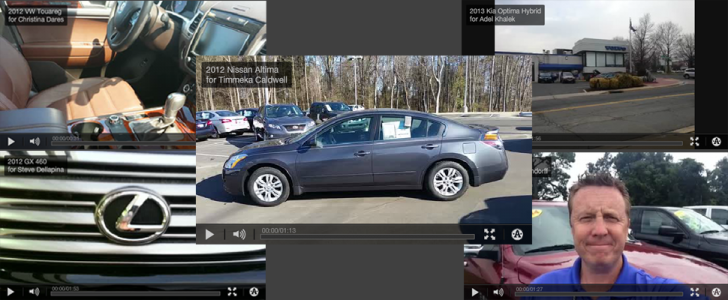
If you're new to sending personalized videos to your prospects, you may not have paid much attention to the first frame. The first frame is the “movie still” that displays in online video player before your prospect clicks the PLAY button to watch the video – or doesn’t.

Not sure how to improve that first frame? Here are 5 tips to to help prevent you from BLOWING your first impression. See them in action...

Smile

The first frame captures a snapshot of your video about two seconds in. To get a good first frame, smile, and keep smiling for a couple seconds before you speak:

Start With the Vehicle’s Logo

Let’s say the customer has his heart set on a 2015 Lexus GX 460. Start your video with a close-up of the classic logo, and stay focused there for about three seconds before you zoom out to show the entire vehicle. You can begin speaking as soon as the video starts.

Start With the Dealership Sign

Because you always want customers to know where to find you (and the vehicles they are interested in), it’s often a good idea to fill the first frame with your dealership sign.

Spotlight the Vehicle Itself

This is your safest bet, make the car the star! Frame the vehicle up nicely in your camera, and film for the first few seconds, before zooming out or in and walking around.

Show the Dashboard

When a customer indicates an interest in a particular vehicle’s features, they will be likely to click on a video that shows that feature in the first frame. Start your video by filming that feature for about three seconds.

These are just a couple of ways to ensure that your video will have a compelling first frame. I think my next post will be a "First Frame Fails" blog since there are so many of them!

Questions:
What are you doing to be sure you have a compelling first frame image?

What else are you doing to make your walk-around personalized videos stand out?

Sound off in the comments!

What Does your Dealerhsip Do With Call Tracking?

Nothing fuels my desire to write like the need to set the record straight. I was recently forwarded Alan Ram’s interview on CBT news. In that interview, Alan shared his thoughts on dealers’ spending money with third party services that reviewed calls and coached calls. Well I am here to tell you my BS meter is going radioactive!

In the interview Alan stated: "managers should be listening to their dealerships calls." Alan, when’s the last time you did this? Do you realize how many calls the typical dealership receives in any given day? It’s a lot, and what manager has the bandwidth to peruse calls all day long! This is a job that can be outsourced for a lot less than what it cost to employ a manager. Why would I want a guy making six figures listening to calls that can be reviewed by a person making minimum wage?

There is plenty of evidence indicating dealerships spending $1K listening to recorded calls can quantify that spend with an additional $10K in profit. Services like CallRevu actually listen to calls within 20 minutes of origination, and are able to alert key dealership personnel when a calls potential was not met. With the average dealership not even answering 34% of their calls, one can see there’s plenty of potential to capitalize on missed opportunities. When people know they are being monitored, they tend to perform at a higher level. This great article written by Mike Haeg from Century Interactive will help you better understand the “Hawthorne Effect.”

Coaching calls is a great way to offer training in areas where improvement is needed. I realized long ago that seminars and video training were ineffective unless followed up with personalized coaching. Salespeople watching training videos and attending seminars will only retain a small fraction of the information presented. Dealers paying a monthly fee to access training videos are wasting their money. The employee watches the video once and then goes right back to their old habits.

Let’s look outside the box and examine the golf industry. Let’s say you’re a 30 handicapper and you have decided it’s time to become a scratch golfer. You purchase several golf instructional videos in hopes of improving your game. The day comes and you decide to take your new knowledge to the golf course in hopes of shooting a career round. Unfortunately things don’t work out and your crappy swing is producing the same three digit scores. A more effective approach would have been to hire a PGA teaching instructor to follow you around the course. Your Instructor would offer a critique after every swing. This type of training is much more effective since it offers the precise training required for that individual based on their actual results. This is exactly the type of service Phone Ninjas offers dealership personnel when coaching individual calls.

So before criticizing dealers for using “magic bullets,” one should do a little more research and better understand how technology can in fact help dealerships gain an advantage over their competitors. I have a very close relationship with CallRevu and I can tell you that our best mutual clients are achieving 80% appointment ratios with first time phone shoppers.

On a brighter note, I do agree with your opinions on BDC’s.

How does the rest of the Dealer Refresh community feel about this? Do you monitor your calls, don't care, or use a third party service?

[highlight color="#F0F0F0" font="black"]The conversation is already happening over on the forums - be sure to check it out![/highlight]

Organizing Your Custom Website Content To Track ROI

It is extremely important you understand that if you can’t track the ROI of your Search Engine Optimization (SEO) and content writing investments, your manager(s) will likely pull the money from the budget for these services.

It is equally important to face the reality that you will likely change or upgrade website technology in the next few years so you must protect your original content investments. The only way to easily track the ROI of your earned media strategies is to organize where the content is published on your website.

I am suggesting that you create a small number of directories on your website that will contain your customized web pages that have been created for marketing campaigns and SEO strategies. If all the content is properly organized, when you change or upgrade website technology, it will be very easy to move the custom pages to the next platform.

You can advise the website provider to transfer over all pages in your sub-directory folders. You will able to inspect the cutover because you can simply count the number of pages in the old sub-directory and compare it to the number of pages in the new sub-directory.

Here are some suggestions for the content directory structure:

/content/sales/              all content pages for sales

/content/service/           all content pages for service

/content/specials/          all pages used for sales & specials

Most every professional Content Management System (CMS) on the market will allow you to create a customized directory structure for your content. Consult with your website provider on a structure that does not conflict with their existing site design.

Organization Helps Track ROI

The second reason for creating content directories is so that you can create Google Analytics goals to trigger when a consumer visits a page in your custom content directories. Wouldn’t it be nice to create a report that shows how many visitors, SRPs, VDPs, and leads were triggered through your SEO and content efforts?

The reason for needing these directory structures may not be obvious right now, but when you think about tracking dozens of custom website pages, randomly created and published on your website, it is nearly impossible to create a goal that traps activity on these pages.

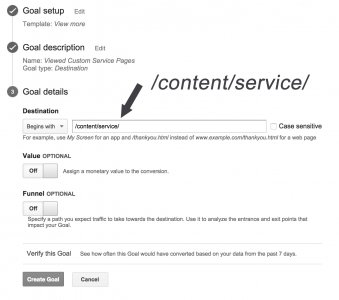
However, if all the service pages were placed in a directory called /content/service, then you could trigger a simple goal that incremented when any page in that directory was viewed by a consumer. Do you see the simplicity in this recommendation?

Here is an example of how you would set a goal to increment any time a consumer viewed a custom service page, in the directory structure I recommended:

goal-for-custom-service-content.jpg

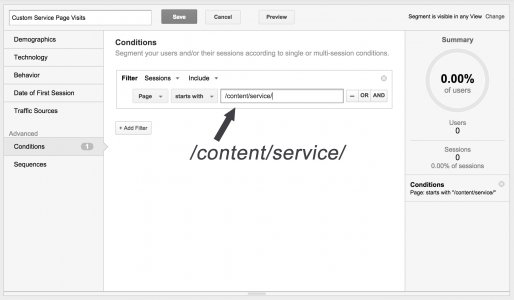
With all your custom content in an organized directory structure, you can also create Google Segments to plot the number of custom content pages viewed each day by consumers. You will be able to document if your custom content investments are generating more incremental traffic over time.

Custom-Segment-Service-Pages.jpg

Using both goals and segments, you will be able to show the quality of traffic that is being generated by your custom content strategies. If you wanted to go one step further, you could add dynamic phone numbers to your pages in this directory to track the phone calls that were generated, in addition to lead forms.

Summary:

If you are investing in custom content you better have a more accurate way of measuring the ROI of that investment and protecting your content when you switch website providers.

I hope you found this article helpful, and if you did, please share this article on your social media channels and with the members of your 20 group. A full discussion on customizing Google Analytics for automotive dealer websites can be found in my book "Mastering Automotive Digital Marketing."

Which One Best Describes Your Dealership's Hiring Process?

Let’s face it: most dealers struggle with hiring qualified employees. And since the car business is a people business, our inability to achieve success with hiring new team members will have a negative long-term effect on the health and value of our dealership.


Why is Hiring Success So Difficult to Achieve?

I define “hiring success” as having the ability to predictably and consistently hire the right people for your store (or stores). Take some small comfort in the fact that, as an industry, we’re all pretty bad at meeting this standard. In fact, our company’s research on hiring effectiveness at retail automotive dealers shows that dealerships hire the right person for the job approximately 50% of the time.
[highlight color="#F0F0F0" font="black"]"the average dealership experiences turnover that approaches 70% a year"[/highlight]

In other words, 50% of the time, the person who’s hired for your open job was not someone who should have been given the opportunity in the first place. It’s no wonder why the average dealership experiences turnover that approaches 70% a year.  With results like that, why even bother having interviews?

Why not just flip a coin and save yourself the trouble?

You’re running a tight operation in every aspect of your business, but you’re probably not treating the recruiting and hiring process with the respect and diligence it deserves. The act of hiring new employees is no different than any other business process: when the process is thought-out, trained, documented, and followed, the results are consistent and are highly likely to produce the outcome you want. "Winging it," on the other hand, will produce wide swings in results, with zero predictability.

Take stock for a moment and ask, Which one describes my hiring process?

For dealers, the issues that typically arise when hiring a new employee are compounded by the fact that recruiting resources (and headcount!) are severely constrained. If you're fortunate enough to have a dedicated human resources person on staff, he or she is probably bogged down in payroll, administration, medical benefits, training...basically, doing everything but developing sound hiring practices.
[highlight color="#F0F0F0" font="black"]"nobody is consistently held accountable for properly executing your hiring process"[/highlight]

If you're going without a dedicated HR resource at your store or stores, then chances are nobody is consistently held accountable for properly executing your hiring process. Which, I can tell you with certainty, is why most dealers struggle to attract and retain quality people.

Without a clearly defined process, followed to the letter with each and every open position - with each and every candidate - the only consistency you'll experience is unpredictable and uncontrollable hiring results. Having a clearly defined hiring process is the most important thing you can do to increase your chances for hiring success.

So what do you mean by "Hiring Process?"

The hiring process is the list of steps that take a manager from understanding and defining the job opening through to the new employee's first day on the job. It's the path that a store follows when management decides that there’s a need for a new employee, and ends when the newly created position is filled.

Ideally, it's simple, straightforward, and, with minimal training, is usable by everyone in your store regardless of experience or background.

This column exists to teach you a proven, straightforward, and effective method for hiring new employees. In doing so, together we will eliminate the guesswork and put you and your team in full control of its recruiting destiny. A big thank you to Jeff and the DealerRefresh team for giving me the space to share my thoughts on this important topic.

What's your current process for hiring the RIGHT people? 

Hiring success is in your future. Until next time!

[highlight color="#CCE6FF" font="black"]Thanks for taking a moment to read my inaugural column for DealerRefresh. Once a month, I’ll be sharing with you some perspective on hiring and selection in the car business – and doing my best to help your team improve this critical area of your operation.[/highlight]

An Argument for Personalization in 2015

Okay, we get it. 2015 is the year of Customer Experience. But what is the first tangible step that a dealership can take toward not just better customer experience, but the sort of award winning, mind blowing, shareworthy, life changing customer experience that will convert your prospects into loyalists?

The answer is so simple it is simply overlooked:

Personalization.

For this discussion, I’ll define personalization like this: Personalization is the art of addressing a group of customers who have seemingly common wants and needs and treating each one as if they were infinitely unique.

Easier said than done.

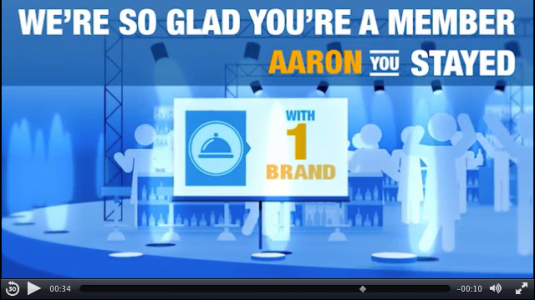
Big brands are trying, though. As one of the 48 million members of Marriott Rewards, I received a video in my email box with the subject line “We Made This Video Just For You,” and it contained my name and specific details about how many nights in 2014 (two, in my case) I stayed at a Marriott property.

Screen-Shot-2015-01-28-at-9.28.46-AM.png

I get it—Marriott has a huge marketing budget and was able to automate the insertion of my details into that video, which doesn’t make it truly personal. Sure. However, what’s more important to note from this example is the expectations being set by content like this. In other words, if Marriott sends me my own video after spending $250 with them, why can’t a dealership send me a personalized response email when I’m preparing to spend $15,000 or more with them? Fair question.

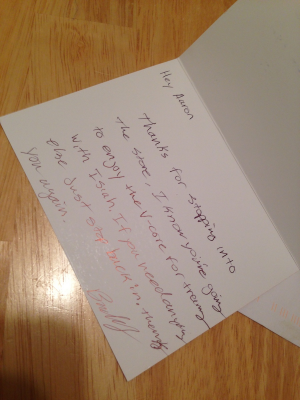
How about this handwritten thank you note I got from Buddy at Complete Nutrition, which mentions specifics from our conversation:

Complete-Nutrition.png

He sent this after I bought a $60 tub of protein powder.

As part of its turnaround efforts, McDonald's is testing a concept called "Create Your Taste," which,according to Fortune Magazine,  allows customers to "personalize their burger, a key part of fixing McDonald's image problem." Are we seeing a trend her?

In a previous DealerRefresh article, I introduced the TCBM (That Could Be Me) Principle, which argues that the age of the spectator is over, and that instead of sitting back and watching a narrative unfold, consumers demand the raw materials to participate in advertising, culture, music, and art. We’re tired of messages geared toward people like us—we want to be spoken to directly and given a platform through which to respond.

On a massive scale, savvy marketers in many industries are leveraging the TCBM Principle to create the illusion of personalization. Perhaps you’ve seen the Taylor Swift Christmas gift video, the Bud Light “Up For Whatever” campaign, or the new Maroon 5 video in which the band drives around crashing weddings.  This “reality” media looks like advertising, advertising looks like reality media, and its effectiveness lies in the unspoken idea that that could be me.  After all, if Taylor loves those fans enough to buy them Christmas presents, maybe she loves me that much, too.

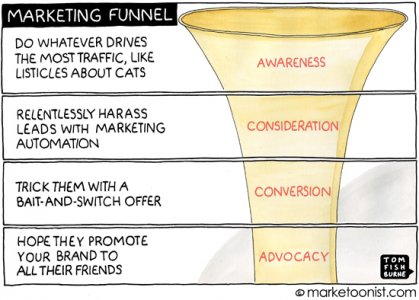
         At the dealership level, we can do better. We don’t have to create an illusion of personalization—we can actually be personal. It starts with understanding how technology fools us into thinking we can connect with more customers than we actually can, which is when our marketing funnel starts to look and feel something like this (graphic courtesy of Tom Fishburne's Marketoonist blog):

150105.funnel.jpg

Like “customer experience,” personalization is nothing new--It just used to be simpler. With so many options for automation, we’re easily irritated by how much time connecting with people takes, so we falsely equate reach with connection.

Auto Dealer Monthly’s 2014 Sales Professional of the Year, Greg Rietz of Lujack Honda, sells 60 units/month on average by keeping track of his customers with notes on index cards, writing as many as 100 letters per day, and making 800 to 1,000 phone calls every month. “When I call, I don’t bring up ‘How is your car doing?’ or ask for referrals,” Rietz says of his phone process. “I don’t grill people; people hate that. I call to say ‘How are you doing?’…Build relationships and the sales will come.” Contrast this approach with the BDC agent who hesitates to ask a personal question because it might lead to an irrelevant conversation that their task load won’t permit.

A relationship isn’t just the R in CRM. Personalization takes time and work, which is probably why your competitors aren’t doing it. Perhaps 2015 should be about reclaiming where we think our time is going and giving our teams the permission to connect, enrich, and delight. Out on the digital edge of the industry, it’s easy to forget how much we can learn from the past, but our futures just might depend on a history lesson—People respond best when they’re addressed like, well, people.

Whaddya know? Everything old is new again.

Login to view embedded media View: https://www.youtube.com/watch?v=afw4Iqf3Wws

How to Track Email Campaigns with Google Analytics

Many people don’t realize that there is a lot more to Google Analytics than just tracking your website activity… it’s also a great way to provide you with insights into your email campaigns.

Advanced Segments are GA’s way of dividing up all your visitors into associated groups. You can acquire details telling when visitors were there; what operating system they use on their computer, and so on… You can find the referring URL (what site they came from) or how many times they have visited. However you can do so much better with your data-mining.

GA includes one Advanced Segment (of many) that sorts by referrers or Traffic Sources. This is much more important because these can include Social Media Sites, Direct Traffic, Search Engines (Paid leads, Non-paid Leads, SEO, etc.), as well as email newsletters and email campaigns.

In this instance, the last two are the important ones to us. If you tag an email for a campaign (or within a newsletter), and clients click on links to your site within them, Google Analytics provides you with lots of data. What you need to do is build the URLs that will allow you to code your links with data GA can interpret. It might be complex, but there are automated tools…

There is a Campaign URL builder here that will take you through the whole process in six fairly easy steps so that you can have information laden URLs, for Google Analytics, that identify your newsletter or email campaign specifically. You input the data required (your website URL, campaign source, medium, term, content and Campaign Name) and it will return the URL you can use on that particular email/newsletter. As a sample I created an URL with this data:

(your website URL), google.com(campaign source), email(campaign medium), Science Fiction(Campaign Term), Writing for Dummies(campaign content), Profit Making(Campaign Name).
It generated this URL:
&utm_medium=email&utm_term=Science%20Fiction&utm_content=Writing
%20for%20Dummies&utm_campaign=Profit%20Making


You include it in a hyperlink like this that doesn’t reveal its complexity (hover over it to see it is the same as the link above). Now the client clicking that URL is traceable when they get to your website. GA “knows” what the source of their visit was; where they spent their time; and what they read, purchased, or downloaded can be tracked to show you the success of that particular campaign or newsletter.

Google makes it easy with handy videos explaining strategies and methods. Have a look at this video to see how marketing goals are important waypoints on your road to success.

Yes, it’s a bit time-consuming, and it takes some effort, but once you get the hang of it, you’ll be generating useful data filled with sales insights in no time.

Will you try this? Do you do this already? What kind of stats are you seeing?

3 Easy Things to Do TODAY to Fill Your Service Bays Tomorrow

Pretend you’re the owner of a 2010 Ford Focus that recently went off warranty. Your check engine light just clicked on – most likely due to a battery issue – and you need to get it fixed ASAP. There’s seven inches of snow forecast for the weekend ahead and you can’t afford to risk an issue in the cold. Put your consumer hat on and think about where you’d turn for help and information given the circumstances.

Now take it one step further.

Pull out your smartphone or open a new tab in your mobile browser and search for “battery replacement,” “brake repair,” “oil change,” or any number of common services consumers look for online in your neighborhood every day.

See what comes up!?

You can bet that Firestone, Pep Boys, Midas and the like will be all over the results but YOUR dealership, if it’s like most, will be nowhere to be found.

Mailers, coupons, email blasts – that’s where most dealerships stop when it comes to marketing their service departments, and it’s a huge problem for our industry.
[highlight color="#F0F0F0" font="black"]"National service chains and independent repair shops are eating our lunch and most of us aren’t doing a damn thing about."[/highlight]

The biggest issue facing dealerships today isn’t inventory turn or overhead costs, it’s the perception of our service departments - the idea that car owners believe non-dealership service options are a better deal than what the average dealership can offer. National service chains and independent repair shops are eating our lunch and most of us aren’t doing a damn thing about.

Run The Numbers

Before we get into what your dealership can do to get its service department online, let’s dig into the numbers.

The first factor in all of this is that the average age of a vehicle in the U.S. is at an all-time high. Consumers are driving cars and trucks that are more than 11 years old, on average, and those vehicles frequently need maintenance.

Unfortunately, as vehicles age, the connection between car owners and dealerships fades. Franchise stores are estimated to lose between 60-78% of service revenue on vehicles that are between 3-6 years old. This jumps to as much as 92% once a car spends seven years on road.

While the service category as a whole is forecast to grow by 15% over the next year, as I travel around the country and ask dealers what they’re seeing, average year-over-year growth is typically a modest 4-5%.

Dealers I meet say, “C’mon Jack, our service absorption is at 90% - business is great!” But it’s not quite as good as it seems.

Most fail to see the avalanche coming, not realizing that national chains and independent shops are gaining two new customers for every one of their own.

Shifting Perceptions

The primary reason consumers opt to have their vehicles serviced outside of the dealership is a lack of transparency about price. As you might guess, shoppers think dealerships are more expensive than national chains and independent shops, and their dollars reflect that.

We know that’s not true, but we’re not doing anything to communicate that to potential customers online.

[highlight color="#F0F0F0" font="black"]"vehicle owners are even willing to pay a premium for dealership service.."[/highlight]

The good news is that by simply showing customers the cost of service at the dealership is similar to other options, that mindset quickly shifts to be more favorable. The same thing happens when dealerships communicate information about technician certification, included warranties and manufacturer parts. In many cases, vehicle owners are even willing to pay a premium for dealership service, they just need to know about the quality they’re paying for.

So why aren’t we doing this?

Establishing a Digital Footprint

When I first started in the business, we had something called a “Dare to Compare” board hanging up in our service waiting area. It told our customers how much an oil change, tire rotation, etc. cost through us compared to the quick lube down the street. If someone was off-warranty or soon would be, it clearly showed them that our prices were just as competitive as others in the area, while the quality of our work was better than anybody in town.

The problem is that the chalkboard hanging up on our wall hasn’t moved in 30 years.

Unlike our sales departments, service never made the jump online, and we’re just now starting to feel the consequences of it.

Most dealerships dedicate less than 5% of the content on their website to service. The same holds true for other online marketing channels, including online reviews.

83-percent-service-e1412621699347-1024x367-1024x367.jpg


So when the 83% of consumers who report using online tools to research service and repair break down, dealerships are nowhere to be found.

Let that sink in.

We’ve got to resolve the disconnect between our digital marketing for sales and service, and upgrading our service departments’ online presence needs to be an immediate priority. Not next week, not next month - today.

3 Quick Things To Do Today

  1. Update information about your dealership’s service department on Cars.com (dealer profile page), Google+ Local, Yelp and other consumer sites used by shoppers in your area. Be transparent about the cost of common services by promoting them online.
  2. Evaluate your website. Check to see if you’re omitting important information about technician certification, OEM parts and service amenities.
  3. Translate CSI scores into online reviews. Two in three new-car shoppers say that service reviews are a factor when purchasing a vehicle, so make a plan to solicit and promote online reviews specially related to your dealership’s service department.

Want to learn more about the changing service landscape? Download our (Cars.com) recent white paper.

Are YOU the Bottleneck?

In the world of business jargon, the term bottleneck is used to describe a point where one area or process reduces capacity of the whole chain or flow of processes.

In the world of drinking, the term bottleneck is the place where the flow of beer is slowed, forcing you to drink slower. In the case of the latter, one can simply pour their beverage into a glass. In the case of the former…well you may need to drink to make it feel better.

From the Bureau of the Obvious Facts, automakers spend bazillions on branding. According to Forbes data  in 2014 GM allocated Chevrolet $5.5B, while Ford followed at $4.4B. Toyota and Honda were at $4.2B and $2.9B, respectively.

This kind of money is spent every year to tell rich and intriguing stories about why consumers should buy these brands, crafted by sophisticated people, in swank offices in Manhattan. The fulfillment of these carefully developed brand promises rest directly on the men and women who are selling vehicles, most of whom are doing so just to make a buck. Inspiring, right?

Take for instance, Cadillac. Here’s a brand that seems to be checking the right boxes:
Awesome design: CHECK!
Authentic brand heritage: CHECK!
Can beat your neighbor’s BMW in a road race: CHECK-CHECK!
Sold at Chevy dealers: ah, #$%&!!!

Don’t get me wrong. There isn’t anything fundamentally wrong with Chevrolet dealers. They’re good at selling Chevys, and most do a bang-up job selling other brands, too. The problem is that BMW, Mercedes, and Lexus buyers (who comprise HALF of the luxury market, and keep pushing downmarket) aren’t so keen on commingling with the natives.

Who (besides GM) can blame the Chevy dealers for catering to Chevy buyers? After all, they sold 2 Cadillacs for every 25 Chevrolets last year.

For the past several years, we’ve often advocated to our dealer clients that they should be putting their personnel ahead of the dealership and OEM brand. I’m going to stick to those guns.

Ipsos conducted a comprehensive study (over 10k people, 99 different psychographics) in which they asked responders what is “extremely/very important considering different auto dealerships that you might visit?

The results were rather startling.

Low-pressure and knowledgeable salespeople trumped the top of the list, while no-haggle policies, previous experience with store, and free loaners rounded out the bottom. That new coffee bar in the customer lounge only matters to one person: the person who put it there.

A few weeks ago I was asked to share my thoughts regarding the changes that will take place in 2015. One of my predictions is that ‘OEMs will also push flatter dealership hierarchy, with more product experts and fewer actual sales personnel.’ Actually, this is already happening to a certain degree. BMW and GM have already tested the “Genius Bar” strategy (with varying degrees of success) as a means to bring the interests of the manufacturer and the consumer in line. Not to rabble-rouse, but I believe these to be merely jabs in a fight to knock-out commissioned dealer personnel.

Let me state, I loved being a commissioned salesperson. Nothing quite beats the rush of selling a (rare) car for more than sticker, or upfitting a truck for snowplow duty. The problem is that it didn’t benefit the manufacturer when I did that. Nor did it benefit the manufacturer when I brokered deals with other dealers so that I could sell other brands of vehicles. The customer and I won, but the manufacturer still lost. That created a bottleneck for the OEM because of my own personal motivations.

Consumer sentiment has changed tremendously in just the few short years I’ve been out of retail. Brand loyalty seems to be questionable at best, with an automotive market more fractured than ever (the standard deviation in market share between all manufacturers, from GM to Rolls Royce, is only 5.6%).

Countless surveys have indicated that customers' tolerance for poor customer service is plummeting. Just look at the omnipresent online reviews. With today’s concierge culture, it’s a real possibility that the activities (or lack there of) from one individual at the dealership cannot only eliminate that dealership from consideration, but alienate the entire brand from contention. Nobody wants that.

As a corollary, it’s high-time that multi-brand, multi-rooftop groups work in concert with one another. If you’ve sold a car, you’ve heard a million car-buying horror stories from everybody and their brother. One that I’m hearing with increasing frequency is that, despite the same name on the building, Dealership A has zero interest in helping Dealer B sell a different brand of vehicle.

As we grade lead follow-up with our TaskTeacher tool, it’s with hilarious regularity that we see customers cross-shopping different brands within the same dealer group. Better yet, we see customers shopping same brand stores across dealer groups. This is a massive bottleneck for the dealer group’s brand. Not only does this damage brand equity, but it causes grief among employees, and alienates customers from future business. It also costs the dealership group money that doesn't need purging. Please wake up!

As the crossfitters post on Facebook with near religious fanaticism, it’s time for dealers to embrace the suck. OEM's will begin to apply every ounce of leverage they have to bring customer experience to a level that is congruent with favorable focus group results (and the said squajillions in advertising dollars).

The dealers who will excel in this brave new world are the ones who will invest heavily in hiring and RETAINING the best talent available (sorry vendors). The most valuable talent will have encyclopedic knowledge about their products, and will act as a conduit between the brand ideals and customer expectations. They will probably bear little resemblance to today’s sales, service, and call center staff. Retention will be the only goal that matters. The brand bottleneck will disappear, and with it a massive influx of cashflow. The earliest dealer adopters will be the most wildly successful in this new retail environment.

It’s not too late to make a New Years resolution. If you haven’t already, it’s time to master the brand your dealership sells. If you sell multiple brands, it’s time to become a chameleon, being able to blend-in with any OEM brand image.

If you run a multi-rooftop operation, it’s time to consolidate behind your brand while effectively representing your OEMs. Your customers are not getting any dumber, the lines that separate vehicles aren’t getting clearer, and access to information isn’t getting harder. Stop being the bottleneck, and pour yourself a frosty glass of success.

Questions:

What kind of training is happening at your dealership to help your sales staff master the brand(s) your dealership sells?

How is your dealership RETAINING its best talent?

How do you feel about being more of a Product Expert rather a Commissioned Sales Representative?

4 Predictions That Will Affect Car Dealer Performance in 2015

photo.jpg

It's time to get the band back together for another round of predicting the future of automotive marketing, technology and consumer behavior for 2015. This is one of my favorite annual posts as it provides the opportunity to share my vision for all of the things I love about our business.

As I gathered my thoughts for this post, I kept coming back to two themes for dealership performance this year: Growth and Simplicity - as in a maturation of our activities and efforts. We have all experienced a flurry of new products and services over the past couple of years. I get a sense that we have reached a point of information obesity and are ready to finally to trim the excess. This year will be more about understanding the customer and how dealers can make better connections based on the unique experiences they provide, versus simply plugging another new tool into a fragmented array of dealership services.

Let's get started...

Mobile Consumer Behavior & Traffic Activity Will Shift: Geo-Targeted content, Hyper-local offers, NFC & Beacons.


Mobile traffic finally eclipsed desktop traffic toward the end of 2014 and won't slow down. The most significant change will come from phablet traffic - devices with screens larger than 5 inches. Traffic to dealership websites from phablets could exceed 25% in 2015.

This means dealers should review their existing mobile site user experience. Google has already indicated mobile health as part of their ranking criteria. If your site isn't responsive, this should be a wake up call for the items that you're displaying on your mobile site. This is an opportunity to provide more rich content such as vehicle reviews, specials, comparison content and especially more videos.

Mobile phones will also provide greater contextual awareness. While mobile search will continue to explode, a newer segment of targeted mobile ads and content delivery will emerge. Geo-targeted and hyper-local mobile targeting (within 1 mile) will provide more consumers than ever before with relevant offers based on their location and prior behaviors. Watch the major retailers as they set the bar for this, it'll quickly flow into other market segments and I believe dealership showrooms are ripe for this experience. Low-frequency bluetooth beacons within the dealership and/or the lot can provide even more relevant information within 60 feet. (A solid showrooming defense play) I see geo-targeting solution providers like AutomotionTV helping push this activity to a new level as well.

Watch out for in increased amount of consumers using their Google Wallet and Apple Pay. NFC is finally a real thing and people are actually using it. There are currently 220,000 merchants with NFC enabled. However, there are 9 million total merchants in the US currently. The adoption rate for retailer NFC usage will finally change significantly in 2015 as merchants are required to accept EMV credit cards, thus creating a spike in NFC enabled equipment, creating greater usage. EMV's are smart credit cards which prevent fraud by authenticating the sale using integrated circuits. Retailers who can't support these cards by October 2015 will be liable for any usage of lost and/or stolen credit cards.

Another huge opportunity for all retailers, including car dealers, is the ability to leverage digital loyalty programs. Users store their loyalty membership info within their digital wallets, allowing retailers to push relevant offers to them. These alternative delivery methods open the door for improved customer communication, greater customer loyalty and more business.

Wearables Will Create A New Layer of Mobile Activity and Data


The US wearable market is poised to grow approximately 40% over the next five years. This includes several types of wearables: smart glasses, cameras, smart watches, healthcare, sports and activity trackers, and 3D motion trackers. The primary device categories to lead the push will be healthcare wearables, smart glasses, and smart watches. This is the one segment where we'll see the greatest acceptance and understanding as we begin to get more comfortable with their appearance and most important, the personal benefits they provide us. Glasses won't become a consumer product, rather a behind the scenes, enterprise experience.

Dozens of brands of smart watches already adorn close to 20 million US user's wrists. The US makes up about 35%+ of the global smart watch market. The real change in usage and mass acceptance will happen early this year with the introduction of the Apple Watch. I'm predicting more than 15 million units will be sold in 2015. (George Nenni bet me less than 10 million. Looking forward to that steak dinner George.) Keep in mind, Android versions such as the Moto 360 will also contribute to this increase - as well as fueling the OS wars even more.

More smart watch users will create different local search discovery opportunities as well. One of the key functions of the smart watch is messaging - glanceable marketing. New permission-based marketing efforts and opt-in notifications (think CRM) will allow retailers to provide additional targeted messages. Remember, this entire segment is about time - or the ability to create the perception of time for the user. Getting more of the info we want and staying connected to the things most important to us are a priority. Customers getting smart watch alerts about pricing, service info and coupons is a real possibility in 2015.

Users will also be able to wave their smart watch over a sensor to receive coupons and discounts. More proximity based notifications will be available to these users. Also, local voice search will continue to grow as a viable alternative. Apple's default search engine for Siri is Bing, so optimizing your business listing within Bing local search is definitely a smart idea.

I also believe there will eventually be a tremendous data surge from this wearable usage behavior. Just as we we rely on Google Analytics for website tracking, data from these wearables will help us understand more about consumer behavior, their location activity and the type of content that is truly helping create more time for users. Look for the Apple Watch announcement to come in March at the Mobile World Congress - they're rumored to be present this year after being absent for the last couple of shows.

Real Time Scoring and Training Will Reach New Heights


Why wait until the month end or even the end of the quarter to figure out that your training services aren't working - or worse, your staff's performance isn't constantly improving?

Again, this is another simple function of consumer behaviors changing so rapidly. More email is being opened on mobile devices than via the desktop. It's getting increasingly harder to reach consumers on landlines as they continue to rely on their mobile phones. Messaging apps and texting have become a simple replacement and even used to gain the permission to contact someone. (How many times have you sent "Got a sec for a quick call?" prior to calling someone? - I counted four times today so far.)

Two of the best known real time training and predictive scoring platforms within the retail automotive industry are Phone Ninjas (phone training) and Task Teacher (email scoring).

Combine the speed at which consumers digest information and attempt to make decisions with heightened expectations of quality, the need to provide a world class experience is more important than ever before.

I see this as a major movement for 2015 as dealers begin to realize this change in training and lead scoring behavior is much more efficient and effective in creating a culture of constant improvement.

Content Marketing, Local Optimization and Semantics Will Replace Conventional SEO Thinking


I predict 2015 will finally be the year the majority of car dealers begin to realize that search engine optimization is now an integral element of their marketing efforts rather than being an optional activity that can't be quantified.

We're well into the age of contextual relevancy and consumers expect to find the best answers when searching for questions, from any device. Dealers will begin to understand how important it is to provide specific content, within their websites, that applies to the intent of the users. Just because your VDP's appear for a search query asking for a year/make/model comparison is not good enough. The user's intent was to compare A to B. If the search results don't provide this level of relevance, nobody will ever click your link, regardless of where you rank.

The opportunity for expert, authoritative and trustworthy content is never ending. New vehicle review pages, vehicle comparison pages, blog posts featuring content from satisfied customers and vehicles videos are vital when helping connect with consumers at various points of the shopping process. Plus, the introduction of connected cars from likes of Mercedes, Audi and Tesla will create such a demand for new content exploration.

Local search awareness will continue to creep into the marketing mix as more dealers grasp the importance of accurate and consistent business listings within local directories as significant ranking factor now. 77% of smart phone users contact a business after looking for local information. Search engines will continue to shift their preference for quality, relevant local search results based on quality signals which reflect the consumer experience and social signals rather than a marketer's ability to game the rankings based on tactics alone. Local search creates an action by the consumer within 30 minutes.

I also expect to hear website providers become more vocal about their use of structured data and Semantic markup within their platforms. These activities will help provide the necessary signals for search engines with regards to topic modeling, hyper-specific queries and deep social/local content. I've been a huge proponent of the Semantic movement and this race is about to get extremely intense as the opportunity to create more linked data grows. Expect to hear more about these elements from the likes of Dealer Inspire, DealerFire and Drive Digital. If any other vendors would like to share what they're doing in this space, you know where to find me. The dealer community needs to be aware of this movement.

The simple theme to succeed in today's marketing environment is to adopt a media company mentality for your dealership: Optimize, publish & distribute will become the blueprint for success for those dealers changing the way they market their brand, their people and their inventory in 2015.

Ideas and Predictions from the Community


I asked the dealer community to share some of their thoughts for changes to expect in 2015 and you didn't disappoint with your contributions.

  • Joey Little Dealerships will start embracing social networking as an additional pipeline for sales and train employees internally on the platforms.
  • Subi Fernando Ghosh Technology, product experts, and individual branding become more common in the average dealership.
  • Aaron Schinke Websites will begin to be recognized as platforms where activities take place and where content is hosted. More as a living breathing organism and less as a static set product or end solution.
  • Bill Playford OEMs will fuel further dealer consolidation in order to streamline customer experience. OEMs will also push flatter dealership hierarchy, with more product experts and fewer actual sales personnel. Luxury OEMs will test remote delivery/maintenance to combat the “Tesla experience.” The vendor world will be shaken by outside venture backed companies. The VCs who have been observing from the sidelines can no longer resist the lofty payoffs, and will seek to radically disrupt the retail vendor ecosystem. The fresh talent, better management, and “freemium” Silicon Valley mindset will greatly benefit dealerships. ISMs will rejoice. Providing AutoNation has a strong showing through the first 3 quarters of 2015, the majority of the mega-dealers will roll out a click-to-buy program, closely followed by the regional multi-rooftops. These programs have been in beta for a while, and shareholders will finally force the issue.
  • Jerry Thibeau More and more dealerships will adopt one price strategies.
  • Christine Robertson Negotiation-Free selling is coming.
  • Adam Ross Further consolidation in the vendor industry to the big guys for an end-to-end solution: Cox, Dominion, DealerTrack, CDK Global, Reynolds.

  • Shaun Raines 1. Some OEM's will finally realize that providing/forcing only one vendor choice does not equal success at the dealer level. This will open up more options for dealers to choose providers that better fit their needs. 2. Distinctive, genuine branding will be the biggest revenue generator for dealers and vendors that figure it out. 3. Like or not, Tesla is doing almost everything right.
  • Will McGinnis Car Sales in general (Used and New) in 2014 roared back to pre-2007 days. In 2015, we will continue to have a lot of supply in both New and Used cars. However, when supply is more than demand, perfection in getting to that customer is key. Used Car merchandising is in place and has been. Finally, in 2015, I believe that our dealer body will embrace the basics of merchandising (photos, price, etc.) to maximize their performance in the New Car realm. It’s absolutely necessary for their success.
  • Kristy Mooney Graves Service departments will be much more crucial to customer loyalty as more OEMs adopt 'free maintenance' programs. & more sales departments will establish tech help desks - Apple Genius style
  • Rick Chavoustie New interactive ways will come to market to assist consumers along the research to purchase path. This will result higher conversions as prospects are walked into the showroom as this will lead them with a consistent expertise beyond today's inconsistent hit or miss online to in store sales experience. The Dealership brand is only as strong as it's ability to execute a consistent - outstanding - customer experience. This evolution leads to a widening gap in regionally market brand leaders who feed on local / rural dinosaurs who wonder where's the biz? Unfortunately they will be like deer crossing as the bright lights of 2016 hit them between the eyes.
  • Brian Pasch Shift Digital will become the largest middleman in the automotive industry; a toll booth that EVERYONE pays for. They will become the "Dealers United" model for all OEM vendor solutions, compressing margins, lowering profits, lowering service levels, and forcing small players out of the market.
  • George Nenni 1) Technology innovation and consumer platform adoption continues to outpace dealers' ability to adopt, thus outsourcing continues to grow in importance. 2) Expert systems applications increase, helping dealers make more and better metric-based decisions in various profit centers. 3) Apple Watch flops, streamline band-watch designs win over traditional watch-face designs, consuming less battery and allowing less-encumbered sleep tracking. (Looking forward to this one George:)
  • Lee Drake By the end of 2015 the number of businesses hosting their email in the cloud will outnumber the number of businesses hosting their own email or using small providers.
  • Anthony Alagona One price strategies are inevitable.
  • James A. Ziegler One Price strategies will come and fail and revert back. There will be a war with vendors making a move on dealer profit centers other than price.. EX: finance, service, parts, service contracts
  • Jaime Poulin Lots here about one price strategies. I too believe that the perception of one price will continue to become more important. But as long as there are more than one person that prices vehicles, one person that appraises, more than one manufacturer producing models, and more than one source providing financing, that there will be competition, and that competition will drive negotiation - negotiation will drive a lot of those so called one price dealers to flatten already thin margins. This will force them to gross on the customers that will let them, and one price as an industry never gets more than marginal play.
  • Tom White Jr. I don't think very many people are going to like what I think is about to happen... I'll say this - Tesla is proving that consumers DON'T like Car Dealers and want a better way to buy the second biggest purchase (from total dollar perspective) they will make in their lifetimes. I'm a car dealer...My days are numbered unless and until I can figure out how this business is going to transact 5, 10, 15 years from now... 2015 isn't going to be THE YEAR that it all happens, but I believe it will be a year to either get your ship in order OR board the life boats.
  • Brad Hensley I'm just a small fish in the pond but I think the noose is tightening on independent dealers quickly. Transparent pricing has to be implemented.
  • Hunter Swift I believe dealers will began to focus more on driving traffic from their existing database in CRM than paying for 3rd party leads. Leads that often cost $20-$50 with no exclusivity and little info that often results in a low gross and low CSI deals. When dealers generate new opportunities from the CRM, you will not only have more info and hold more gross but will help salespeople to use the CRM more since that is where new opportunities will be found.
  • Joe Chura It's not a matter of if, but when, the buying model will shift. I'm in complete agreement that the customer will choose the path of least resistance. Transparency during the transaction will be more demanded. With technologies like Docusign and Right Signature dealers can get a lot closer with less effort than they think. With little innovation they can offer a richer online buying experience. Choose a vehicle, leave an online deposit, fill out an online form using Right Sig, and 80% of the transaction is completed. (I believe even with Tesla the customer still needs to pick up the car and sign something in person.) 2015 will be the year.

Thank you all for sharing your ideas!

Here's to everyone having a lot of fun and to a very successful 2015, as we all continue to do what we love.

For more of Eric's yearly predictions check out his previous posts:
2018 Automotive Marketing Predictions – DealerRefresh

5 Automotive Marketing Predictions For 2017 – DealerRefresh

4 Predictions in 2016 for Car Dealerships – DealerRefresh

4 Predictions That Will Affect Car Dealer Performance in 2015 – DealerRefresh

6 Predictions That Will Impact Automotive Retailing in 2014 – DealerRefresh

Your Dealership's Digital Marketing Strategy Sucks!

Well... Maybe "Sucks" isn't exactly the right word but, I promise that you are going about your digital marketing in the wrong order of operations. And, yes, there is a correct, comprehensive and strategic Order of Operations when it comes to all dealership website marketing approaches.

Hey, do you know something else that "Sucks"? Car Superchargers!

Building high-performance muscle cars and building a high-performance dealership website is very similar especially when the goal is getting the absolute best output from every dollar spent from your budget. I assume that everyone who reads DealerRefresh is familiar with what SEM is and what it basically does. And, seeing how this is an automotive-audience I will make the same assumption that everyone here knows what a Supercharger is and what it does.

Search Engine Marketing is the Same to a Dealership's Website as a Supercharger is to a Vehicle's Engine.

1.) Both are tasked to force-induce more "volume" into their perspective power plant.
2.) As they REV up whether it's RPMs or dollars spent they increase exponentially.
3.) They both work better when the power plant is built to handle them.

Where superchargers and SEM are completely different is the stage at which they are implemented to increase volume.

Nearly every dealer that wants more leads starts SEM as their first (and sometimes only) modification to their website marketing  and very, very few engine builders select a Supercharger as their first power plant modification and for really good reasons.

Sure, you can add a Supercharger to a stock car engine and sure, it will build more power, go faster, accelerate harder, but it will accomplish all of these goals in the most inefficient way possible. Street Racers are constantly asking themselves in the quest for more power things like: How is my chassis going to respond to the power increase? What about my tires will they hook? Is the drive shaft going to snap? Am I going to throw a rod through the block? Nitrous? These are just some of the many questions hot rodders want to address prior to supercharging the car.

What is Engine Blueprinting? And Why Are We Talking About It on a Dealership Marketing and Sales Strategy blog? 

When it comes to building a really bad ass muscle car built for speed one of the first things the engine builder does is blue print the engine. Basically, blue printing an engine means optimizing all of the existing components to produce more power and reliability. In the blue printing phase exhaust systems, intake systems, and even the cylinder heads and cam shaft(s) are changed so the engine can produce more horsepower immediately and substantially more when things like nitrous oxide or superchargers are added and do so safely. What is the point of spending more money for traffic if you can't turn the traffic into profits?

Let's apply this to the dealership website and assess where website blueprinting possibilities exist.

Conversion Rate Optimization "CRO" or Dealership Website Blue Printing

Before forcing more traffic to your dealership website you should find your current conversion rate benchmark. A combination of your CRM, Google Analytics, and DMS should help you calculate how much of your existing website visitors, leads, and phone calls are turning into sales or at least sales opportunities. These figures should be considered your starting point or "bench mark". Next, go through your inventory to ensure you are merchandising all of your vehicles effectively. This means good photos, great descriptions, competitive prices, strong Why Buy messages or value propositions you may even what to showcase your Dealership's Online Reviews.

You should consider (or in many cases reconsider) your calls to action. There are many, many articles written about this topic especially with regard to what works and what doesn't. My advice is that no one CTA is going to work the best 100% of the time especially when used cross brand, do your homework, experiment. And, if you want to go really crazy look for articles and blogs written about "Persuasive UX".

You should also consider making adjustments to plug-ins on your website like chat, trade-appraisal tools, finance and lease payment tools. Tip: Often times I have found that if you ask the companies you're working with to make adjustments to how their product works (especially with chat) based on traffic source, page the visitor is on, and when to engage they will and should do this.

Make sure all of your incentives, specials, and promotions are current, attractive, and competitive. Make sure any national promotion materials are present on your site and easy to find.Once you are satisfied that you have reworked your website to convert more digital traffic into showroom traffic it's time to take the next step and we're still no where near adding our Supercharger SEM.

Benchmarking Your BDC/Internet Staff and Preparing For Increased Traffic

When a hot rodder wants to go faster they rarely stop at just modifying the engine or even adding a supercharger. They practice, they bench mark, they bracket race. They learn where they currently sit in terms of quarter mile, 0-60 mph, etc and they practice to improve things that will make them faster like their reaction time, time pressure, launch RPM, etc and practice to get better. Perhaps a very similar approach could yield improved results if applied to your BDC department and the sales floor.

There really isn't a good reason to send more digital customers to a department that is already overwhelmed or inefficient with existing opportunities. The better prepared your departments are to handle an influx of customer opportunities the better they will handle them, satisfy them, and most importantly, sell them. Tip: Hiring a sales trainer or phone trainer or both is something that should be considered.

Time To Start Growing Traffic But No Forced Induction Yet

Once you have blueprinted your website's stock internals, prepared your BDC/Internet and showroom staff to better handle all customer opportunities, a great next step would be to work on SEO marketing strategies to widen your audience exposure. Making sure every page has a unique title, meta description, and content is a good way to start. You can build out some vehicle specific landing pages, start writing blogs on upcoming model releases, and also dedicate pages to region and national OEM sales events.

I recognize this is a time consuming practice that lacks the instantaneous gratification that can be realized with SEM, but there are several key reasons why this is better choice at this phase of your dealer website build. Good SEO content provides continuous traffic that is cost efficient and absolutely more effective in terms of lead submission both phone and email than PPC based traffic. Building pages designed to be rank high and be useful is a natural first step toward better understanding the desires of your online customers what vehicles or services they are most interested in and then custom design catered content that will answer their questions and intrigue them. Know what your organic customers want will help you fill in gaps and create a blue printed SEM budget when you're ready.

Now That We're Firing on All Cylinders Let's See What SEM Can Do!

5 Reasons Video Is the #1 Vehicle Selling Tool

TV commercials. Billboards. Newspaper advertisements. Direct mailings. Door hangers.

 
A new study by Demand Metric shows why video is better than most all other forms of marketing and advertising. The study weighed more towards the B2B audience, but the takeaways are just the same.

The Video Content Marketing Metrics Benchmark Study asked 295 businesses that were using video about the ROI they are getting from their strategy. More than 70% responded that, in terms of conversion rates, online video gets better results than traditional approaches to customer acquisition. About 8 in 10 video marketers said their programs were somewhat (60%) to very (17%) successful.

Here are 5 reasons why videos is so effective…

1. Personalization

Walkaround videos are a 1:1 communication. Video allows you to personalize that 1:1 communication, while offering a complete personal experience. Something that rarely happens anymore.

You’re not treating the customer like they’re a number in line at the DMV. You are taking the opportunity and addressing your prospect by their actual name while showcasing exactly what they are interested in - on video.

2. Targeting

With video, you can SHOW clients the information and data they are looking for; while doing so quickly. 

Sending a prospect a personalized video of like vehicles in your inventory is extremely effective for short term and long term targeted follow-up.

When most sales representatives are struggling over which email template to send next (if any at all),  sending your prospect a personalized video sets you apart from the competition and significantly increases your response rate and sales opportunities.

3. Interactivity

A well put together video can be a real conversation starter. With the increased engagement rate you get from video, transitioning the customer to the phone and appointment becomes more effortless.

Nothing short of an actual face to face visit, video is the ultimate digital ice breaker and the start of a great conversation and relationship.

4. Real Time Reporting

Most video services provide real time reporting. The most important stats are obvious - who has opened and watched your videos.

Did they watch the video all the way through or bail out early?

Real time reporting can not only gives you the ability to make decisions on how and when to follow-up, but can also be used to improve your process and videos in the future.

5. Wow Factor

Junk mail is junk mail. A door hanger is a nuisance. Nobody reads print ads anymore, and TV is prohibitively expensive for undetermined results. By contrast, video is a genuinely interesting and useful experience for clients – for a tiny fraction of the cost.

Let’s face it. We have all become quite numb to the “usual”. You really need to WOW people anymore in order the grab and keep their attention. What’s better than video to get the job done? Nothing.

Get the most out of your marketing budget by using video to create a distinct, lasting impression with prospects and customers. Once you get past the camera shy phase, you quickly realize how much easier and effective video is.

Have another reason to add to this list? Sound off in the comments.

How has utilizing video helped you achieve success at the dealership?

8 Essential Attributes Dealer Marketing Pros Need

Whether you call him/her a Digital Marketing Manager, Web Presence Manager, or something else, you need someone at your dealership to manage the marketing efforts of your partners, vendors, and agencies. 

Dealers, if you're not actively managing the efforts of your vendors with some level of in-house oversight, you're probably being taken for a seriously expensive and round-about ride.

Further more, if you are incapable of appraising the effectiveness or ineffectiveness of your marketing due to a lack of on-site digital marketing guru it is very likely that other, more progressive, dealers are getting the upper hand and are eating your lunch.

I know this because I have been on the losing team and, more recently, a winning one.

Professionals from dealerships around the country often reach out to me for recommendations on who they should work with whether it be a vendor, agency, or even a service provider. They ask questions like, "Should we hire them or avoid them like the plague? What do you think about the work XXXXX is doing? What was your experience working with XXXXX?"

Although the questions dealerships ask varies, my response to them always the same: who at the dealership is going to be responsible for managing that agency or vendor? Who do you have on staff that can hold their feet to the fire?

At the end of the day it doesn't really matter what outside company you employ to aid you with your marketing. The difference maker is always going to be the person on your staff  that you appoint to manage your vendors, agencies, and service providers effectiveness and value-add.

So before you reach out to someone like me or sign a contract the first question you need to ask yourself is: Who can I have Manage our outsider marketing efforts and what skills do they need to have to ensure we get the best results and ROI?

Here are 8 Essential Attributes Your Dealership's Marketing Professional Needs:


1. Advanced Understanding of Google Analytics

If they do not know how to use Google Analytics they do not know how to properly evaluate your website vendor(s), the results of SEO work, SEM campaigns, email marketing, and any other website traffic related you are currently paying for. They should know how to build reports, be able to set up conversion goals, install CRM Lead values, and know how to evaluate areas of website improvement directly from the analytics.

It is IMPOSSIBLE to hold outside digital vendors and marketing agencies accountable without an in-depth knowledge of Google Analytics possessed by a member of the dealership's staff. You know you've selected the right person when you observe them spending about 35% of their work week in GA.

2. Advanced CRM Data-Mining, Opportunity Management, and Email Marketing Skills

In my professional opinion your dealership marketing professional should be spending no fewer than 25% of their time studying the CRM.

The ability to find good prospects, building compelling email copy, and sending out a business-driven email broadcast is one of the most valuable skills an automotive marketing professional can have. Knowing how to develop a good workflow and recognizing your best internet lead sources is essential in building an effective game plan that attracts customers to your dealership with the absolute goal of selling more cars.

[highlight color="#F0F0F0" font="black"]"The ability to find good prospects, building compelling email copy, and sending out a business-driven email broadcast is one of the most valuable skills an automotive marketing professional can have."[/highlight]

Without a total understanding of the CRM, specifically in regards to identifying internet lead sources, their closing ratios, and lead quality, you have no way of understanding the true ROI of your internet marketing partners.

3. Attention to Detail and Drive to Ensure The Full Resolution of Problems

The dealership's marketing pro needs to have an intense commitment to trouble shooting problems, reporting and tracking them, and most importantly seeing their resolution through to completion.

They should be expected to identify issues whether it be with the store's Google Business Page, CRM, Website(s), or other - and they need to be expected and trusted to find solutions and work with all parties involved to resolve issues. If you have any doubts that your dealership's marketing pro is irresponsible, then without question you have found the wrong person for the job.

4. Ability Develop and Manage Vendor and Service Provider Relationships

The Digital Marketing professional at your dealership needs to know how to manage and maintain the relationship between the dealership and those you've hired to market the dealership. They need to know how to report vendor marketing failure to the vendor, build documentation, and push vendors to improve products and strategies to better accommodate the goals of the dealership.

[highlight color="#F0F0F0" font="black"]"They need to know how to report vendor marketing failure to the vendor, build documentation, and push vendors to improve products".[/highlight]

This person should always be up-to-date on current digital marketing trends (not just the one's being adopted by dealers) and should know how to sniff out bullshit products and vendors.

The dealership's marketing pro should be expected to spend approximately two hours each day reviewing strategies and reports with their vendors and service providers.

5. Experience Building Webpages using intermediate-level HTML and CSS

I'm not suggesting that your Marketing Manager needs to be able to build a website from scratch but they should be able to build a basic website page that is attractive, compelling and constructed using text, tables, hyperlinks, and images.

Anyone relying 100% on a WYSIWYG editor or copies and pastes directly from Microsoft Word does not actually know how to build a page. If they can't build a solid webpage they should not be responsible for overseeing your digital marketing.

6. Automotive SEM/PPC Management

Everyone knows that PPC and SEM is one of the most immediate ways to grow your internet traffic, but just because you can get more traffic doesn't mean you're making more sales.

Your on-site marketing pro should have experience building and managing SEM campaigns. If they've never built an actual campaign they will not know: how to evaluate what reasonable cost-per-click is, how much budget to allocate per campaign, which campaigns are successful and cost-effective, and which are just wasting money.

They should also be familiar with what a good Click Through Rate (CTR) is. They should also know how to identify and evaluate Adwords/Bing campaigns in their website analytics and what your users are doing once they're on the website from an SEM ad. They should know which negative keywords should be used for each campaign and, if they are not in immediate control of the account, they should be reviewing negative keyword lists with the vendor who is.

7. Current SEO Best Practices

Your marketing pro needs to understand all current SEO best practices. They should know how to optimize a page for increased organic ranking by implementing clean code, utilize correct ALT and TITLE HTML tags, and most importantly, they should know how to write compelling content that is designed to, not only increase organic page ranking, but actually be useful and relevant to readers.

If you are paying an outside provider to manage your SEO your marketing pro needs to be capable of evaluating the execution of SEO best practices and evaluate organic page ranking increases, as well as, decreases.

8. Must Be Crazy About Cars

Dealership life is not for everyone. When selecting someone to manage your digital marketing efforts make certain they are truly passionate about cars. I've always felt that no one can effectively market what they do not believe in.

For this reason, I feel that it is very important to find someone who is completely crazy about cars, has had some dealership or automotive related job experience and is a true automotive enthusiast. Is it possible to do this job without being a car nut? Sure. But do you want someone who is dedicated to going through the motions, or someone dedicated to kicking the crap out of your competitors?

You want someone who loves cars and dealership life or at the absolute minimum, understands cars and dealership life.

Are there more attributes that could be included in this list? Absolutely! However I primarily wrote this article to raise awareness that dealerships need to employ someone who can watch over their vendors. For this reason, I chose to focus on what I consider to be the core competencies of a true Dealership Marketing Manager.

What do you think? Did I miss one? Agree or Disagree? Let me know in the comments...

Your Dealership Needs a Go To Market Strategy

In politics, just as in life, the devil is in the details.

When it comes to winning elections, the difference between victory and failure can come down to a figurative – and sometimes literal – handful of votes. Advertising strategies usually revolve around big spending on attack ads through traditional media, with local TV blanketed throughout the weeks and months before Election Day. We all count the days until the election is over; when things return to normal!

TV advertising can influence elections, but big spending doesn’t always equal a big win: See, last month’s North Carolina senate race, where both sides shelled out historic amounts, but the incumbent lost despite outspending her opponent.

Car dealers approach their local markets no differently, except that, unlike in politics where elections only happen periodically, dealers live in a world where de facto elections occur every 30 days! Every month brings different nuances in a dealer’s local market: New goals, new incentives, new inventory, new competitive tactics, requiring constant reaction and adjustment. While it’s a comfortable, go-to tactic, blanket spending on ads to drive sales often quickly reach a point of diminishing ROI.

Ultimately, winning elections in politics, and winning the month in automotive, comes down to capturing the attention of voters and shoppers who are undecided, and who will sway the outcome to one side or another. For that, you need a good, focused, and dedicated ground game.
[highlight color="#F0F0F0" font="black"]It’s the opposite of carpet-bombing markets with TV advertising[/highlight]

The Ground Game

You’ve probably heard the term “ground game” during the last few elections. It’s the opposite of carpet-bombing markets with TV advertising; instead of blasting an area with one message, you hone in on focused pockets of people who have the “right” characteristics to favor your point of view. The Democrats applied data science to their ground game to great effect in past elections, including during 2012’s presidential election. Of course, after 2014’s midterms, it looks like the Republicans’ work honing their ground game paid off. Reince Priebus, Chairman of the RNC, even stated, “We made a commitment to mechanics and data and digital operations first and foremost.”

A tightly focused strategy applied to pockets of voters or, in automotive terms, “in-market shoppers”, will help you convert those who aren’t yet swayed to one vehicle/dealership or another. The executive team of a large dealer group I recently visited hit the nail right on the head: “It’s not our loyal customers we need to win over, since they’re already in the our corner. It’s the people in the middle that are the key.”

So, how do you begin drawing up a blueprint for a strategy to win the ground game? You start with a few key data-driven inputs: Product, target, and message.

The Product

If you want to win, you need a good product that people will relate and respond to. Political candidates need to reflect what the electorate wants, and cars need to be designed around what consumers need and priced in a range they can tolerate.

You may not have control over how cars are designed and built, and in many cases you can’t dictate what new inventory you’ll get on the lot. But you can control what models to market, to which people, rather than wasting time and money trying to fit a square peg into a round hole with a one-size-fits-all strategy.

We all know that every market has different characteristics. Sure, some models are great sellers nationwide, but when you get down to a local level, the picture can change dramatically. Looking at proactive shopper demand data and even recent registration data on a market-by-market and even zip-by-zip basis will give you great insight into what models people in your area are interested in, both on the demand side and on the sales side of the equation.

The Target

When you have a handle on your inventory and the areas you’re selling into, it’s time to get surgical. Whether you’re in a crowded metro, a more rural market, or somewhere in between, it’s critical to understand your geography, your competition, and your customers to understand where, who and how to target.

When looking at geography, we find that it’s best to look at a map with competitors plotted on it. This is a simple exercise, and a visual that most every dealer has in their head, but mapping the data can lead to some interesting insights, especially when working with vendors who may not know your local market nearly as well as you do. Three on-brand competitors between you and the north side of the city? Why are you conquesting there, if you’re only going to take a bath on margins? No easy route for people to get across town to see you? Chances are you probably shouldn’t be putting too much emphasis on those areas, unless you have a really good reason to.

Layering on sales data, market share, registration data, and so forth, adds critical depth to a geographic overview. Maybe you’re missing a lot of opportunity in a few key zips; maybe you’re going about your marketing strategy all wrong!

The Message

Now that you’ve identified the “persuadable voters” in your market – i.e., people interested in the models you have in inventory who are willing to consider your dealership -- crafting the message is critical to helping seal the deal and to capture someone’s attention. Engaging customers on a deeper, emotional level is an art as much as a science, but data can be essential to segmenting those voters, determining what’s important to them, and contacting them in a way that will make them receptive to what you’re saying.

Having rich demographic information at our disposal from companies like Experian, Nielsen and, even, Google [[UA] About Demographics and Interests [Legacy] - Analytics Help] makes our job as marketers easier, providing better insights about “who” our prospects and customers are and what they care about. Armed with what to say, and to whom, we can work with our partners to come up with messaging that cuts through the noise in an increasingly loud space. Just knowing that Fusion buyers in your market tend to be young families who are receptive to digital advertising, value financing options and new technology, and prefer being contacted by email can put you that much closer to crafting a cost-effective microcampaign that helps get out the voite.

The Takeaway

Rolling up your product, demographics and messaging together is the fun part, because now you have a go-to-market strategy you can feel confident about, and one that’s a heck of a lot more defensible than saying “it feels like this will work.”

There is simply too much at stake with our advertising and marketing dollars and strategy to not have a solid, focused plan to reach the right people with the right message through the right channel.

So, save “feels like” for the tables at Vegas…not for a $100,000 advertising plan, the results of which can make or break your month. There’s obviously a lot more to success by way of in-store process and execution, but make sure your dealership – your political candidate in the monthly race – puts its best foot forward and gives your team the best possible chance of winning the ground game.

4 Steps to Being an Essentialist - Learn to Say No

A few days ago a friend of mine shared an article with me all about being busy. At first I thought, “I’m too busy to read this article, is there a 30 second video?” But, I was fresh off a lengthy conversation with him about being pulled in too many directions and the inability to simply say, “no”, so I read the article.

And, every word rang true.

Like you, I’m balancing too many balls in the air and hoping that I drop not one. While I will admit I haven’t actually implemented anything in that article I read regarding being pulled in too many directions, being too busy and simply saying no – I am a lot more aware of it and I would like to think that leads to change.

Turns out I’m not alone. According to Harvard Business Review this is called the More Bubble. The More Bubble is just what it sounds like – how much more can you pack into your life until it burts? For many of us, stuffing ourselves full is about bragging and not so much about busy.

We are more aware than at any time in history of what everyone else is doing and, therefore, what we “should” be doing. In the process, we have been sold a bill of goods: that success means being supermen and superwomen who can get it all done. Of course, we back-door-brag about being busy: it’s code for being successful and important.

Whatever will save our poor souls? Essentialists, that’s who. It’s hard to spot them in the wild – but, they can be seen enjoying another person’s company sans smartphone. Instead of scheduling a meeting, they schedule “blocked off” and get essential work done.

How do you become an essentialist you ask? Here are 4 steps (according to Harvard):

1. Quarterly Strategic Offsite Meetings:
When’s the last time someone walked into your office and said, “you got a minute?” and you said, “no”. I’m guessing somewhere between never and no way. You need to take your team and get out of Dodge and plan. If you want to be Harvard about it – you will take 3 hours every 3 months and write down 3 things you will accomplish in the next 3 months.
2. Sleep:
That’s all. Just sleep. When’s the last time you were in a meeting, rubbed your eyes, yawned and then looked around the room asking for someone to get you some Starbucks because Good Lord you only got 4 hours of sleep last night working on that project? That’s called a humblebrag and it makes you go bald. Stop doing it.
3. Not every event is “your” event:
Traditions are in place for a reason, no one is arguing with that. However, if you go to a fun event and had a great time no one is looking to make it a monthly reoccurring thing. Smile, thank your host and go home to get that sleep you so desperately need (see above).
4. Say No to a good opportunity:
I’m not one to argue (bahahaha, sure I am) but this is a tough one to swallow. We have to learn to say no, simple as that. Maybe, you’re saying no to the lazy coworker who wants you to pick up her slack. Possibly, you’re saying no to your kids who want a reward for no hard work. Potentially, you’re saying no to the opportunity to play golf with the execs on the Saturday your kid has a big game. Pick your battles, but learn to say no.

Because after all, today when I was replying to a PTA mom’s email regarding a fundraiser I am chairing I caught myself adding, “we need to grab coffee while the boys have a play date.” To which she replied, “ The earliest I have open is the morning of Dec. 13th, how does that work?”

Maybe I should send her the article.

A Why Buy Is a Must Have!

“Today, the fight to convince automotive shoppers to buy from you is won and lost on the digital battlefield.”

This is a statement frequently made by Mike Hills, General Manager at Acton Toyota of Littleton, one of the most successful and progressive Toyota dealerships in the country.

We hope and trust all of you out there reading are in full agreement with Mike’s belief. If not, please realize the only time Mike made a mistake was when he incorrectly thought he had made a mistake, but in reality, hadn’t. We’d also refer you to a recent study from DMEautomotive to convince you Mike’s right on the money.

The DMEautomotive study reveals that overall car buyers only visit 2.2 dealerships to make a purchase. This study confirms similar research from McKinsey which found car buyers visit just 1.6% dealerships before buying- plummeting from 5 just a decade ago. That’s right. In just 10 years the average number of dealership visits for a car purchase decreased by well over 50%.


Ultimately, if you’re not differentiating your store and your brand from your competition online you stand little chance of persuading a shopper to buy from you. And, please always remember- If you’re not a brand, you’re simply a commodity.

So, what’s the best way, then, to knock car shoppers flat with a great first impression of your dealership and Why Buy? The answer is video.

A recent eMarketer poll finds that shoppers themselves are very receptive, enthusiastic really, to branded videos. In fact, 59% of US adult internet users say they watched branded videos when they visited a brand’s website. 40% of respondents even favored watchingsuch content over reading the same information.

Click on the Why Buy logos below to view two highly successful videos for our clients, Acton Toyota of Littleton and Stadium Toyota in Tampa, FL.

actonpromise.pngstadiumpromise.png

Once you have a great Why Buy page supported by good customer testimonials you need to ensure both have a strong presence throughout your entire website, especially on your most highly visited pages.

All too often, both a dealership Why Buy message and customer testimonials are buried under the “About Us” tab where there’s little, to no traffic, on any given month. Doing this severely limits the likelihood you’ll successfully communicate your unique competitive advantage and persuade site visitors that you’re the right place to buy a car. Therefore, your Why Buy Message and customer testimonials demand prominent placement on your site’s most highly trafficked pages.

Perhaps the most effective and highly visible area to promote your Why Buy message and customer testimonials is on your VDPs. After experimenting and testing multiple locations for a Why Buy message on the VDP, we had the greatest success with placing the message in the area directly above the vehicle photographs.


About-Us-1024x775.png


department-specific-testimonials--1024x963.png


A quick tip with customer testimonials. We’ve found by placing department specific testimonials on their respective pages, we were able to deliver the most relevant endorsement at the right time. For instance, if a customer is visiting your Service Department landing page, wouldn’t they be more inclined to choose your dealership for vehicle maintenance if they’re reading how exceptional your staff and facility is?

And, once that online car shopper decides to finally visit your dealership it’s essential you again reinforce your Why Buy message with prominent in-store signage and point of sale material. The moment that car shopper walks through your showroom doors it’s another opportunity for your dealership to make a great first impression. Make it really count and leave them little to no reason not to buy from you.

Having a coordinated and consistent Why Buy message across all marketing channels (traditional and digital) including in-store, builds trust, the critical element needed to make a sale. Do you have this in place?


Why Dealers Should Protect Their Time More than Anything Else

At most dealerships in North America, there is a huge gap in the free time available to people in different roles. Some people such as General Managers and eCommerce Directors could probably count the free minutes they get in a day on one hand. Other roles seem to have a hard time staying busy at all.

When I sold cars, the salespeople often fell into the category of those who had plenty of free time. Many would sit around waiting for the next up. Things have changed and many dealerships keep their salespeople busy with follow-up, online prospecting, training, and logistic activities. That's not every dealership, but it should be. Before I get into the meat of this article, let me say that there is plenty to do in the digital age rather than waiting aimlessly for the next up over a cup of coffee and discussion about last night's game. If you still have idle salespeople, fixing that is the first step.

Now, let's talk about your time...If you're reading this, chances are you are an internet manager, sales manager, eCommerce director, GM, DP, or someone who has a vested interest in improving your dealership's profit and your own performance. If you're not in one of those roles and you're reading this, chances are you should be in one of those roles. Send this article to your GM and let them know that you're keeping up with the latest and greatest on Dealer Refresh. The promotion will be on its way.

At the dealership, I cherished my time. I protected it. I looked for any ways to make performing my responsibilities more efficient. There was always more to do and it was challenging to keep up with everything that was thrown at me. It's for this reason that I wonder why so many people, particularly internet managers and eCommerce directors, still tell vendors, "I can do that myself."

Of course you can. There are very few things that any vendor can offer that cannot be accomplished manually by a dealership employee. There are dealers who have built their own CRMs, website platforms, and PPC management tools. Just because you can doesn't mean that you should. Some things are better handled by people at the dealership. Other things are better handled through tools or services. When determining whether a tool or service is a good investment, you shouldn't just ask whether or not you can do it yourself. You should ask whether or not the investment into the tool or service is going to save you a sufficient amount of time to justify the cost.

Dealers are getting much better at looking at the return on investment of a product, but it's usually only viewed as a quotient of cost versus reward. A true calculation of ROI must include the time-saving factor of the product. Only then can you get a real understanding of whether or not the cost is worthwhile. Your time is valuable. Spend it wisely.

Let's take a look at some of the time-saving tools or services that I would invest in if I were at a dealership today.

PPC Advertising

In 2006, I opened my first Adwords account and started running search ads for my dealership. I was forced into the situation because the dealership had only allocated $300 per month. I had to dive in to make the most out of it if I had any chance of convincing the skeptical DP that Google could help us sell more cars.

I read blog posts, went through the tutorials (they were terrible back then but exceptional today), and experimented. By the end of it, I was competent at best.

Today, I have much more skill, understanding, and strategic grasp of Adwords and I would definitely outsource it to a specialist. As long as there's a decent budget involved, the cost to have a company like Dealer.com or Showroom Logic doing your PPC management is normally well-worth it. One needs to watch the management costs, of course, but if it's reasonable and associated with good customer service, it's much better than trying to do it manually.

Are there dealers who can manage it themselves? Absolutely! I know one in particular whose expertise makes them more effective than any vendor without much time spent on it. However, this particular dealer is the exception.

Craigslist

First and foremost, Craigslist is better today than it was when it was free. I'll have that debate with anyone who doesn't believe it. The reduction of automation spam and the longevity of the ads makes them better at $5.

Unfortunately, the cost has made many dealers determined to "save" money by posting to Craigslist manually. This is a bad idea. It's not consistent. Manual posts normally don't look as good. Most importantly, it can easily become a hassle to the point that it doesn't get done at all. With easy and inexpensive tools like LotVantage out there, dealers can get much more bang for their buck by saving time while still getting the posts out regularly.

Reputation Management

Now we're getting into some controversial territory. I could make a very valid argument for the fact that dealers should be handling their own reputation management. They should be contacting their customers, both sales and service, and discussing their experience. They should be encouraging them to leave reviews on the various review sites to help spread the word about their experience. It doesn't take much time, especially if everything is done through email and with scripts.

With that said, I would still encourage dealers to use reputation management solutions like Dominion. Just like with Craigslist, it's a consistency issue. This has to be done. It cannot be overlooked. You can't take a break. You can't get too busy to make it happen. Every customer's satisfaction must be checked and the most successful dealers in our industry take this issue very seriously. They want to know about every bad experience and they want to make sure their happy customers are posting publicly.

If your dealership has dedicated some BDC bandwidth to the process, then I can see a dealership doing it themselves. If it's someone in the internet department trying to remember to pull the emails from the day, week, or (gulp) month so they can send form emails and check off the box, then it's better to hire a company to do it.

Content Marketing

I wasn't going to include this since it's technically self-serving, but it's too important to leave out. I'll recuse my company from the recommendation and tell dealers that you should hire one or more content specialists for the dealership. They don't have to be full-time, though that would be nice. One might say, "but that's not outsourcing", and it's not. However, I want to make it clear that this role should not be someone at the dealership who has other duties. I'd rather see you pay a professional writer to post on your behalf regularly rather than having someone in the BDC write an occasional blog post or start posting a batch of 4 iPhone videos in between the 5-month lulls on your YouTube channel.

So many aspects of modern automotive digital marketing revolve around high-quality content. SEO, social media, PR, brand exposure - they're all tied directly into a dealership's ability to post high-quality content in abundance. I won't go into too much detail because most of you already know this and it would its own blog post to go over the specifics for those who do not.

Chat

More controversy. I'm ready for the hateful comments. Yes, I'm a proponent of managed chat. Even if you have the right people manning the chat for you during the day, it's important to have a backup chat operator at night.

Chat is not an art. It's not like speaking to someone face-to-face. The vast majority of chats revolve around the same basic topics and the science behind chat scripts makes me a firm believer that a good service like CarChat24 will yield better results than doing it yourself. Some say that chat is a waste, but with the rise of mobile and the necessity to communicate with potential buyers through the methods that they find most comfortable, I don't believe that anyone should dismiss it. Many do, even people here on Dealer Refresh, but to me it's something that plays an important role on your website.

Email Marketing

For once, I don't have a solution I would recommend. I do know this: dealers should not be doing their own email marketing, even if it's through their CRM.

This will probably be another one that ruffles feathers, but there are too many nuances surrounding proper email marketing that requires specialists. Wording, format, servers, targeting, appending, purging - it can be a mess if handled improperly. The biggest risk with email marketing that many dealers have had to deal with is getting blacklisted by the various spam filtering services out there. Believe it or not, it's much easier to get blacklisted than most people know and when it happens, it can affect the way you do operate your business.

Time is More Valuable than Money

Our industry is loaded with wasted talent. So many people at dealerships are not able to do the most productive activities that can benefit their dealerships the most because they have too much on their plate that could be handled by others. We all have to deal with budgets that are not what they should be. We all have to cover for people who get sick, go on vacation, or leave the company.

When I debated Ralph Paglia at DSES last year, I knew I had no chance of winning. It wasn't because Ralph is such an incredible orator. It wasn't because I'm such a bad debater. I knew I would lose because I was tasked with arguing to a group of savvy dealers about why they should outsource a good chunk of their work rather than doing it all in-house. As dealers, we do not want to rely on anyone. We aren't the ones who want to watch from the sidelines. We want to be in the game and we better get handed the ball or we'll get mad. It's in our DNA to want to take charge of situations. That's what makes our industry so great.

Those who are able to put aside our type-A personalities for long enough to realize that there are better uses for our time than configuring email servers or manually inputting negative keywords into Adwords are the ones who can focus on the high-value activities that deserve our attention.

Money is important, but your time is precious. Don't let menial tasks take any of it away from you.

Do you feel there are other areas at the dealership that should be outsourced rather than done in-house?

Is it better to rely on yourself and others at the dealership rather than using vendor specialists?

Filter