• This thread is just the tip of the iceberg.The people ahead of the curve aren't Googling for answers — they're already in here, having the conversations you haven't found yet. DealerRefresh is free.Get the full picture →

Don't Allow Social To KILL Your Conversions

AWESOME - I love the idea of the social plugin for FB - the fact prospects can see what others are asking or saying right there on the site without leaving is huge. i think as fb continues to become inundated with information overload, creating ways to engage them right on the website (especially an  inventory page) will be huge. 
 
as a vendor, we will have to examine the possibility of including a plugin in a live chat window so someone can hit 'like' or make a comment at the end. seems like it would get to a gray area for who gets the comment - the dealership or the vendor. hmmm...

Don't Allow Social To KILL Your Conversions

Great job Phil. You are a long time contributor to automotive and I appreciate your insight. The common input given when creating Facebook ads is to point them back to your fan page, or another Facebook page to have higher conversion, rather than directing them to your own website. I am watching performance on sponsored ads to measure between the 2 approaches to try and see for myself. Your thoughts from experience?
 
I always come back to "common sense". Facebook is a social site. If we treat our shoppers well, they will "socialize" on Facebook and share their positive experiences with their friends, which leads to more business for us. When we can encourage folks to socialize with/about us by making it simper with tools like Facebook connect, then we can benefit greatly. Sales 101 never really changes, it just takes place in different areas as technology changes...

Don't Allow Social To KILL Your Conversions

Phil, Great post & I agree getting people to your actual site is the major objective of (online) advertising (other than get getting 'em in). I also love that you've called out this practice of sending shoppers back out onto social sites where they will more than likely get lost in engaging not shopping...on your site...or will go to a different dealer's site. Everyone knows I love social media, but I don't have any links from our site out until a customer has completed shopping (confirmation pages)
I love the idea of social widgets integrated into the layout of a site - but other than the social tool DDC has, I don't think they'll ever let us plug in widgets on our own...@axsnyder ?

Don't Allow Social To KILL Your Conversions

whiteline-300x8.png


First, let me begin this post by saying I have much love for Facebook. After much observation I've determined that Facebook targeted ads pull in more leads than many other marketing tactics for local dealers. However, when I got an email from one of my own employee’s the other day extolling the values of a sports company promotion (below) leading people to Facebook, I realized the madness has to stop.

What is the madness?

Luring your own visitors away from your dealership homepage to other sites, like Facebook and Twitter, with promotions and campaigns. By doing this you are essentially taking customers from the bottom of the sales funnel, your website, back up to the top. You would never greet an up in your showroom by saying..

“Thanks so much for coming, but may I escort you to a dealership down the street for more options?”

While this sounds absurd, it’s exactly what is happening when your dealership designs a promotion that sends would-be shoppers away from your website to visit another.
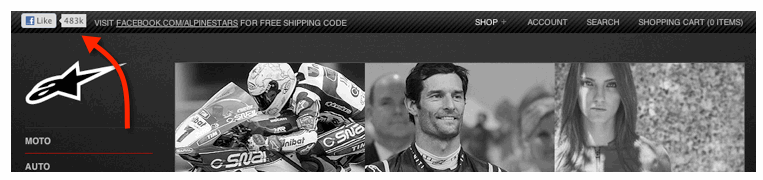
Apline_sport_social_example.gif

Let’s look at the above homepage from Alpine Sports as an example. Their promotion for free shipping sends visitors away from Alpine Sports own website by directing them to visit Facebook.com/Alpinesports for a free shipping code.

While this may seem, on the surface, like a great way to increase Facebook “likes” and get visitors to their Facebook page. Is this the best way to engage shoppers?

Let’s look at what visitors can do from the Alpine Sports homepage:

  • Search apparel
  • Get recommendations
  • Check out Q&A with Alpine-branded stars
  • And most important of all, BUY their merchandise.

In comparison, a quick glance over Alpine Sport’s Facebook page shows some cool pictures and a listing of upcoming events, but nowhere can a visitor find apparel for sale and they certainly can’t buy anything directly from the Facebook page.

While Facebook campaigns are great for a lot of things – branding, event promotions, coupons – they should always be driving customers to your dealership website – not the other way around.

Establishing a strong social community has many benefits I could extrapolate on for hours… and I have. Instead, I’d like to focus on just one, recommendations. A Nielsen study showed that 92% of consumers trust word of mouth. That far exceeds the 47% who trust advertisements. Facebook is a great place for people to discuss and recommend your product, which is why some businesses might feel so compelled to send customers there in the first place. But let’s consider an option that keeps your customers at the bottom of the sales funnel, while still allowing them to contribute to your social community -- Install the Facebook Connect Comments widget directly onto your site.

This strategy works for any company that sells a product, but let’s focus on a dealership-based example. If someone is looking for a car and they find it at your dealership… give them the opportunity to comment on Facebook right then and there on your website. Now you are getting your consumer actions into the newsfeed to drive more traffic straight to your site while simultaneously generating user feedback and building a social community.

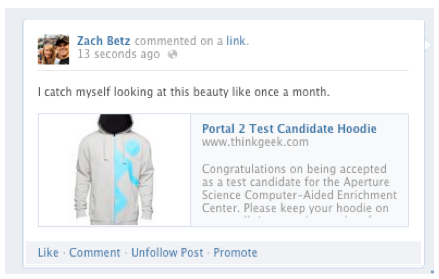
Let’s look at a real example of someone doing it right. ThinkGeek.comallows Facebook users to comment on all their products. Here a customer finds a hoodie they like.
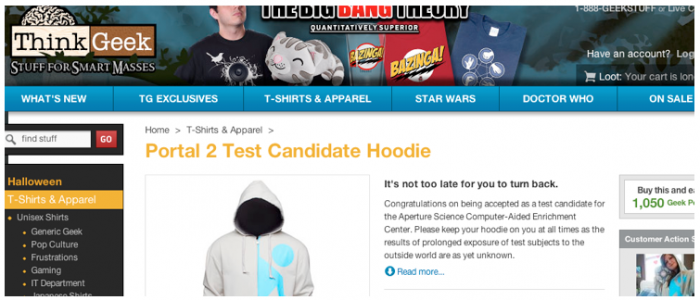
Apline-sport-facebook-product-example.png

They scroll down the page and find a place to leave a comment.
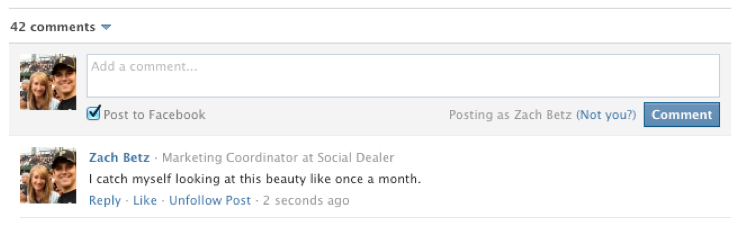
Apline-sport-facebook-comment-example.png

Their comment shows up right on the page but also goes to their Facebook page, sharing both their comment and linking his friends and followers back to the ThinkGeek site.
Apline-sport-facebook-onpage-comment-example.png

Bottom line: when you have customers on your dealership homepage – keep them on your dealership website website. They’re more likely to be much closer to the bottom of the sales funnel – time to convert! With the right strategy and tools in place, you can continue to build your social presence without killing your conversion.

Based on these factors where are you integrating social within your website?

Do you have social icons on your dealership homepage?

If so, are you worried that you're potentially directing customers away from taking action on your website?

Have/Would you install the Facebook Connect Comments widget directly into your dealership website?

Sounds off in the comments below. I want to hear your opinions and answers to the above questions!

Your Customer: Now an Early Adopter (Of Mobile)

Are we reading over what this research really means? When I read the quote:
 
"Interestingly the study found that among shoppers that used both websites and apps in their purchase process, nearly double those surveyed preferred apps over websites when using a mobile phone."
 
This only talks about those users that did download the app and thus use both. A more relevant question would be: What is the % of customers that download the app when wanting to visit the dealership site.
 
Furthermore, if double the customers that were surveyed prefer the app, that does not mean they use it. I would rather see usage numbers then survey results that will be biased. In addition, this means that one third of your customers that did download the app, actually preferred to go back to search.
 
As Kevin and Drew point out, I think the line between a dealer app, searching Google or yet a third option to simply teaching your customers to bookmark your site on their phone and saving it on their phone desktop are all seen as the same to the consumer.
 
Some of our customers' families drive 4 or 5 different brand vehicles which would mean they need an app for each dealership? Would you download an app for each grocery store you go to? Remember we go to the grocery store almost daily and a dealer site maybe once or a couple of times a year?
 
If someone could offer me some real numbers I might reconsider, but for now that's my two pennies...

Your Customer: Now an Early Adopter (Of Mobile)

I think that the line between app and website is becoming more blurred. People think a website is an app, and some even look like such on a mobile device. Esp on some sites that are extremely mobile friendly.
 
"Prefer to use downloadable automotive app" in the study tells me that the sites being designed right now are not REALLY mobile and multiple size friendly - or the consumer wouldn't care.
 
Re: Google -- doesn't want the user to use an app -- and while "do no evil" comes to mind... think about what Google looses when they do. And then think why they would downplay the importance of an app.
 
Studies can be interpreted and refined for data in multiple ways - pay attention and find out what works for you.
 
I don't personally see the point in a dealer app - just my few cents.

Your Customer: Now an Early Adopter (Of Mobile)

@kevinfrye
Kevin, great points as always.  As this is a third party study and I have no additional data on your comment points, I can only offer possible explanations from my own observations and experiences.
 
Mobile shoppers ALWAYS access a dealer's mobile site first during their initial search.  They do not FIRST search the app store to locate a dealership app.  It just doesn't happen.  I think this agrees with your point, Kevin.  
 
The study states, however, that "shoppers used apps MOST for contacting or locating a dealership" and found that they prefer using apps while performing these tasks.  Note the study doesn't state WHEN the customer used apps vs. the dealer's mobile site.  
 
Here's my experience on this topic.  Our best dealers are using "app option" code on their sites to identify when an iPhone or Android user is visiting.  This code then offers the user a dealer mobile app to assist in their shopping process.  Therefore, an initial mobile site visit leads to an app download.
 
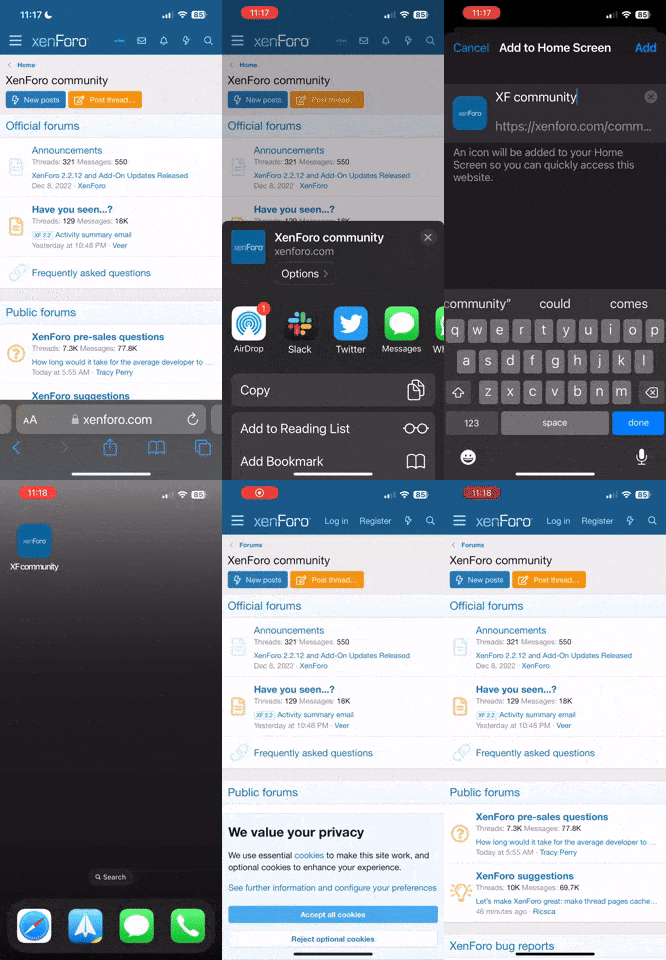
Here's where the "shoppers used apps most" explanation comes in.  Once that app icon is installed on the customer's phone, we find that shoppers open the app to search inventory more often during the shopping process.  The ability to open an app and access inventory in seconds has a convince advantage over opening a mobile browser, typing in a keyword search, and find a dealer's site.  The problem is shoppers rarely bookmark a dealer mobile site and therefore tend to repeat a Google search every time they’re searching for current inventory.  An app, in a way, is a forced bookmark that resides on the customer's smartphone home screen and allows the shopper quicker, easier, access to inventory, dealer contact info, and directions when they’re ready to visit the store.
 
As a result, I think the study is stating that shoppers used apps “most” rather than “first” – essentially finding that shoppers went back the app more often during this stage of the shopping process.
 
Disclaimer: the above is simply a suggested explanation on the study’s findings.  It would be great to get other’s comments on this topic!

Your Customer: Now an Early Adopter (Of Mobile)

Kevin, great points as always.  As this is a third party study and I have no additional data on your comment points, I can only offer possible explanations from my own observations and experiences.
 
Mobile shoppers ALWAYS access a dealer's mobile site first during their initial search.  They do not FIRST search the app store to locate a dealership app.  It just doesn't happen.  I think this agrees with your point, Kevin.  
 
The study states, however, that "shoppers used apps MOST for contacting or locating a dealership" and found that they prefer using apps while performing these tasks.  Note the study doesn't state WHEN the customer used apps vs. the dealer's mobile site.  
 
Here's my experience on this topic.  Our best dealers are using "app option" code on their sites to identify when an iPhone or Android user is visiting.  This code then offers the user a dealer mobile app to assist in their shopping process.  Therefore, an initial mobile site visit leads to an app download.
 
Here's where the "shoppers used apps most" explanation comes in.  Once that app icon is installed on the customer's phone, we find that shoppers open the app to search inventory more often during the shopping process.  The ability to open an app and access inventory in seconds has a convince advantage over opening a mobile browser, typing in a keyword search, and find a dealer's site.  The problem is shoppers rarely bookmark a dealer mobile site and therefore tend to repeat a Google search every time they’re searching for current inventory.  An app, in a way, is a forced bookmark that resides on the customer's smartphone home screen and allows the shopper quicker, easier, access to inventory, dealer contact info, and directions when they’re ready to visit the store.
 
As a result, I think the study is stating that shoppers used apps “most” rather than “first” – essentially finding that shoppers went back the app more often during this stage of the shopping process.
 
Disclaimer: the above is simply a suggested explanation on the study’s findings.  It would be great to get other’s comments on this topic!

Your Customer: Now an Early Adopter (Of Mobile)

@kevinfrye
Kevin, great points as always.  As this is a third party study and I have no additional data on your comment points, I can only offer possible explanations from my own observations and experiences.
 
Mobile shoppers ALWAYS access a dealer's mobile site first during their initial search.  They do not FIRST search the app store to locate a dealership app.  It just doesn't happen.  I think this agrees with your point, Kevin.  
 
The study states, however, that "shoppers used apps MOST for contacting or locating a dealership" and found that they prefer using apps while performing these tasks.  Note the study doesn't state WHEN the customer used apps vs. the dealer's mobile site.  
 
Here's my experience on this topic.  Our best dealers are using "app option" code on their sites to identify when an iPhone or Android user is visiting.  This code then offers the user a dealer mobile app to assist in their shopping process.  Therefore, an initial mobile site visit leads to an app download.
 
Here's where the "shoppers used apps most" explanation comes in.  Once that app icon is installed on the customer's phone, we find that shoppers open the app to search inventory more often during the shopping process.  The ability to open an app and access inventory in seconds has a convince advantage over opening a mobile browser, typing in a keyword search, and find a dealer's site.  The problem is shoppers rarely bookmark a dealer mobile site and therefore tend to repeat a Google search every time they’re searching for current inventory.  An app, in a way, is a forced bookmark that resides on the customer's smartphone home screen and allows the shopper quicker, easier, access to inventory, dealer contact info, and directions when they’re ready to visit the store.
 
As a result, I think the study is stating that shoppers used apps “most” rather than “first” – essentially finding that shoppers went back the app more often during this stage of the shopping process.
 
Disclaimer: the above is simply a suggested explanation on the study’s findings.  It would be great to get other’s comments on this topic!

Your Customer: Now an Early Adopter (Of Mobile)

Kevin, great points as always.  As this is a third party study and I have no additional data on your comment points, I can only offer possible explanations from my own observations and experiences.
 
Mobile shoppers ALWAYS access a dealer's mobile site first during their initial search.  They do not FIRST search the app store to locate a dealership app.  It just doesn't happen.  I think this agrees with your point, Kevin.  
 
The study states, however, that "shoppers used apps MOST for contacting or locating a dealership" and found that they prefer using apps while performing these tasks.  Note the study doesn't state WHEN the customer used apps vs. the dealer's mobile site.  
 
Here's my experience on this topic.  Our best dealers are using "app option" code on their sites to identify when an iPhone or Android user is visiting.  This code then offers the user a dealer mobile app to assist in their shopping process.  Therefore, an initial mobile site visit leads to an app download.
 
Here's where the "shoppers used apps most" explanation comes in.  Once that app icon is installed on the customer's phone, we find that shoppers open the app to search inventory more often during the shopping process.  The ability to open an app and access inventory in seconds has a convince advantage over opening a mobile browser, typing in a keyword search, and find a dealer's site.  The problem is shoppers rarely bookmark a dealer mobile site and therefore tend to repeat a Google search every time they’re searching for current inventory.  An app, in a way, is a forced bookmark that resides on the customer's smartphone home screen and allows the shopper quicker, easier, access to inventory, dealer contact info, and directions when they’re ready to visit the store.
 
As a result, I think the study is stating that shoppers used apps “most” rather than “first” – essentially finding that shoppers went back the app more often during this stage of the shopping process.
 
Disclaimer: the above is simply a suggested explanation on the study’s findings.  It would be great to get other’s comments on this topic!

Your Customer: Now an Early Adopter (Of Mobile)

Great piece, though the line "The study found that shoppers used apps most for contacting or locating a dealership, sharing aspects of the shopping process, and writing reviews" does not make sense. Why would you download an app to contact or locate a dealership??? Makes no sense. Why would you search for a dealership app, take the time to download it, and then look for how to contact or call them? You would contact or call them after your initial search brings up that info...
 
During Google's keynote presentation at Digital Dealer, they brought up several points from the Polk/Google study earlier this year. Of interest was this point: “Of the 15 percent of mobile consumers conducting mobile Auto searches, less than one percent are using apps – likely because their occasional use of the category doesn’t demand the day-to-day benefits of app usage.” That's less than one percent OF the 15% conducting mobile auto searches...
 
They also shared that the top mobile search activities were:
 
44% look up business location
43% do price comparisons (hmmm - usually on your showroom floor)
36% look up phone numbers to contact business
 
Mobile will continue to grow, and it is important for each of us to understand the patterns of our car shoppers on their smartphones AND tablets. Fish where the fish are, make sure you have a strong mobile site, that you have mobile SEM in place, and that you complete your due diligence on any mobile solutions you implement. Thanks for the great contribution Ben!

Your Customer: Now an Early Adopter (Of Mobile)


Yes, by traditional standards I was considered an early adopter. I tend to be one of the first to embrace a technology that permits me more efficiency on the go. Smartphone? I had one of the originals - a massive Handspring Treo 300. The year was 2002 – your PC was based on a Pentium processor and James Bond’s iconic BMW Z3 was still in production.

I’ve been using a smartphone for over a decade. Whether that makes me innovative or dangerously close to a Star Trek bedroom set is your call. My first smartphone was large and closer in size to the iPad mini than a current mobile phone. However, despite the size, myself and other early-adopter business pros couldn’t go back. It went quickly from a want to a need. It was the convenience, power, and ability to get things accomplished on the go.

Wait, you understand. A recent study found that more people would rather lose their wallet than lose their smartphone. I think this speaks volumes of how precious our mobile devices have become in today’s society.

Over 110 million in the US have a smartphone. My article on Nielsen smartphone data shows just how fast the revolution is moving. Not only is there a growing number of smart phone purchasers in US, but their usage behavior is more in line with early adopter tendencies than ever before. They’re willing to upgrade and place a priority on having the latest features.

I’m writing this one month after the iPhone 5 and iOS 6 launch. Let’s look at some staggering numbers.

In 2001, one year after Windows XP was launched only 14% of users had upgraded to the latest Microsoft software offering.

In the first month over 60% of iOS users have upgraded to iOS 6 – a month old operating system with well-documented issues and bugs common to new software releases. That’s tens of millions people willing to risk the functionality of a device more important than their wallets so they can have the latest.

Today’s early adopters are not the fringe, they are becoming the majority.

Your mobile customer is an early adopter and a recent Nielsen study helps define their behavior.

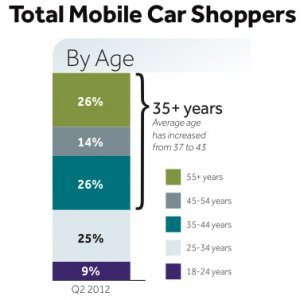
shoppersbyage.jpg

 
This Nielsen study published by Cars.com surveyed 1,500 recent automotive purchasers and intenders.

1. Mobile car shoppers aren’t just young and techy

Of Nielsen’s survey the average age of mobile car purchasers and intenders was 43. Further, a full 66% of those surveyed were over the age of 35. In fact, 26% of this grouping was made up of individuals over the age of 55.

2. Mobile: Not just high-end purchasers

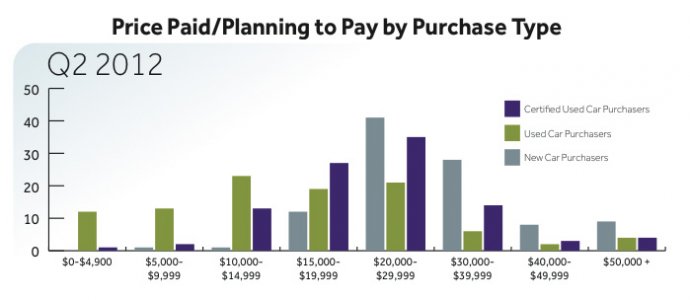
The study finds that among new car purchasers, the majority “paid price or planning to pay price” was between $20k and $40k. Used car purchasers cited the $10k to $15k range most, with certified used car purchasers/intenders one bracket up at $15k to $20k.
pricepaid.jpg

3. Shoppers prefer mobile close to time of purchase

The study found that while computers, tablets, and smartphones were used in all stages of the purchase process, different devices were used more commonly in certain phases. Desktops/laptops were favored early in the process during the research phase while mobile was more often tied to activities closer to the purchase stage.

4. Mobile Apps vs. Mobile Sites

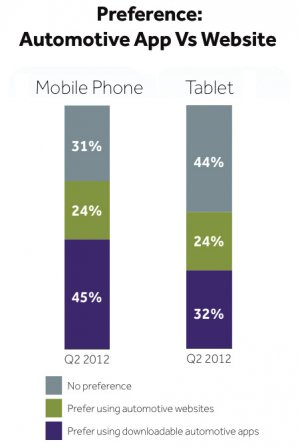
Interestingly the study found that among shoppers that used both websites and apps in their purchase process, nearly double those surveyed preferred apps over websites when using a mobile phone. The study found that shoppers used apps most for contacting or locating a dealership, sharing aspects of the shopping process, and writing reviews.

appsvssite.jpg

5. Dealership apps / mobile sites influence dealer selection

The study found that nearly 2/3rds of intenders had narrowed down their dealership choice since they first accessed an automotive website or app from their device. This is one of the most interesting finds in the study. After using their mobile device, two thirds of intenders had made the decision from which dealership to purchase their vehicle!

In summary, your customer is increasingly utilizing mobile during their automotive shopping experience. They’re not afraid of using new tools to enhance their shopping efficiency.

What steps has your dealership taken to create a mobile marketing strategy?

A Better Analytics Tool To Improve Customer Experience & Conversion?

Thanks guys for sharing your findings. It really puts things into perspective with what dealer website vistors are doing on your site.
 
I love your VDP's... work of art.  The use of different colours (that's how we spell it in Canada)  to focus on certain calls to action is a great idea.
 
Go Acton!

A Better Analytics Tool To Improve Customer Experience & Conversion?

Using ClickTale to Improve Conversion

While building our new website, www.actontoyota.com, we were continually asking ourselves a number of questions in an effort to create a site that ultimately improves page layout, enhances the visitor experience and, above all, increases conversion rates.

For example, we asked ourselves: What can we do to improve our pages’ layout and contact form placement to increase conversion? Are the pages we’ve built filled the type of content our visitors seek, find engaging, and want to interact with?

To help us answer these questions and more we turned to ClickTale, the industry leader of customer experience analytics.

Clicktale-logo-300x90.png

With dozens of unique features, ClickTale offers an all-around optimization suite that combines visitor recordings, mouse move and click heatmaps, form analytics, and more as part of its analytics information. We especially like ClickTale’s in-page web analytics. Now, we are able to know what our visitors do inside all the pages of our website thanks to ClickTale recording everything from mouse moves and clicks to actual keystrokes inside every page of our site.

Click here to watch the 1 minute video about ClickTale

Ultimately, we’re excited to share ClickTale with this community as we’re confident their analytics will provide unparalleled insights into how visitors engage with a website. In just a short time, we know it has already helped us.

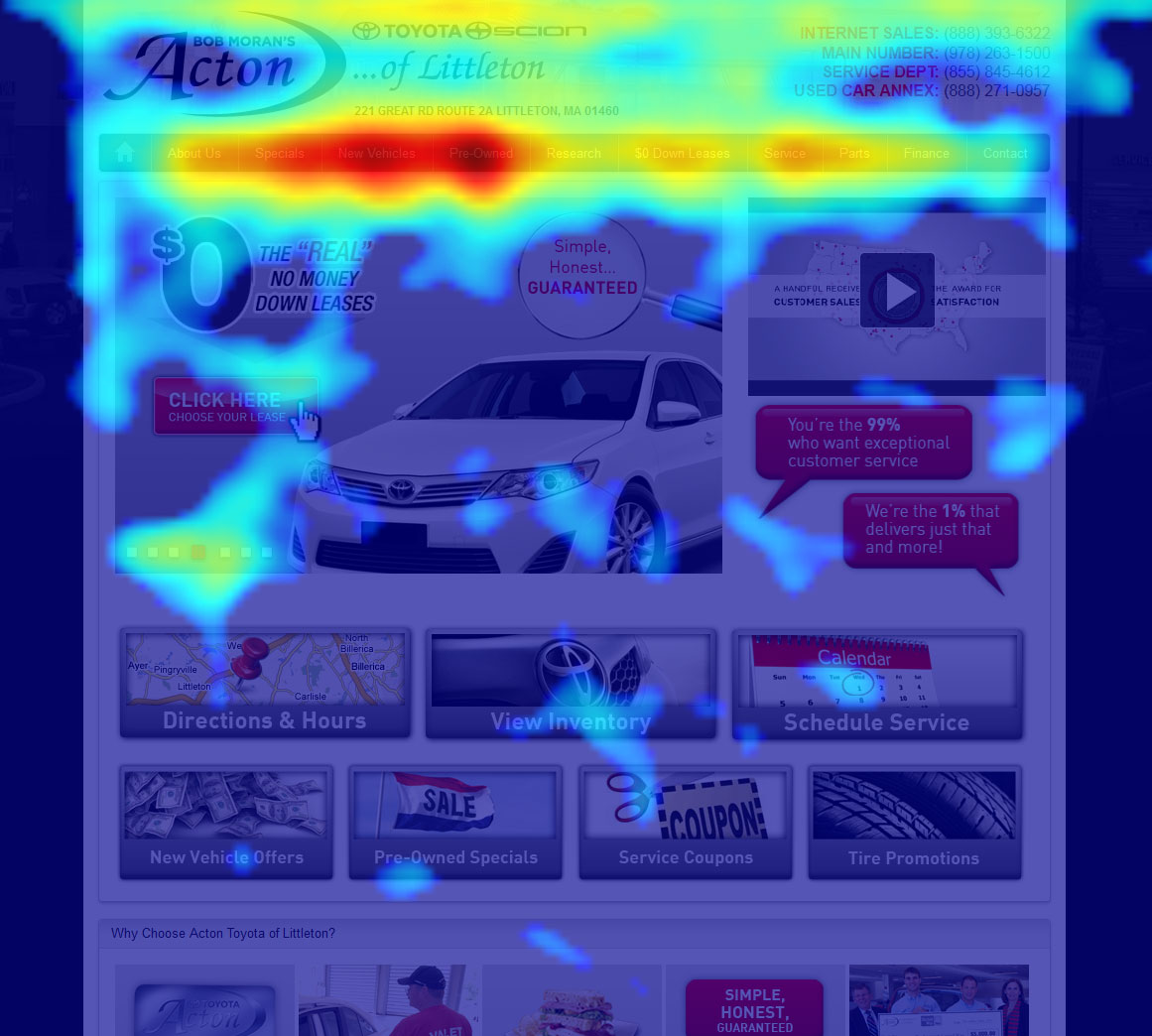
While still young and limited in size, ClickTale’s analytics were abundantly clear that the overwhelming majority of visitors who were interested in a vehicle purchase and started on our homepage headed immediately to our inventory and stayed there for their entire browsing session. See below for a ClickTale heatmap of our homepage.


At its face, this information may seem like it is pretty common knowledge and of little real value. However, consider, then, that much of your website content meant to differentiate your dealership and brand from the competition goes unseen by your potential customers.

This means visitors are not reading your wonderful testimonials located under your “Dealership” section nor can they be impressed by your exclusive ownership benefit program (i.e. complimentary oil changes for life) promoted within the “Why Us” section. Moreover, visitors are unaware of the unique sales pledge or customer-centric, no haggle sales process they will receive should they do business with your store. Unfortunately, that information is situated only under the “About” section. It is imperative this valuable information be placed where it can be seen - your VDPs.

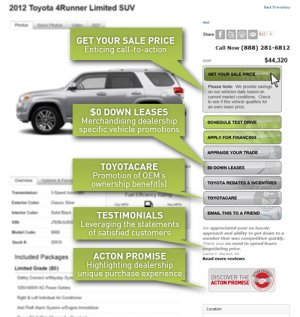
Below, you will find a screenshot for one of our newly created Vehicle Detail Pages (VDPs). Within the page, we’ve highlighted a number of the ways we’ve tailored our VDPs to increase the likelihood of conversion by ensuring visitors find what they want to know about the car, but also discover what we want them to know about us as a dealership and the brand we sell.

Enhanced-Dynamic-Beacon-VDP.jpg

We encourage all of you to evaluate your own VDPs and ask yourself whether they include your store’s and manufacturer’s unique offerings, benefits, etc., thus increasing the odds a visitor will be motivated to pick up the phone and call or complete a contact form.

If you feel your VDPs need improvement and you cannot customize them on your own due to CMS restrictions, we suggest you reach out to your website provider for assistance. There may be a small fee for the custom work, but the additional lead volume will more than make up for the expense in no time.

When was the last time you worked with your website provider to help improve your VDP?

Secrets of the Inbox - Presentation for #DSES

30 MORE? You had 10 over already - @zonewebb & @imacsweb did another hour after theirs...But yes, to see your full presentation and the topics you didn't get to would have been nice!
Side note with all I've implemented since DSES & DD, our open rate has gone from 11.8% to 32.5% opt out .4% to .4%. (2 weeks pre:post) I know it's only been just under 2 weeks but that's big news here under the rock!

Looking Inside the Minds of Car Shoppers!

Even with those broad searches above......a local dealer is not going to rank for terms like
 
do I need a downpayment to buy a car
how do i buy a car online
car dealer trade in value
 
you have to ask yourself this question "If I create a page targeting one of these terms, will I outrank who is currently #1?"
 
in most instance you will be hard pressed to beat out 3rd party sites like Autobytel, Edmunds, or KBB for these types of terms.
 
With "best car dealer in cincinnati" your meta description contains highest and rated which are similar terms to best. But unfortunately no one searches best car dealer in.......

Filter