• This thread is just the tip of the iceberg.The people ahead of the curve aren't Googling for answers — they're already in here, having the conversations you haven't found yet. DealerRefresh is free.Get the full picture →

Why does it take a crisis?

I'm really curious what data was used to determine this conclusion.

CARVANA is spending millions of dollars of borrowed money that they don't have because they can't turn a profit. Please use an example that actually makes a profit.

Ummm... It's kinda hard not to. Especially when all of your customers are being told to hunker down, don't go outside or you'll be eaten up by the Rona.

Thats what I keep saying.
giphy.gif

I am really happy that you posted this @Rick Buffkin . I have written several replies and deleted every one of them.

To @Alex Snyder point about the amount of time it takes to buy a vehicle, the easier and more profitable approach to correcting this problem is for dealers to actually make it take less time for a customer to buy a vehicle. Seriously, it takes too long...then speed the damn process up. Make "time of transaction" a metric that is measured and worked on. We did this in my store, and we can get people in and out in a hurry. If approached correctly, the customer can actually help the process. We just tell the customer, you can be here all day or you can be in and out of here in an hour. Which do you prefer?

The existing way of doing business is profitable above all else. Depending upon the organization, it may be extremely profitable. To throw all of that out in favor of a process that primarily shifts to online and delivery is extremely expensive and involves a complete turnover of front end employees.

As Rick stated (basically), if this is such a great way to go then why are these companies that you are wanting everyone to model after losing so much money?

Why does it take a crisis?

People want a remote experience vs. the traditional buying process that requires the consumer to be on-site and in-person.
I'm really curious what data was used to determine this conclusion.

CARVANA and VROOM have clearly proven that there is consumer demand for a similar experience in automotive. CARVANA is not spending unknown millions on Ads targeting "Contactless Home Delivery" for no reason.
CARVANA is spending millions of dollars of borrowed money that they don't have because they can't turn a profit. Please use an example that actually makes a profit.

We are now seeing a very large number of dealers around the country scrambling to move toward this new model.
Ummm... It's kinda hard not to. Especially when all of your customers are being told to hunker down, don't go outside or you'll be eaten up by the Rona.

Unfortunately saying you offer a service and actually, offering it are two very different things.
Thats what I keep saying.
giphy.gif

Why does it take a crisis?

Part of our day to day market research and prospecting includes asking our sales team to reach out to dealers who are advertising this "Remote" Sales and Service process with Home Delivery and Pick up on their website to see if we can help them out by bringing our services in. What we have found is that there is a very small number of dealers that are actually providing anything even close to this type of service: maybe 1 in 20.

Unfortunately saying you offer a service and actually, offering it are two very different things.

We are now seeing a very large number of dealers around the country scrambling to move toward this new model. What I see is significant infrastructure challenges due to cultural issues because leadership is not seeing their orders through. Before the dealership can truly practice off-site sales and service offerings, or even a hybrid, they need to reset and take necessary steps to redefine their processes at the store.

Interesting point. I guess it shouldn't be surprising that something shown on the dealer's website isn't truly available.

It makes sense that if a dealership has enjoyed years of walk-in traffic a complete change to the way you do business would be an incredibly difficult shift. I get it.

I can also see where the messaging of the difficulties of actually pulling off a remote delivery or service is not being stated clearly to the dealer principle. Most care about their customers and will want to take action. Sometimes the employees of a business perceive that to not be the case... hence to your culture statement.

Good on you, Anthony, for pointing this out (y)


  • When it comes to doing offering "off-lot" sales and servicing, were they not in touch with the consumer sentiment?

I did not appreciate customers until I became one.

I am part of the third generation of a family of car dealers. Buying a car, like a peasant (yeah, I said that), was an experience I didn't receive until 2014. I much prefered selling myself a car and desking my own deal. It takes waaaaaay too many texts, emails, phone calls, and then soooooo much wasted time sitting in the showroom to buy a car. The chore is ridiculous. And it is incredibly infuriating because I know how it works and can't believe I'm being put through it every time I've done it now. It feels like the system is rigged to not be in touch with the consumer at all.

On the other hand, the dealers who have decided to take a different approach, and put the customer first, seem to be experiencing greater profits than the rest.

In their face! And other tales from the lead addiction chronicles.

It takes 8+ touchpoints for a customer to make a decision to purchase so gradual (while continuous) engagement is so crucial!

I've always disagreed with this logic and approach - I find it too surface level.
A dealer that advertises on 10 networks (Facebook, Google, billboards, radio, etc) is always going to have more touchpoints per sale than a dealer who spends less but still sells cars. I have never needed a single touchpoint to buy a car, but when I am in the market to buy a car I am overwhelmed with dealer marketing and communications. Just because I see them all, doesn't mean they're actually impacting the sale.
The data often comes from studies where they ask customers "how many times did you see an ad" or "check all the places where you looked before buying" - but none of that actually indicates that these touchpoints are required or actually resulting in a specific sale.

Customers I talk to don't slowly get convinced to buy a car by seeing overwhelming amounts of ads and touchpoints from the dealer - they decide to buy a car and then inevitably see and engage with these things everywhere. We also run countless campaigns where we send a letter to customers and with 1 letter we convince them to come in and buy a car.

Through diligent monitoring and advanced data collection, we stumbled across a revelation. At FRIKINtech, our ability to connect multiple browser sessions across multiple devices opened a window that we previously didn’t even know existed!

My decade of operating Checkered Flag Auto Group’s websites, compounded with 15 years in the automotive trenches with DealerRefresh, followed by nearly a decade at Dealer.com all informed my certainty that car shoppers on dealer’s websites were most likely within one week away from making a purchase.

...

Gradual Engagement. It is easy to say “No” when all the dealer’s cards are on display. Instead, hold a few aces up your sleeve and reel in your trepidatious website lurkers with progressive enticements. Exploit your shoppers’ uncertainty and appeal to their deal-seeking hesitation by rewarding each revisit.

Some will pop before the lowest final offer is presented. Some will buy on the spot. Others will come back 10 times a day for another “hit.” It’s a path to greater profitability, an enjoyable experience, and, in fact, quite addictive for the consumer who wants nothing more than to beat the system- even if the victory is only perceived. As we all know, the house always wins. That is a gradual engagement.

I do agree with all of this, and it aligns with what I tend to see personally (both at the stores I work with and with my own friends/family).
When someone is ready to buy a car, they go to the dealership website to see if the car is available. I also see them go back over and over again to show their spouse, their parents, check if the car is still in stock, drool over it, etc. They're excited about this purchase and many times they'll show you that in the data.
I don't often see people shopping dealership websites if they aren't in the market fairly seriously, as this is a low funnel step where they're often looking for a very specific unit that they've already decided on.

In their face! And other tales from the lead addiction chronicles.

“But it's easy to talk about and sum it up when you just talk about patience; we're sitting here, and I'm supposed to be the franchise dealer, and we're in here talking about patience. I mean, listen, we're talking about patience. Not a lead! Not an appointment! Not a sale! We're talking about patience. Not leads; not the leads that I go out there and die for and respond to every lead like it's my last, not the leads, we're talking about patience, man. I mean, how silly is that? We're talking about patience.”
View attachment 4973

Are you eligible for Google Ad Credits for Covid-19

A couple questions I've gotten since publishing the article:

Q. Can my credit be distributed to a different dealership?
A. No. It's allocated to a specific account and can not be transferred.

Q. Is it possible for my agency or partner to take the credit and use it elsewhere?
A. No. It's allocated to a specific account and can not be transferred.

Q. What if I switched providers recently or in the middle of last year?
A. The credit is associated with your specific account. If you've owned and kept your account, the credit will be associated with it. If you've switched accounts or created alternative accounts then the credits can go there. My recommendation is to reach out to your previous and current provider to determine the amount, account, and how to spend it.

Q. Why did I only get $150 or (x amount)?
A. Google does not provide an equation for how much you will receive or how they calculate your ad credit.

Q. When should I expect a check from google or from my provider?
A. This ain't mailbox money. The credit can only be used for google ads on google owned properties.

Q. What if my provider does not give me the ad credit?
A. Consider an open dialogue with your provider to discuss the amount and how it will be applied. In many cases your provider has already used or allocated your ad credit. If they refuse to use or allocate your credit, consider an alternative provider.

Q: I'm in an OEM digital advertising program and they won't let me pay Google directly.
A. Find out who your OEM program administrator is and kindly request to pay Google directly. This is not your vendor or the OEM Program management company. You need to find out from your DSM or OEM rep who administers the program within the OEM and call/email that person. The OEMs programs are billed through your Parts and Service statement.

What is more important ROI or ROE?

NADA 20 Groups have been tracking the "ROE" metric for as long as I can remember.

The composite did not break this number on a per department basis (directly), but did cover it. If I remember correctly, they labeled it "Gross Profit Per Employee".

It is a strong measure for sure. Where it really showed it's teeth was in small dealerships that were heavy in support staff. From there, the calculations had to manually be done to expose the departments that were suspect.

Great post!

What is more important ROI or ROE?

So wait, you mean to tell me face to face they're saying "hello, my name is John Doe" and giving a fake name and number literally lying to someone's face? So that only impacts auto show season. I guess but damn, is a free candy bar that important? What a bust out. And WTF is the OEM doing this for anyway? Can't the dealer just buy the snickers and say get lost?

We use Unlock the Price with great success, how are you seeing these being faked? I can't think of a way to spoof them.

The OEM gets leads from all sorts of places. I should have clarified that ONE of them is car shows. Much of the time the leads they gather are from giveaways. The quality of those leads is not so hot.

I don't disagree but wouldn't it be easier to just respond to the questions being asked? And I hate to be "that guy" but anyone that says every single second of their day is packed with constant productivity is full of shit. If the day ever came when I heard one of my desk guys say he was tired of giving numbers that would be the same day I started my search for a new desk guy. I don't see how giving numbers is an issue when that's your job?

:iagree:

What is more important ROI or ROE?

I don't believe people are submitting fake leads.

Here are a few sources for fake contact information:
  • OEM leads are notorious for this as they're usually giving something away at a car show.
  • Unlock the price leads are too.
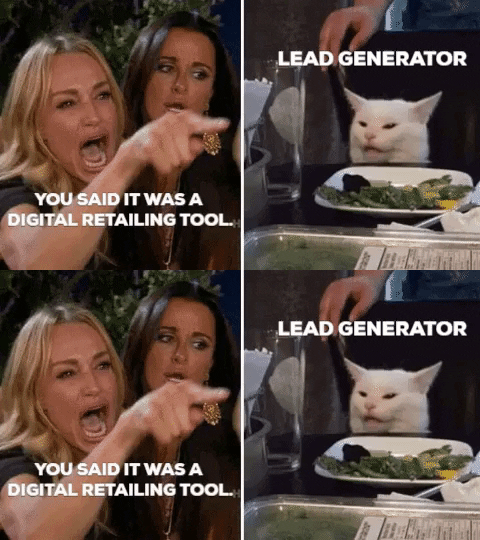
  • Digital retailing leads.
  • Any dealership that can no longer show a price below a manufacturer threshold aside from a specific 1:1 conversation.

" 100 leads to 5 deals? I can't get there. That screams broken process, broken prices, broken people, etc.

I agree! It is a broken process that continues to get worse and worse as time goes on. When the first internet leads were coming in we did not know what to do, so we answered the customer's questions and gave them a plethora of information. We had closing ratios above 25%.

Then we discovered the desk was tired of giving us numbers, so we developed ways to not answer the customers' questions. Our closing ratios fell. So we pushed our vendors to get us more leads because our pay plans did not change.

  • Spend more on SEM
  • Spend more on SEO
  • Spend more on social
  • Turn our websites into the Vegas strip with pop-outs, pop-unders, chat this, chat that, text us, get your ePrice, check availbility, unlock your savings. and whatever call to actions someone can come up with
  • Try anything that brings a lead in
More leads, more leads, more leads. And our closing ratio fell further. But we still have the same pay plans. And we still have the same reluctance from the desk to provide the customer with answers.

We blame it on not being able to hire good people. We blame it on the lead sources. We blame it on the vendors. What we are missing is a simple single truth: we are not putting the customers first.

What is more important ROI or ROE?

After the 2008 recession layoffs, we put the GMs on an ROE (I like that Shaughnessy - stealing it) pay plan at Checkered Flag. It was a pure headcount to profit number that was set for each department. Parts had a different profit per employee number then sales for example. But porters and detailers fell into this statistic too.

It forced the GMs to be diligent about who was on the staff and that also invested them in making sure the people were able to do their jobs. Obviously, it did not last, but it was a helluva neat experiment.

I Love the article @shaughnessy2323 and can tell you the national average for engaging with internet leads (email response from the customer, "contact made" phone calls, and even floor ups) is less than 16%. If the average dealer received 100 internet leads they speak to 16 of them. They close 20-30% of those making the REAL (not cherry-picked) internet lead closing ratio closer to 5%.

If you think that 5% number is low, I agree. In my opinion, the issue is in what is being sent back to these leads and what is being communicated over the phone. Customers want two things from dealers:

  1. Can I buy THIS car (is it available)
  2. For how much

The latter question "for how much" is where dealers fuck things up. It is so difficult to get an actual out the door number or payment (yes, that's what the customer is after - out the door numbers) the person working directly with the customer creates BS excuses as to why they can't provide it. The customer translates it into two things: 1) you're expensive and 2) you have terrible customer service. If dealers can make it easier for their staff to answer those two questions for every customer they'll see improvements in... well, everything.

COVID isn’t going to change dealers

I'm not sure... could this be the end of "Just get 'em in?" That'd be a pretty big change.

I never thought Digital Retailing was a technology (I was delivering cars to homes & businesses in the 90's). DR has always been an attitude... a culture.

Forget about the dealers... think about the consumer. Consumers have been 95% complicit in Just Get 'em In; dealers could get away with Just Get 'em In because they could... the consumers would ultimately come in.

What if consumers won't do that anymore? For the first time ever, I just called a health care facility to ask if I could get what I need without being there in-person. I imagine there are and very well will continue to be a lot of those kinds of calls in all kinds of verticals.

It's the consumer who holds the cards...

COVID isn’t going to change dealers

Great observations @Chris Vitale

There's inertia in the market and COVID-19 will have a marginal effect on the business, it's simply too big of a boat.

The dealer won't have to flip their business upside down yet because the consumer will still behave in the same way.

For example Remote sales & at-home delivery will hit logistic issues and at the next thing your know, customers will ask if they come to pick up the car at the store instead.

Habits are already resuming, people are being less careful, gathering in groups more, waiting for restaurants to open, etc... The human brain forgets. At the macro level, we'll be back on trajectory before we know it.

Flexibility will be the real golden gun for dealers from now on.

COVID isn’t going to change dealers

In 2010 and 2011 the recession lessons were still on the tip of our brains. We learned how to service and retail with half the staff in 2008 and 2009. We had reduced advertising budgets and learned that PPC (also known as SEM) marketing was a strong advertising channel. We also re-learned that sales agents were still not ready to handle internet leads. But we did finally learn that most customers were online shoppers.

What I learned from that recession are things that have and will shape my perspective for the rest of my life. One painful truth has stuck with me though: even when change is obviously better, the old ways are just easier.

The recession obviously did not last long enough for the efficiency changes to become habit. We got a bail-out to return to doing business the same old same old.

We are faced with new learnings today. We were forced into newfound efficiencies that are so impactful to the bottom line some new car dealers are seeing sales profits they've never seen before! It is so obvious that when each salesperson moves 30+ cars a month we have a winning formula! Duh of frikin duhs!

I'm with you @Chris Vitale, I don't believe we will learn enough from this short lapse in business as usual. By 2022 dealerships will staff sales departments with enough salespeople to sell 8 cars a month and have enough desk monkeys to cover that. They'll still be short F&I people as that job burns people out and pays too well to have enough on staff to keep customer wait times down. We'll be right back to the same old same old.

Perception and Reality: Taking Control of the Video Experience

Great post @BillPlayford and very timely, as I have a few customers who are working to up their game. There are great examples out there, test drives, reviews, how-tos, but my questions are more at the strategic campaign level. For the Refresher experts out there, what is the mission of the page/channel, what are the broad messaging categories, what is the right mix of those campaigns? Thx!

Are Dealers Measuring These 8 Facebook & Instagram KPIs?

Alex, you're going to get waste with any advertising source.

Your tv commercial plays while someone is in the bathroom...

Your email campaign gets flagged as spam...

Your YouTube ad is played on a minimized and muted browser window...

Your organic search result is shown to a user 1,000 miles away...

With your mentality, dealers shouldn't advertise anywhere...

I'm going to evaluate my advertising on the KPI's available and make the most informed decision possible. With that being said, I will take Facebook's $2.84 cost per lead and $65 cost per sale any day of the week.
Waste yes (of course), but not bot-driven, non-anthropogenic or native fraudulent traffic. Definitely not that at the overall 50% rate. All of this (as you know) comes down to cost / lead, ultimately cost / sale, so evaluate accordingly (we agree there). As I just said, what works in one demographic might not in another. It's always continuous testing, but for my money... I'm placing the majority of my ad spend in other channels. I don't trust Zuckerberg as far as I can throw him. I never said not to advertise.

Are Dealers Measuring These 8 Facebook & Instagram KPIs?

Alex, you should know from my DealerRefresh posts that I practice what I preach and always have data to backup my claims. I don't BS.

With that being said, here's data from one of my Facebook ad accounts. I'd be happy to share any account or date range to show I'm not cherry-picking the best data. All of my campaigns perform similarly well.

$4,162 Facebook Ad Spend
  • 1,463 leads for $2.84 each with name, email, phone number
  • 64 car sales at a cost per sale of $65
  • $127,731 total gross profit
For every dollar I spend on Facebook, I generate $31 in profit. :dance2:

View attachment 4850
That's fantastic, but you'd generate A LOT more and SHOULD if 50% of their traffic wasn't bogus. How much is wasted? That is the entire point. I don't think anyone can truly answer that, as they're pissing on advertisers' legs, while telling them it's raining. Furthermore, my question stays to him. You ARE at the dealer level, it makes the pulling and pushing of data from your sales numbers into FB, etc., much easier. It's not an easy task for a 3rd party to do such things for dealers (access the worst challenge). I know, I did it at the 3rd party attribution level and it's extremely difficult to scale.

Additionally, you must be pulling some magic tricks across your FB ads, I've never witnessed a top's or group's cost that low in FB and that's a sample size of ~750 dealers (it's generally much higher, so kudos to you). Granted, I'd be defying my own logic as what works in one demographic might not in another. There's that.

Are Dealers Measuring These 8 Facebook & Instagram KPIs?

Yes, the Facebook ads I run without a doubt generate leads and sell cars at the lowest cost per lead/unit of all our advertising sources.

I hope all of my competitors listen to your 50% fake traffic stat and get scared away from advertising on Facebook while I eat their lunch.
And I think you're totally full of shit and probably wasting a ton of your dealer's money.

Are Dealers Measuring These 8 Facebook & Instagram KPIs?

Hi Jacques! This article is largely meant for dealers already advertising on social media. Specifically, Facebook and Instagram.

The article is meant to help dealers dial in their efforts and maximize the money they're ALREADY spending on advertising.
Yeah but, if they are advertising on FB and Insta and the half of their traffic is bogus and botgenic WTF does that do for them? No offense.

@joe.pistell always says, DISC as in Does It Sell Cars? What type of sales attribution are you placing on it?

I see:
  • Cost per lead
  • Purchases (sales measured with Facebook’s offline conversion measurement tool)
  • Cost per purchase (cost per purchase with Facebook’s offline conversion measurement tool)
How are you doing this? Using 3rd party attribution tools or your own? FB conversion measurement tools are pretty bad actually and not set up for auto very well, online and offline (are you pulling data from dealerships' (sales) and pushing that back into FB?). I get that you're attempting to market yourselves with a branded thread (good on you), but there are loads of threads on much of this. Ping them and educate.

Filter