• This thread is just the tip of the iceberg.The people ahead of the curve aren't Googling for answers — they're already in here, having the conversations you haven't found yet. DealerRefresh is free.Get the full picture →

Cars.com Enhances Car Shopping Experience With Latest Feature, Salesperson Connect

CHICAGO, September 12th, 2017 - Cars.com is announcing its latest car shopping feature, Salesperson Connect, which helps connect dealership salespeople directly to in-market shoppers before visiting the dealer lot, creating a more personalized car shopping experience for consumers.

DealerRater, a Cars.com company, launched DealerRater Connections earlier this year to help connect consumers directly with dealer salespeople through dealer reviews. This latest feature upgrade integrates DealerRater data with the Cars.com Vehicle Details Page (VDP), providing shoppers with access to information critical to making a buying decision on what Cars.com refers to as the 4P's: Product, Price, Place and Person. Salesperson Connect is available for dealers nationwide who are currently DealerRater Connections customers.

"Real human relationships are a key to the next phase of the consumer-driven shopping transformation, and providing car shoppers with valuable data and information around a specific salesperson moves us towards that goal," said Tony Zolla, chief product officer at Cars.com. "Cars.com has created a Vehicle Details Page that provides a full range of data to help consumers make a more informed decision. The new Salesperson Connect feature surfaces top rated salespeople based on their DealerRater reviews and provides one-stop-shopping for car buyers on a single page, helping us streamline the process for consumers and connecting them to the right dealership and right salesperson to meet their needs."

"In a survey of over 6,400 car shoppers on DealerRater.com, 97 percent of them prefer to select a salesperson before walking into the showroom, which means that making a personal connection early is incredibly valuable," said Jamie Oldershaw, general manager of DealerRater. "Having access to reviews and information about specific salespeople at a dealership empowers consumers and helps them feel more comfortable about the car buying process. It also helps establish a baseline of trust before setting foot in the dealership and ultimately enhances the customer experience."

This feature can also help lead to stronger employee engagement at dealerships when salespeople know each experience with a customer could affect their review rating. In a recent survey of 233 DealerRater Certified salespeople, over 80 percent said their employee profile helps them sell more cars, drives more showroom visits per month, and speeds up the sales process resulting in a higher close rate.

"A shopper recently contacted me after reading a review on DealerRater, asking for me specifically," said "Wrangler Rob" McGuire, certified sales consultant at Garavel Chrysler Jeep Dodge Ram in Norwalk, CT. "Leads that come through the VDP salesperson profiles are more substantial because the consumer is already committed to the car and to the salesperson. Integrating the employee (salesperson) aspect can drive more business to the dealership because a shopper can review the VDP and think, 'I can buy this car anywhere, but this salesperson has more reviews and this is a more reputable dealership.'"

About Cars.com
Cars.com is a leading online destination that helps car shoppers and owners navigate every turn of car ownership. A pioneer in automotive classifieds, the company has evolved into one of the largest digital automotive platforms, connecting consumers with local dealers across the country anytime, anywhere. Through trusted expert content, on-the-lot mobile app features, millions of new and used vehicle listings, a comprehensive set of research tools and the largest database of consumer reviews in the industry, Cars.com helps shoppers buy, sell and service their vehicles. Cars.com properties include DealerRater®, Auto.com™, PickupTrucks.com™ and NewCars.com®. The company was founded in 1998 and is headquartered in Chicago, Illinois. For more information, visit www.Cars.com.

The Ultimate Guide to Video and Email

VIDEO-AND-EMAIL-GUIDE.png


Video is king, there’s no way around it.

It’s the Tesla of marketing, ruler of the seven kingdoms, the end-all-be-all of content. It sells better, conveys better, and it’s found better.

In strategizing any sort of video efforts for your brand these days, it would be difficult to escape sending personalized video to your customers and prospects. After all, personalized video has a 16x increase in click-to-opens and a 4.5x increase in total/unique click-throughs (Vidyard).

If you’ve attempted sending videos via email, you’ve probably run into an important question: What’s the best way to send videos? Email and video have an interesting relationship, and they don’t always get along. (Read DR Forum "Why Is Video So Difficult.)

Here are some obstacles you may run into...

Size Matters

A big problem arises when Gmail’s message limit is 25MB per email (that includes text and attachments) and a typical 2 minute video recorded with an iPhone 7 is about 220MB. The math doesn’t add up for sending video via email. It’s important to mention, most private servers have similar size limits.

We took it a step further and tried sending a one-minute video recorded with an iPhone 6 (lower quality). Here’s what we got…

iPhone6-Video-upload.jpeg


We were able to send an old 40-second video recorded on a iPhone 4, but this is what happened when we tried to open the attachment…

gmail-viewing-video.png


Not a very elegant solution for sender or receiver...

Stop Spamming Me

Anytime an email is sent with an attachment, Internet Service Providers (ISP’s) try to prove it’s not spam. They’ve become very weary of attachments and there’s good chance it will get blocked by spam filters, especially when sending to private servers with tight security. If it does get past the gates, your video still has to get past the recipients that are opening it, all of whom are wary of downloading large file attachments from people they don't know.

As with most computer viruses, victims are often first targeted with a fraudulent email. If hackers can get victims to open an email and then download an attachment, then they can infiltrate their computer—and any computer associated with that computer’s network.

—  Time Magazine

The YouTube Blues

While YouTube is a great tool that helps tremendously with sales and marketing efforts, it still has its obstacles if you plan on actually sending the videos you’re producing. The biggest YouTube complaint we hear is the time it takes to upload a video and fill out the required information, and don’t forget you still have to write a corresponding email.

It’s no secret YouTube wants people to stay on their site and keep watching videos, understandable, but this means they don’t really care that you’re trying to sell a vehicle. It’s safe to assume your competitor’s ads and “related videos” of similar vehicles will be queued up and placed next to yours. Not to mention, the YouTube black hole of distractions like Carpool Karaoke and kittens playing tennis.

...So what are the best solutions...?

File Sharing

Services like Dropbox (also WeTransfer, YouSendIt) provide a place to store and send files. Everything is done from their respective sites and your recipients receive an email directly from the third party service.

Although they get the job done, receiving an email from these companies can be intimidating to customers, and there is a learning curve. It may not be intuitive for your end user, but typically instructions are provided with the email on how to download the file(s). After clicking "View File", recipients are then prompted to create an account.

Dropbox-Email.png


Video Email Service

Now, I'm a little biased on this topic... but using a video email service has become the standard for any company that’s looking for ROI with video. Here’s why…

  • The ease of use. For both the sender and receiver, this is by far the easiest and most efficient way to send and receive video. Pre-designed and branded email templates allow for a speedy process, while still supporting the video with a personalized message. The scope of work for the sender only depends on video production, because that’s pretty much all you have to do… Record. Send.

authntk-video-email-template.png


  • There’s no sending of large files, the video usually streams through an HTML5 player. The downloading and transferring is all done on the service providers end before the email is sent.
  • Most video email services now include an SMS package, which gives you the option to automatically text the recipient your video, along with the email. 75% of millennials choose texting over talking (OpenMarket).
  • Imagine not worrying about which videos to delete to save space or if you have enough storage for a new recording. With a video email service, your videos are stored and saved forever on their servers… easily recalled at any time, and no storage required on your end. NOTE: Some service providers may charge extra for storage tiers.
  • Performance reports are huge perks of email services. They allow you to see open rates, who has viewed your videos, and when.. An invaluable tool that can steer your video marketing strategy in the right direction.

No matter where you are in your video marketing process, it's never to late to try out one of these solutions, your customers will thank you for it! 

Before I wrap this up, I have to give a shout out to Jeff Kershner for being all over the video trend 9 years ago! He saw the value of it way back when and to his credit has stuck with it. I wonder if he still has that flip video camera.. Shouts to Jeff, he's a rockstar. Literally...

rock_star_kershner.jpg

Leads? Customers? What's the Difference?

A guy walks into a bar and says, "Bartender...." -- oops.. wait.. different story.

A guy walks into a dealership and says, "I'd like to see an SUV with 3rd-row seating."

Who is this guy?  Is he a lead?  Is he a customer?

If you ask the Salesperson, he's an "Up," but again, that's a different story.

What is he in your system?  Does it matter?

If you've ever attempted to produce Lead ROI reporting, generate Customer lists for targeted Campaigns, or just generally wondered what the heck was going-on with your data, then yes, it matters. It matters a lot.  But it's really not that complicated -- let's make this easy.

Leads:

Rule of Thumb: you cannot shake hands with a Lead.

Think of a Lead as a starting point: data with a need to be understood:

Lead is an entity with unverified information and unverified intent that has purposefully contacted the Dealer.

Sounds a little complicated, but think of leads as simply words on a piece of paper or words sandwiched between tags in ADF/XML -- just words sent to a dealer or dealer's system that need to be understood.  The words don't change -- ever.  Leads are immutable, a fact from a particular point in time.  Once we start to understand these words, the game starts...

Customers:

Rule of Thumb: you can shake hands with a Customer.

Customers are often people, although businesses can also be customers.  Therefore, let's use the word "entity" in our customer definition:

Customer is an entity with verified and sufficient information that has purposefully been in contact with the Dealer.

"Customer" is synonymous with "identity;" the answer to "Who?" when the question is asked.

Does "Customer" indicate a transaction has occurred?  Not necessarily -- but a verified person or business has been in contact with the dealership.

We have the concept "verify" in both of our definitions because verification logic is a key to determining the maturation path of a lead: do we have enough data to make a determination that the words reasonably represent an identity?  Or are the words a bunch of gobly-guk destined for the trash can or in need of further information to make sense?

If we're shaking hands, it's pretty easy to verify that there's an identity.  Systems are not so fortunate, so verification logic is put in place to start separating the wheat from the chaff: the maturation of a lead.

This Maturation Path is what it's all about -- commonly referred to as The Road to the Sale.  In the old days, The Road generally started when a customer walked through the door.  Today, that door is no longer the glass rectangle hanging on the front of the building, and very often our systems are performing the first Meet-n-Greet. When a system understands the difference between a Lead and a Customer, the system's foundation is set to be an integral partner as the dealer travels the Road alongside his or her customers.

And when your system understands the difference between Customers and Opportunities.... then WOW!  But that's a story we'll save for next time :)

Have a comment you'd like to share? Post it here in the dealer forums

The Autonomy Quatrains ....a Reality Check.

Nostradamus would be having a field day.

When pondering the impact of Autonomous Driving Vehicles, the predictions about the future of automotive (and the resulting impact to society) are, if anything, vast. In a world that requires constant content, everyone has an opinion and the ability to publish their opinions. So they do.

The Unbridled Technophiles:

  • Less than 4 million autonomous cars will replace 50% of all commuter traffic in the U.S.1 With roughly 250 million people in the U.S. living in urban communities, 3.75 million autonomous vehicles will handle 50% of peak commuter traffic in the country.
  • Overcrowding will officially come to an end.1 One thing that symbolizes overcrowding more than anything else is traffic. Once traffic flows smoothly, people will begin to regain control of their lives and our sense of feeling overcrowded will begin to disappear.
  • Driverless technologies will cause 1 in 4 jobs to disappear.1 Over the next 2-3 decades, driverless technologies will be either directly or indirectly responsible for the loss of 25% of all of today’s jobs.
  • We won’t need to teach our children how to drive. Today’s infants will wonder how or why we let people drive cars.

The Unbridled Technophobes:

  • Self-driving cars will never be safer than the human eye. Even military fighter drones need remote human pilots.
  • We can’t have machines running the world. "The development of full artificial intelligence could spell the end of the human race." -- Steven Hawking2
  • The insurance industry will never let it happen. Billions of dollars of insurance money will find a way to quash this fad.
  • It’s already over. Apple laid-off it’s staff from Project Titan3, and Uber is crashing cars in Arizona4.

Start at the far left, and travel to the far right, and you will undoubtedly pass a few sensible predictions and even find a few realisms along the way. So let’s look at the items that reach easy consensus and see if there are logical conclusions.

The Demand for On-Demand Transportation Will Not Wane

In the future, there will still be distance, and there will still be time. People will want to get from X to Y and back again, and they will want to get there when they want to get there. Autonomous Vehicles (AV’s) certainly broach the topic of ownership and convenience, but they do not change the fact that multi-wheeled technology will traverse distance -- miles -- carrying a payload. Miles driven do not decrease, even if the number of units in the marketplace decreases.

If a shared or fleet-owned marketplace takes shape, fewer vehicles driving the same amount of miles creates the realism that these vehicles will quickly accumulate miles -- like taxis. And autonomous as these vehicles may be, they are not magic: more miles equals more maintenance. People get upset when their own vehicles break down -- imagine the drama when the Uber AV breaks down halfway between home and taekwondo practice with your 12-year-old in the car.

Prediction: Preventative maintenance will be more critical than ever.

The Demand for Specialized Maintenance Will Increase

Manufacturers build things. Things that are built wear-out and break. Things that are built to travel 60+ miles per hour over potholes, through rain, snow, heat and freezing temperatures carrying various cargo wear-out and break more often than manufacturers prefer. So manufacturers foster relationships with entities designed to care for and repair their things. The more intricate the thing, the more intricate the relationship between manufacturer and maintenance/repair entity.

Today’s vehicles are intricate things, and they are not getting any simpler (I recently witnessed an 11-year old get into a 2000 Jeep Wrangler and ask, “What is this?” while pointing to the window crank). Removing the driver from the equation substantially increases the intricacy of the vehicle.

When was the last time you changed your own oil? When was the last time you diagnosed a software anomaly that applies the brakes too soon before they are needed? The Dealership Service Department is the place where this knowledge is executed. The need for specialized knowledge will be tremendous and the ability to apply this knowledge to AV’s critical.

Prediction: The dealership’s Service Department will become the #1 focus of a dealer’s efforts.

Auto manufacturers already recognize the increasing need to emphasize the Service processes and practices of their franchised dealerships.   As vehicles become more intricate, and as customers become more demanding, the relationship between consumer, dealer, and manufacturer, as expressed through interactions in the Service Department, has never before been the subject of such scrutiny; just ask your friendly neighborhood dealer what they’re talking about with their OEM reps these days. A progressive dealer recently averred, “Think about where the Service Department was located in the 90’s and prior -- out in the back. Today’s dealership places the Service Department right up-front next to Sales -- a prominent entry point into the facility.”

Now, how the vehicle gets to the Service facility and who is paying the bill may very well be changing, but as mileage and intricacy increase, so goes the need for specialized OEM maintenance and repair. That space is the sole domain of the dealership Service Department. Technology companies wishing to expand and enhance their relationships with dealerships that recognize this need will be well served when emphasis begins to “shift” from Sales to Service. Some tech companies already are.

What Sells More Cars; Being Found or Being Chosen?

There was a great post in the forum that got me thinking. The post was titled, “Google Review Success Tips.”

As I was rereading the original post, I began to suspect that the poster was at least as concerned with generating reviews to boost search engine ranking as generating reviews for the sake of the store’s reputation. I get that – I understand. Dealers have been told that their rank on search engines is going to mean the difference between success and failure in the digital age. They may have been told wrong.

I’d suggest that ranking high up on a simple Google search is important if you are selling small, inexpensive, unimportant items. It is much less important when you are selling big-ticket items that consumers spend some time researching. I could argue that we are only looking at this from our perspective; We want to be found. But is that what we need? I contend that what we really need is to be chosen.

Being ‘found’ is only very small piece of a much larger puzzle. The larger puzzle is getting ‘chosen.' Google has laid out the questions most consumers need to have answered before they choose a dealer;

  1. Which car is best?
  2. Is it right for me?
  3. Can I afford it?
  4. Where should I buy it?
  5. Am I getting a deal?

Your customers are not searching for you; they are searching for the answers to those five questions. Being ‘found’ doesn’t move the metal, being the answer to all of these questions does. Being ‘chosen’ sells cars. Being found is only vital if you believe that there is only one path to selling a car; being found leads to a customer picking a car leads to determining the right price leads to deciding that they can afford to buy, etc.

The reality is that there is no one path; a customer can be shopping for the vehicle first, or they can be shopping for a payment, or they can be looking for a dealer that can help them with a credit challenge or… you get the picture.

Working within the context of being chosen and not simply found, when consumers start to consider the sales person they want to work with early in the process (something real estate embraced long ago), this gives the customer an added path to choosing you.

The Internet helps shoppers choose the right vehicle (Product). The Internet helps shoppers find the right deal (Price). The Internet helps shoppers find a store they can trust (Place). Now, the Internet can help shoppers find the right salesperson (Person). The really cool thing about this approach is that a shopper can enter this path at any point. They may choose to start with the salesperson first and everything falls into place from there.

Being Chosen sells cars.

There were two inspirations for this post; The post from the forum, “Google Review Success Tips” and this blog post from Moz, “Location Data + Reviews: The 1–2 Punch of Local SEO”

TransparencyAI Acquired by Semcasting

Bringing Deterministic Attribution to the Auto Industry

NORTH ANDOVER, MA – (August 23, 2017) – Semcasting, creators of the patented IP targeting technology Semcasting Smart Zones®, today announced the acquisition of Orlando-based Transparency AI (TAI), an automotive marketing attribution company. The transaction was a purchase of assets for an undisclosed amount.

Since September 2015 Semcasting and TAI have worked successfully together to bring attribution and media solutions to auto dealer groups and the top online auto-listing publishers. Transparency AI uses Semcasting’s IP matching and Universal Data Exchange (UDX) to connect online and offline customer activity on online publishers’ sites that host individual and dealer group inventory for sale. Auto dealers can measure the impact of their promotional marketing spend against the traffic on publisher platforms and track it directly to the purchase of a car.

“We have been working hand in hand with Transparency AI for nearly two years, creating significant value for publishers and the auto dealer groups through attribution reporting,” said Ray Kingman, CEO and Founder of Semcasting. “This acquisition formalizes our partnership and is a natural extension of our core strategy of delivering deep insight through data to marketers in key markets – such as automotive, health care, finance, politics and retail.”

According to eMarketer, the U.S. automotive industry is projected to spend $9.94 billion on digital ads in 2017 and digital ad spend will reach $14.14 billion in spending by 2020. Semcasting and TAI offer a deterministic attribution solution for publisher’s and dealer’s ad spend.

With Semcasting technology, clients can deterministically identify an auto buyer across the entire customer journey. It links a customer ID across multiple online platforms; matches consumers to dealer repair, test-drives and website visits, and matches audiences served on behalf of the dealer and to select pages in online auto listing sites.

“The automotive industry has always been aggressive in its adoption of online and lead-generation technologies that improve results,” said Jon Lamb, GM of Semcasting Auto Solutions Group. “Being able to prove the impact of online and offline activity at scale across-channels, locations and devices ensures that auto dealers and publishers are going to have the insight they need to optimize their ROI on ad spend.”

The TAI team will continue to operate out of their Orlando and Minneapolis locations as the Semcasting Auto Solutions Group.

About Semcasting

Semcasting is the next generation in Data as a Service Platforms, providing actionable intelligence for marketing services, CRM enhancement, and manufacturing logistics on any Internet-enabled device. Our Semcasting Smart Zones® platform maps real consumers and businesses to their internet delivery points. Semcasting matches customers, prospects, and devices to the locations and media they prefer, enabling analytics and advertising to be targeted with nearly 100 percent reach and unrivaled accuracy. Semcasting is headquartered in North Andover, Massachusetts.

Three Ways To Find Candidates With Quality - For Hire!

Most dealerships struggle to find quality applicants for their open positions. Merely acquiring resumes to review is not enough; your goal is to find a small number of motivated and qualified job applicants with whom you can invest time.

When attempting to fill an open position within your dealership, it is important to use your time and money efficiently. The best way to do that is to leverage your existing brand, to leverage your existing employee network, and to make strategic use of all the different online job boards.

three-ways-find-quality-employees-for-hire

Attracting the highest quality candidates can be difficult if you don’t know where to begin. Consider the following strategies:

1. Showcase Your Company Story and Culture With a Career Site

Adding a dedicated career site on your dealership’s website gives your applicants a portal through which they can learn more about your company. Stand apart from other dealerships in the area by providing a clear description of your culture, core values and history.

Your career site will allow everyone who is interested in a job to view open positions directly on any device. Using the right type of technology for you career site will deliver SEO value and reduce the overall effort and cost required. By utilizing a contemporary page design, you’ll attract higher-quality applicants who opt in to learning more about your career opportunities. As an added benefit, linking your career site to your dealership’s website will boost traffic to your consumer site.

Even candidates who are not actively looking for a job may be intrigued by what your dealership has to offer compared to others in their area.

2. Utilize Employee Referral for Retention

Word of mouth is a powerful tool when it comes to selling cars, and the same concept applies to sourcing qualified candidates. Ask your current employees to reach out to their networks, both online and offline, and let them know about the current open opportunities in your store. If you want to take your employee referral program to the next level, offer a cash bonus for referrals who are hired and who complete six months of continuous employment. In the long run, paying referral bonuses will be much more cost effective and time efficient than any other recruitment channel

Candidates that are sourced through employee referrals have better retention rates than others so you can start the onboarding process quicker and without worry. Allowing employees to recruit people they know and trust can also help improve morales. Current employees that take the initiative to find qualified candidates within their social circle can feel valued and trusted within the dealership. The candidates that are referred will feel an increased sense of connection from the beginning since they know the employee that referred them.

3. Online Job Boards Bring You Increased Traffic

Online job boards are an important part of the recruiting equation. However, maintaining quality is difficult if you don’t utilize an automated pre-hire assessment to weed out the obvious bad fits.

When considering the use of a paid job board, it’s important to set your budget - and expectations - accordingly. The average marketing-cost-per-hire for candidates sourced via a paid job board is just under $300. This budget will yield you on average around 20 candidates for your open role; the number for technician roles will be much less than that.

Job boards are a great option to utilize if you need a higher volume of candidates in a short timeframe.

The time you invest in sourcing quality candidates, as opposed to focusing strictly on applicant volume, will lead to a reduction in your overall turnover rate and will have the added benefit of lowering your subsequent recruiting costs. Try incorporating these three options into your dealership’s hiring strategy and begin to see a better class of candidate walk through your doors.

LotLinx Integrates with VistaDash, a Premier Marketing Analytics Tool

Strengthens TURN and Gives Dealers More Efficiency in Tracking and Measuring Results

CHICAGO, August 17, 2017 -- LotLinx, the leading VIN-specific digital marketing solution for the auto industry, today announced its collaboration and mission with VistaDash to give dealers unbiased marketing metrics and greater insight into how to better achieve their business goals. VistaDash is a platform developed with the understanding that dealerships need a better, more efficient way to track and measure their marketing efforts, and is the result of research from PCG’s Brian Pasch and is now fully linked to LotLinx TURN™, a platform that gives dealers valuable metrics on shoppers targeted, total spend, sold VINS, conversions, and engagements on VDPs. LotLinx customers can seamlessly access VistaDash metrics from their TURN dashboard, and now have an enhanced ability to make better marketing decisions to improve their ROI and digital ad spend.

VistaDash is the brainchild of automotive digital marketing expert Brian Pasch, whose book “Swimming with the Digital Sharks” has been hailed the auto industry for its research on digital advertising inefficiencies and dealers’ inability to obtain actionable marketing metrics. VistaDash’s metrics that inspect ad traffic quality allow dealership managers to quickly inspect and identify ways to increase their Return on Ad Spend (ROAS). VistaDash was developed by PCG Companies, an industry leader in online marketing strategies and education for the automotive community.

“With VistaDash, it’s our mission to help dealers finally understand their data,” said Brian Pasch, Founder of VistaDash. “Through this partnership with LotLinx TURN™, our products are working side-by-side to provide our clients with strategy, transparency, and actionable data to help them succeed—and that is invaluable in today’s digital age.”

“Dealers should demand transparency, and VistaDash delivers it. That’s why we are so pleased to add it, right alongside with Google Analytics, to our TURN platform,” said Len Short, founder of LotLinx. “Give dealers clear and accurate facts, and they will make smart decisions. That’s what TURN and VistaDash are all about.”

LotLinx and PCG will be at the upcoming Digital Dealer 23 Conference and Expo, September 18-20 in Las Vegas. Together, they’ll educate dealers about the importance of avoiding digital sharks and empowering the industry with data-driven solutions. Earlier this year, LotLinx was the primary sponsor for PCG’s seven-city Automotive Engagement Conference, where they joined industry-leading companies in showing dealers the latest online strategies for connecting with today’s shoppers and measuring consumer engagement. For more information, visit www.lotlinx.com.

About LotLinx
LotLinx is an award-winning digital advertising technology company, developed specifically to advantage automotive dealers and the agencies that work with them, up to the OEM level. The LotLinx TURN platform can transform dealer results, dramatically increasing online engagement and net-new shoppers while eliminating digital advertising waste. Founded in 2012 and based in Chicago, LotLinx works with thousands of dealers around the country to reach over 63 million unique car shoppers per month across more than 500 digital properties.

5 Shocking Stats That Will Change The Way You Sell


Reality check. We’re not living in the Information Age anymore.


Newspaper and banner ads have long been forgotten across sales & marketing meetings around the world. Our most basic vehicle for communicating and information gathering, text, is now being replaced with video, emojis, GIF’s, augmented reality, and voice assistants.

1. Consumers will purchase an average of $2,276 over the vehicle base price to get the tech features they want.

Here are a few of the latest tech features that are steering purchasing decisions: V2V Communication, Apple CarPlay/Android Auto, 360-Degree Cameras, Bluetooth Connectivity, Mobile Wifi, Blind Spot Awareness, Wireless Device Charging, Autonomous Vehicles, Heads-Up Display, Keyless Entry, and Forward Collision Avoidance.

Focusing on tech features with your customers is a no-brainer, but it’s also important to know which features they have their eye on like connectivity, convenience, or safety. Your customers are already doing their research on auto tech before they get to you. 87% of consumers will research the latest vehicle technologies before purchasing a new vehicle. The key is to be there when they look. The beautiful thing is they’re all totally demonstrable. Turn the spotlight on these features when you’re selling, whether it’s face-to-face, in your walkaround videos, or on your website.

2. 4X as many customers would rather watch a video about a product than read about it.

The consumers have spoken, time and time again. If you’re not using video in your sales process, you should have started yesterday. Statistically speaking, your competition is using video and they’re gaining sales because of it. Shoppers who view video are 1.81X more likely to purchase than non-viewers. Here is just one of the ways to use video to sell cars:

Login to view embedded media View: https://www.youtube.com/watch?v=cKjCmRkunEg


3. US social-media ad spend will top $8.5 billion this year and reach nearly $14 billion in 2018.

There is a reason that 93% of marketers use social media for business, whether it’s spending money for advertising or simply having a presence. The reason is because there are 1.65 billion, with a “b”, active mobile social accounts globally. Your customers are there, so why can’t you be too? It doesn’t mean you have to spend your portion of the 8 billion, but start somewhere. Being that it's free, infusing your sales efforts with a social business account that's active and engaging is a great start.

4. 71% of millennials say it's important that my car syncs with all other technology in my life, versus 44% of baby boomers (Gen Z 66%).

Are you selling cars to millennials the same way you’re selling cars to baby boomers? This statistic isn’t so much about syncing your phone as it is about the vast contrast in priorities and mindset of these two generations. It’s key to adjust your style based on the generation you’re dealing with. Millennials value your transparency and resources over a lengthy sales pitch like the baby boomers are comfortable with. Millennials and Generation Z will increasingly dominate the pool of car-buyers as time goes on, so it’s imperative to do your research and adjust accordingly.

5.  The number of email users in the U.S. is projected to grow to 244.5 million by the end of 2017, and grow to 254.7 million by 2020.

There are 325 million people in the U.S., so that is a huge percentage of emailers out there. What does this mean for you? It means if you’re not taking advantage of email marketing in some form or another, you are seriously missing the boat here. Email marketing yields an average of 4,300 percent return on investment for businesses in the United States.

Don’t forget to focus on personalization and mobile when emailing customers and prospects. If your emails are not mobile-friendly and don’t display correctly, 71% of people will delete it immediately. Harsh, right? Also, personalized emails are proven to improve click-through rates. 74% of marketers say targeted personalization increases customer engagement, and emails with personalized subject lines are 26% more likely to be opened.

For even better results, send an email WITH a video! Marketing trends show that including the word [Video] in an email subject line can:

  • Boost open rates by 19%
  • Boost click through rates by 65%
  • Reduce unsubscribes by 26%

Question...

What changes have you, and/or your dealership, implemented to keep with the current trends?

Drive Motors Raises $5.2 Million, Expands Online Checkout for Automotive Dealerships

SAN FRANCISCO (August 2, 2017) -- Drive Motors, which builds ecommerce solutions for the largest car dealerships in the country, officially announced today that it has raised $5.2 million in total funding with the completion of its seed round, led by Bullpen Capital, with participation from existing investors: Y Combinator, Khosla Ventures, Perkins Coie LLP, Emagen Entertainment Group, and others. Drive Motors transforms car-dealership websites and showrooms into ecommerce destinations, and, since completing Y Combinator’s incubator program in 2016, has grown to over 1,000 car orders per month.

"We are excited to back Drive Motors as they have captured the elusive Millennial car buyer for dealers, by selling cars the way Millennials like to buy -- online with full information -- and yet delivering twice the profit to dealers for the convenience," said Duncan Davidson, a general partner of Bullpen Capital, who will join Drive Motors' board as part of his company's investment. "It's a great example of thinking outside the bubble, and leveraging the existing value of brick- and-mortar businesses, rather than being disruptive for the sake of it.”

Since launching online checkout for car dealers in 2016, Drive Motors has surpassed 1,000 car orders per month, and $250 million in annual order volume for its dealership customers. Current customers include top-grossing dealerships from the largest dealership groups in the country, including Atlanta-based Fortune 500 company Asbury Automotive Group, which was one of Drive Motors’ first customers and has since rolled out online checkout across their entire group of stores.

“It’s always seemed odd to me that buying a new car is so incredibly complicated. It seems like something that should just work, once I’ve picked out what I want,” said Aaron Harris, partner at Y Combinator. “Drive Motors is actually making that happen for the first-time ever, and they’re doing it in a way that actually aligns the dealers and the buyers. That’s a big leap forward.”

According to a recent survey from Drive Motors, which regularly analyzes data to inform the industry about car-shopping trends, nearly half of all online orders are placed between 5pm and 10am, and nearly half are placed on mobile phones. Drive Motors has observed that car buyers prefer to visit the dealership showroom as part of their research process, but prefer to make their purchase decision after-hours, from home. The company will use its new funding to expand its dealership network, and develop more features to streamline the car-ownership experience.

"Ecommerce is rapidly becoming essential to top-grossing car dealerships, and this funding will allow Drive Motors to offer dealers of all sizes a full-stack solution that streamlines marketing, financing, contracting, servicing, and more," said Aaron Krane, CEO and founder of Drive Motors. “Frictionless ecommerce is a win-win for buyers and dealerships, alike."

About Drive Motors
Drive Motors builds ecommerce experiences for auto dealerships. For dealerships, Drive Motors offers an online-checkout experience that integrates effortlessly into their own website and showroom, and transforms their dealership into an ecommerce destination. For buyers, Drive Motors offers a simple, end-to-end checkout experience that removes sales pressure from the showroom, and lets people buy at home in their comfort zone. For more information, visit www.drivemotors.com/dealers.

The Enormous Untapped Potential of Live Chat for Service - Part 2

Your service department is integral to the success of your dealership. Service brings in vital revenue and often accounts for the majority of a dealership’s profit. Yet, it’s highly likely that your service department’s manpower and resources are already stretched to the max, limiting the number of service leads and appointments your dealership is able to generate.

In Part 1 of this article, I explained how live chat benefits your service customers. But, have you thought about what automotive live chat can do for your service department’s processes?

Live Chat Increases the Productivity of Your Staff

Your service advisors should not be sitting behind a desk all day picking up chats. A properly managed chat team, whether in-house or outsourced to a provider, can handle a much higher volume of service inquiries, increasing your revenue potential and decreasing your staffing costs.

You can also streamline procedures -- such as helping online shoppers set appointments and sending them straight into your DMS -- by offering live chat for service. If you think your service customers aren’t using chat to set appointments, A) your chat provider is pulling a fast one on you and B) you’re missing out on significant revenue opportunities. In fact, 30-40% of ActivEngage chats are related to fixed ops. And the #1 question asked is: “Can I schedule an appointment?”

According to the Cox Automotive 2016 Maintenance and Repair Study, while having appointments is convenient to shoppers, setting them is another story entirely.
Then again, today’s consumers have a weird sense of entitlement to fast, easy-to-do experiences -- so it could be laziness on their part. And while service scheduling software has made leaps and bounds towards simplifying appointment-setting, many online shoppers still prefer the easiest, quickest method available for setting a service appointment. That’s why they click to chat.

If your dealership’s service drive has been impacted by OEM recalls recently, your ASM was most likely going crazy juggling between scheduled appointments, walk-ins and everything in between. Having live chat in situations such as this one to manage online appointment setting takes a load off your service staff, which allows them to focus on people at the store.

Some managed chat providers even integrate with popular service scheduling software to set service appointments on your behalf. Having these tools working together will save you time, increase your team’s efficiency, and help you fill more service bays.

Live Chat Helps You Streamline Communications

How long does it generally take to build your repair order and answer all customer questions over the phone? Too long? Imagine what would happen to your service team’s efficiency if you could have all of the information for your service tickets delivered to you without even having to pick up the phone.

With chat, your staff has access to vital customer information ahead of time. And unlike lead forms on your website, it gives your team the opportunity to acquire additional need-to-know information and rapport, like:

  • The last time the vehicle was serviced
  • The car’s make, model, and mileage
  • Any other concerns such as strange leaks

At the same time, the instant communication of live chat allows customers to ask and learn about warranty information, how long a repair will take, estimated cost of repairs, and loaner vehicle options. In that way, chat can streamline and enhance your service lead generation process while helping you build repair orders ahead of time.

Additionally, if you’re using your DMS for service (and I hope you are), you can opt for a live chat solution that integrates with it for access to and tracking of the lead information and appointment updates. This smooth transfer of data provides a more efficient way for the service team to obtain information.

Technology + Processes Drive Service Success

Like most digital marketing tools, live chat success doesn’t happen on its own. Incorporating chat into your service department’s processes takes planning. You can have the most amazing online conversations in the world, but if your staff isn’t properly following up with your customers, you won’t be reaping all the rewards from chat.

Plan for a successful lead follow-up system at your dealership, and you’ll see just how much chat can do for your business.

And remember, technology can be your service drive’s best friend; don’t limit yourself by refusing to embrace tools like live chat. By integrating technology with well-designed processes, your dealership can set the standard for convenience, value, and trust while maximizing your team’s performance.

The Enormous Untapped Potential of Live Chat for Service - Part I

New vehicle sales in the US came in below Spring’s market expectations, evidence the industry is starting to experience the decline analysts have been expecting despite new vehicle incentives. As new car sales flatten, the service drive will play a critical part in dealership revenue. Not that it hasn’t in the past:


According to recent NADA data, fixed operations account for nearly 50% of dealership revenue. But for some reason, dealers still don’t give the service drive any digital love. In fact, a recent study by the National Automobile Dealers Association indicated that dealers are only leveraging 3% of their digital marketing to optimize service drive performance. Fortunately, you probably already have the tools available to vastly improve your service department's digital presence and your bottom line. One of those powerful tools is live chat.

Before I get into the ways your service drive can utilize chat to boost ROI (I’ll save those tips for another article), let’s go into WHY chat is the untapped potential of your digital fixed ops and, specifically, service.

Live Chat Caters to Today's Automotive Consumers

At last year's NADA convention, Peter Leto, the Head of Automotive Retail at Google, shed light on some interesting consumer trends:


According to Google, online car buyers behave much differently than traditional car buyers. They prefer a digital conversation first, before making the commitment to come into the dealership to move forward in the buying process. As a result, online chat and text have become an increasingly popular method of communication to connect and communicate with online shoppers.

Advances in technology have created more lines of communication for the online consumer. They no longer want mass-produced, one-way messages, but rather personal and instantaneous two-way communication. Digital tools such as chat can provide real-time communication and provide the dealers with sales and service customers.

Think about it: tech giants like Google and Facebook understand the value of real-time digital conversations for both consumers and businesses, which is why instant messaging tools have propagated themselves into exciting new avenues like Facebook Ads and Google Adwords.

In fact, this evolution of social communication channels has allowed some of the most innovative chat providers to assist in bringing new integration features to market that help your dealership’s service department expand its reach online. So essentially, your service department can maximize its digital footprint across platforms, get more out of current marketing efforts, and ultimately give the people what they want with one tool.

Live Chat Can Vastly Improve Your Satisfaction Scores

Popular sites like Amazon invest heavily in review quality because they understand shoppers want to hear other customers’ experiences

More and more dealerships are following suit and leveraging reviews to build their service department’s reputation. And reviews are everywhere -- Google, Facebook, review sites, dealer websites, etc. But if you’re service drive gets the wrong kind of attention on any of these, it’s not so easy to move the needle on overall satisfaction.

Imagine a car owner whose check engine light turned on right after receiving service. Or a customer who came into the service drive and didn’t receive the care he or she expected. In situations like these, live chat can serve as a medium for mediation! Upset customers just want to be heard, and live chat gives them the opportunity to express their concerns. Meanwhile, you get a second chance to address the situation and protect your CSI.

Much like face-to-face conversations, live chat interactions have the power to create lasting impressions on your service customers. Just like a service advisor would in-person, online reps have the opportunity to:

  • Build rapport with web visitors via text-based conversation
  • Add value and transparency to the online experience through real-time education and customer service
  • Assist in online service scheduling by leveraging software technology
  • Guide conversations into conversions using word tracks and live chat data

Final Food For Thought

Look, today’s service customers aren’t easy to win over. They’re impatient, have preconceived notions of what to expect at the dealership, and even if the come in for service once, there’s a chance they might never come back.

But while building lasting relationships with your fixed ops shoppers can be a challenge, it’s not impossible. You just need to bring the human touch to the online world -- regardless of technology, people still want to buy from people. Tools like live chat will HELP you deliver an efficient, outstanding experience - both on and offline - that your customers will remember, and come back for.

Believe it or not, customers can be loyal -- if you treat them like people, one conversation at a time.

Continue reading Part 2

Dealers Still Own Their DMS Data...For Now

Information is power – it’s a truism we all know. But in the 21st Century, access to information is where the real power lies. This point has been illustrated with crystal clarity in the recent CDK / Reynolds & Reynolds lawsuit brought by Authenticom. The public fight between these companies is finally getting its day in court and the first round has made headlines throughout the auto industry.

CDK and Reynolds & Reynolds handle the vast majority of the data management software sales for the auto industry. CDK alone boasts more than 27,000 retail client locations and is the primary provider of data management systems(DMS) to most of the top US dealer groups.

Reynolds also represents a large portion of the market and bundles DMS solutions with consulting, training and management systems for the entire dealership. Both companies also offer data integration, the combining of separate data to present one, unified view. Simply put, the two companies represent the lion’s share of the data available in the auto marketplace.

When you’re dealing with that much information, you’re also talking about a lot of power.

CDK / Reynolds & Reynolds - The Story

The story begins back in the early 2000s. At that time, the data management system market was developing – and flourishing. Both CDK and Reynolds had come out publicly supporting the idea that data belonged to the dealers.

At the time, Reynolds emphatically stated “The data belongs to the dealers. We all agree on that.” CDK agreed and said they had "always understood that dealerships own their data and enjoy having choices on how best to share and utilize that data with others."

This inclusive and open environment allowed the data integration market to flourish. With more than a dozen providers offering data integration services, the competition kept prices competitive while fostering plenty of innovation in terms of user-friendly software.

But all that began to change in 2007, when Reynolds and Reynolds was acquired by Bob Brockman. At the time, Brockman was the owner Universal Computer Systems, a company he founded in 1970. Over three decades he built the company up to become a heavy hitter in the world of automotive services. When he headed up the acquisition of Reynolds and Reynolds, people expected a change – and Brockman delivered.

Almost immediately, Reynolds began restricting who could access the data their system had. Other data integrators found themselves with their credentials yanked and a wall built between them and the data they needed to deliver results to their own clients. It was a complete about face from the position of Reynolds just a few years ago, and the dawn of a new age when it came to data integration.

In a somewhat niche field like the automotive industry, the actions of Reynolds and Reynolds effectively cut off nearly half of the available data to other integration service providers. Over the next few years, this tug of war over access to information effectively killed off much of the competition.

But even as Reynolds was limiting the flow of data, they were placing a higher premium on the data they alone could provide. Fees to access their data climbed to almost staggering numbers, with some dealerships coughing up $150,000 or more every year simply to access and manage their data.

Meanwhile, their stranglehold was about to become even stronger. While the number of players was dwindling in the field, Reynolds clearly wanted to narrow things even further. According to the story laid out in Authenticom’s Complaint, in February of 2015 Reynolds and Reynolds reached out to CDK to strike a deal.

The two teamed up to freeze out everyone else. They would attack, undermine and thwart the efforts of everyone else in the market, ultimately leaving the two companies to reap the full rewards of a niche – but lucrative – market. Not only would this plan leave the entire market theirs for the taking, it would allow them to set any price they wanted. They would control ALL of the information – meaning they could charge whatever they wanted for it and dealerships would have to fall in line.

Since then, the companies have controlled the data integration system world with an iron fist. It became the Nasty Little Secret everyone knew about. As companies fell by the wayside, turning their focus to another area of service or simply going under, the pressure was turned up on the competitors that remained.

A Problem (Not Just) for Authenticom

One such competitor was Authenticom, headed up by President and CEO Steve Cottrell. Cottrell was another well-known player in the automotive data industry. With more than three decades of experience in the industry, he had spent 15 years building Authenticom into an impressive and well-respected company.

During that time he managed to grow their revenue from $3.7 million to $20 million in under 5 years. In 2015, the company was saluted by President Obama as "one of America’s own fastest-growing private companies”, so his efforts were clearly paying off.

Until, he says, CDK and Reynolds decided there wasn’t enough room for all of them. Authenticom, like other rivals, felt the pinch of CDK and Reynolds’ attempts to prevent data integration companies from accessing their data.

Then, Cottrell says, CDK offered to buy him out. They came in with an offer of $15 million – laughably low considering Authenticom’s track record. When Cottrell turned the offer down, CDK's Vice President of Product Management at the time, Dan McCray, got involved.

According to Authenticom’s Complaint, McCray asked Cottrell to “take a walk” during an industry convention in 2016. Once alone McCray began talking about the offer Cottrell had turned down, urging him to reconsider and reminding him that his company’s “book of Reynolds business is worthless to us because of the agreement between CDK and Reynolds.”

When Cottrell was unmoved, McCray allegedly got nasty telling Cottrell “For god’s sake, you have built a great little business, get something for it before it is destroyed otherwise I will f***ing destroy it.”

Less than a Month later, Authenticom filed their 96-page Complaint.

Since then, the fight between CDK, Reynolds and their competitors has become increasingly public. Authenticom’s complaint is full of allegations that paint CDK and Reynolds executives as shrewd and calculating at best, deceptive and aggressive at worst. The fight to control automotive data has pitted not only competitors in the field against each other, but it’s brought dealerships into the fray.

These days, CDK and Reynolds insist the data stored with them is theirs – and theirs alone – and only they can decide what happens to it and who has access to it. The companies have blocked Authenticom’s access to data repeatedly essentially plunging any dealerships working with Authenticom into digital darkness.

Over the space of two years, the relentlessly aggressive pursuit of Authenticom has driven the company nearly out of business. The same company that was once hailed for three consecutive years of record-breaking growth is now close to bankruptcy and, by their own account, on the “verge of collapse”.

Customers who are forced to leave Authenticom and work with CDK and Reynolds have voiced their concerns over and over, but to no avail. One customer who was forced to migrate his data platform simply so he could do business confirmed his choice to leave Authenticom was "solely the result of CDK’s aggressive and recurring disablement of our data access credentials” and went on to add, “being forced to do business with CDK is distressing."

If information is power and power corrupts then it’s no surprise that two of the titans in the world of DMS would eventually try and crush the competition. But when it comes to data integration, the real power still lies with the data itself.

This lawsuit focuses on questions over duopolies and anti-trust laws, but it has prompted a bigger conversation in the auto industry and beyond.

Who owns your data?

For years, dealers were assured their data was their own and they could control who was able to access it, no matter what integration platform they chose to work with. The arrangement between CDK and Reynolds did more than try to freeze out the competition – it changed the way dealers see their data.

Is the data they use and access really theirs or is it something a DMS company can restrict or cut-off access to depending on their mood? Will the auto industry be ruled by two companies who have already proven they’re willing to go to almost any lengths to lock down a market?

All this remains to be seen, but the court has already granted Authenticom’s request for an injunction against CDK and Reynolds, a decision both companies have vowed to appeal. In the meantime, Cottrell is waiting for his day in court – in front of a jury – to lay out his story and have them decide not only who’s right or wrong – but the future of his company.

[highlight color="#f4b945" font="black"]Want to chime in? Join the discussion in the Dealer Forums.[/highlight]

VIDEO: How to Turn Customers' Phones Into Cash Registers

You know that thing that the Internet is really good at, buying stuff? Let's apply that to the most expensive stuff anyone wants to buy...new cars. -Aaron Krane, Drive Motors.

This is not only the viewpoint of Drive Motors Founder and CEO, Aaron Krane, but also what inspired him to form the San Francisco based company in 2015. And it's this simplicity that is so infectious with franchise dealers.

During my recent interview with Aaron, our second in the last 12 months, one thing was particularly clear to me - Aaron isn't bent on being disruptive to the vehicle transaction process. Quite the opposite. He's seeking to enhance it, for dealers and consumers.

When I first spoke with Aaron in June 2016, we had recently published a piece by Prodigy CEO Michia Rohrssen titled, "Online Sales Isn’t The Future Of Car Buying…" that re-kindled a discussion thread in the forums that began in March 2015 titled, "Online Shopping to Online Buying." The debate was (and has remained) one of the most heated discussions on DealerRefresh of all-time.

The reason why is this...if you look at (or pursue) the idea of online checkout as a disruptive threat to the dealer and the sales professional, then you're missing the point.

As Aaron stated in our interview, studies continue to show that consumers prefer to purchase their vehicle from a person at the dealership. But by giving consumers the OPTION (and that's the key, the option) to facilitate some or all of the process online, on their own time, on whichever device they prefer, this can give your dealership a competitive advantage.
Why? Because nowadays, people are accustomed to buying things online and this it's become an expectation for them. 

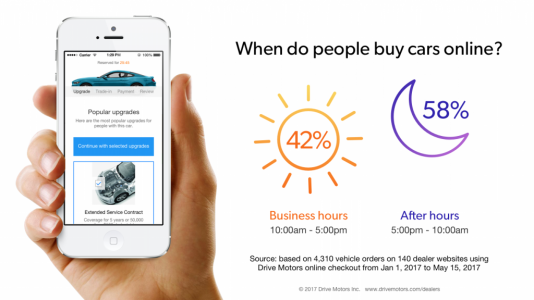
When do people buy cars online?

During our discussion, Aaron points out that depending on which state you're in, car buying may never become a full online experience - as some documents can only be signed offline.

However, there is a growing segment of car buyers that prefer to make their vehicle purchase on their own time. In fact, based on 4,310 vehicle orders across 140 dealer websites using the Drive Motors online checkout within 5 months, 58% of the transactions happened during office after hours, from 5 PM to 10 PM.

day-time-vs-night-time-buying-onlline-1024x576.png

More purchase intent than the average TV customer

Drive Motors is helping to facilitate more than 1,000 vehicle orders each month across its dealership base. This comes to about 50 per day, and 40-50 per month per dealership, with an average gross profit of $500-600 per unit.

Through all this, there are two key metrics they are observing:

  1. The drop-off abandonment rate is relatively high compared with other forms of e-commerce. This is to be expected however when you consider the novelty and newness of buying a car online, and the fact that it's a car which requires significantly more time and information.
  2. The return rate is noticeably higher than typical e-commerce levels, also to be expected when you consider the nature of the product being purchased.

But here's the most interesting point. Although the abandonment rate is high, the ratio of people who enter the online checkout funnel and complete the process entirely is higher than the average for e-commerce retail.

As Aaron suggests, the purchase intent of people doing online checkout is higher than your average TV customer.

Give Customers What They've Come to Expect

The average online checkout time with Drive Motors ranges between 15 and 30 minutes, plus about 30-60 minutes at the dealership. But as we stated earlier, most abandon the first time.

This is why Drive Motors recently added a feature to their checkout system which saves all of the buyer's preferences, including their trade-in and financial information, for a later time. When the buyer comes back to the dealer's website to complete the transaction, all of the information they entered remains.

This was a key feature introduced as an answer to the high abandonment rate - because as Aaron says, "almost no one will complete the transaction in the first visit, but they will the second or third time."
Aaron says that the online checkout system has to be developed to match the psychological buying process that buyers are used to.

It's about helping dealers integrate a simple online checkout

We want to help our dealers turn their customers' phones into cash registers.

This is Aaron's goal with dealers - to turn customers' phones into 24/7 "cash registers." Those are his exact words. The online checkout system needs to complement the buying process, not turn it upside down and certainly not replace the existing one already in place. This is accomplished but giving dealers and consumers a simple yet intelligent tool that integrates seamlessly with the dealership website, inventory, and their back office.

Online checkout isn't a magic pill by any means. In fact, when you listen to the interview, you will hear how Aaron is clear about the online checkout component being part of an already well functioning process and customer experience.
Chat and Mobile

When I asked Aaron about mobile adoption, he stated that 30 to 40 percent of online checkout users are on a mobile device. Plainly put, your online checkout experience must be designed with mobile in mind - first.
Additionally, the chat experience is also an integral component leading up to the online checkout process. Listen...

Highlights of my interview with Aaron Krane

Login to view embedded media View: https://youtu.be/p8obXVaCet0


Continue the Conversation

Do you think online checkout is right for your dealership? Continue the conversation in the forums using the link below and also be sure to check out our new podcast featuring this interview with Aaron Krane.

[highlight color="#f7b32e" font="black"]Discussion: Online Shopping to Online Buying[/highlight]
[highlight color="#CCE6FF" font="black"]Podcast: Episode 1 - Online Checkout, 56k modems, and more...[/highlight]

About Drive Motors

Drive Motors builds ecommerce experiences for auto dealers. With the Drive Motors online checkout experience, car buyers can order directly from the dealership website, day or night, including financing, leasing, trade-ins, vehicle upgrades, and pickup or same-day delivery. For more information visit www.drivemotors.com.

Mobile Car Shopper Conversion-Enhanced Product Suite Now Available to Dealers from LotLinx

CHICAGO, July 13, 2017 -- LotLinx, the leading VIN-specific digital marketing solution for the auto industry, today announced an expansion of their award-winning VS product suite with new CX solutions that enhance and customize the customer experience to generate more high-quality conversions for car dealers. New products include CX - Photo AI, which uses artificial intelligence to boost underperforming ads with optimized stock photos proven to convert shoppers at a higher rate. And CX - Amplified Mobile Pages (AMP), which offers dealers fast loading, mobile-friendly VIN landing pages optimized to drive high-value conversions such as click-to-contact and click-for-price for every car in their inventory. These new products are geared to strengthen VIN-specific consumer engagement and drive more profitable digital advertising campaigns for dealers of every size.

Recently, LotLinx expanded its VIN-specific solutions (VS) for Facebook to include VS - Lead-Enabled Retargeting and continues to roll out advanced product offerings to an industry facing a glut of car inventory. Because today’s online car shoppers are 90% more likely to view an ad that contains an image, and will wait just 3 seconds for a page to load before abandoning, the logical next step for LotLinx was to release the consumer experience-oriented CX suite. Photo AI was built to create more relevant and visually appealing ads for viewers, as well as detect when ads are running without any image. And as global consumers rely more on smartphones for their shopping, AMP delivers faster, conversion-enhancing pages allowing dealers to make the most out of mobile.

"The auto industry is constantly evolving, particularly with the shift from traditional ad spend to digital campaigns and outreach,” said Len Short, founder of LotLinx. “With these new consumer-oriented products, we’re taking a ‘dealer-first’ approach with solutions specifically designed for dealers who are faced with increased days-on-lot metrics. This is an exciting step forward for our company.”

The LotLinx TURN™ platform, which includes VS and CX product suites, offers dealers digital efficiency with marketing solutions that optimize spend - eliminating waste and increasing inventory turn up to 36%. Since the launch of TURN earlier this year, this fast-moving startup continues to grow and add seasoned marketing personnel to the team, including the recent addition of SVP of Channel Strategy Mark Connor, an auto industry veteran with a history of driving ROI and cost-efficient solutions for dealers nationwide. For more information, visit www.lotlinx.com.

About LotLinx:
LotLinx is an award-winning digital advertising technology company, developed specifically to advantage automotive dealers and the agencies that work with them, up to the OEM level. The LotLinx TURN platform can transform dealer results, dramatically increasing online engagement and net-new shoppers while eliminating digital advertising waste. Founded in 2012 and based in Chicago, LotLinx works with thousands of dealers around the country to reach over 63 million unique car shoppers per month across more than 500 digital properties.

4 Reasons You’re Not Getting Great Dealership Reviews

We watch a lot of videos around here, that goes without saying. Almost 1,000 videos come through on any given Monday, so it’s pretty easy for us to have a grasp on what’s important to car salesmen.

Customer reviews are at the top of the list, it’s not surprising considering 84% of people trust online reviews as much as a personal recommendation. They can make or break not only dealerships, but individual salesmen as well.

Over the years there has been an increase in videos centered around review requests; but in addition to that, the requests are getting more innovative and direct with a variety of strategies.

4 REASONS YOU DIDN’T GET A GREAT REVIEW, OR ANY AT ALL…


 1. You didn’t squash issues beforehand


This is a strategy we see a lot now, “Please contact me before submitting your review if for some reason you don’t feel completely satisfied, I can try to fix whatever it is.”  Address any negative feelings before the customer submits a review and tell them you need all 10’s and perfect scores for it to count.

2. You didn’t make it easy.

Most people will think it’s a hassle to leave a review... they’ll have to provide too much information, create accounts, it’ll take too much time, etc. Be sure to address these objections ahead of time. -- Provide links in your emails, online profiles, and social accounts. Let them know which ones will or won’t need an account along with detailed instructions. Give people ideas on what to say and prompt them when they’re most likely to be available, which is weekdays during work hours.

AUTHNTKWALKAROUNDVIDEOS.png


3. You didn’t ask

7 out of 10 customers will leave a review if they’re asked. The truth is most salesmen don’t directly ask for the review, and they don’t convey the importance of them either. Asking for reviews in person or on video is the best way to show customers how essential they are to your business. Try not to automate requests to multiple people at the same time, make it personal and genuinely ask each customer.

4. You didn’t give a good experience

Why wait until after the encounter to think about reviews? Go into every single sale with a “pursue the review” mindset. There is a great review in every customer, you just have to be good enough to get it out of them. Consider that a challenge!

Video can play a major role in helping you remind the customers to leave you a review, walk them through the process, etc... Check out this great video from Jennifer Baker at Causeway Honda. She sent this directly to the customer's inbox and phone:

Login to view embedded media View: https://www.youtube.com/watch?v=mYSRer9QWtM


A few tips about reviews…

The more engagement, the better the reviews. If you do get a negative review, always respond. There’s nothing worse than a negative review with no response. Studies show that dealer review response rates positively correlates to a higher average star rating.

Train your sales team on how to ask for reviews, or bring up a reputation marketing strategy at your next meeting. The greater success of the dealership, the greater your success. Use video to personalize the experience even further.
Reviews are essential to the millennial buyer. It’s no secret millennials are research experts. They rely on word-of-mouth and online reviews in making purchases more than any other generation.

What are you and your team doing to make sure you're getting perfect 10's? 

VIDEO: How to Design a Retargeting Program to Increase Return Visitors

If you managed to catch the live webinar with Ian Cruickshank from Speed Shift Media, you were one of the lucky folks to learn how exactly to design a retargeting program to increase return visitors to your dealership website.

But if you didn't catch it... well bad luck.

Just kidding!

The most website traffic comes from return visitors

During the 'Increase Online Conversions by Increasing Return Visitors' web chat; Ian explained how the most traffic to dealership website comes from return visitors (your more loyal audience and potential customers).

Oddly enough, dealerships spend thousands of dollars each year trying to attract new website traffic to disproportionate to what they spend converting return visitors. This results in financial losses and poor web marketing results which is something we talked about in another recent webinar with Ilana Zur.

Design an effective retargeting program for your dealership

So, if you want to give your business a boost through web marketing (and you should), start with maximizing your web traffic by designing an effective retargeting program. You'll definitely want to know how to avoid the most common problems with dealership retargeting and how to measure retargeting performance based on return visitors.

Mini-Webinar

Below is our latest mini-webinar, which we've produced for your convenience to quickly obtain the key talking points and highlights from the original webinar. To view the full version go here.

These condensed versions are designed to help you acquire useful knowledge quickly to learn innovative ideas, tactics, and strategies that will help boost your dealer business. We've also created a mini webinars tag, so you can find all of them in one place, check the other ones out too.

Login to view embedded media View: https://www.youtube.com/watch?v=ssni1JPK0Ag


Join the DiscussionWant to chime in about this article or topic? Head on over to the Dealer Forums to discuss. You can create a new discussion or join an existing one.

[highlight color="#f3b851" font="#000000"]Proceed to Forums[/highlight]

4 Reasons to Stop Using Your DMS as a HR System


Hiring new employees to your growing dealership can be EXCITING and STRESSFUL. 

Without a comprehensive human resources (HR) system, keeping track of your current employees’ payroll and adding new employees in the system can be difficult. It's fair to say your stress levels probably increase with the thought of the next pay period or the implementation of new compliance regulations.

Your dealership’s reliance on an outdated dealer management system (DMS) could be the reason for your continual struggle during the HR process.

Get Your Dealership’s Payroll Rolling...

Take a step in the right direction by incorporating a more conducive way to complete recruiting, hiring, onboarding and payroll. A DMS has strong suits in areas including inventory, sales and service operations, but it also possesses glaring flaws.

It is time for your dealership to consider an integrated HR system. Rather than putting up with tedious programs to complete payroll and administer benefits, your dealership can reduce inefficiency by incorporating an integrated HR system. For those dealer principals that are still on the fence, consider these limiting factors associated with your current DMS:

1. Limited Payroll Abilities

A DMS has the main function of yielding quantifiable information for dealerships. As time and technology progresses, a DMS provides increasingly limited services for your business. You are required to manually enter workflows to ensure your employees are getting paid. Completing extra steps to manage your dealership’s payroll and benefits are extraneous and unnecessary.

The manual system makes errors more prevalent for those who are responsible for the data entry. This creates a stressful environment for everyone involved because a DMS takes more time and effort to properly manage.

2. Difficult Onboarding

Typically, the first day of a new job is filled with paperwork and back office logistics. A DMS requires an extended amount of dedication to file and enter paperwork. An integrated system alleviates the paperwork process by providing a single location to enter all the information. You can focus on the other important training steps once the paperwork is entered quickly and correctly.

If your DMS is limiting the onboarding process then your new hire might not efficiently learn their role and your dealership’s expectations.

3. No Ability to Track Vacation, Training or Paid Leave

Providing your employees with a compliant PTO policy improves the morale within your dealership. You must be able to track your employee’s vacation and PTO days to provide a dependable policy. The dealership and your employees may experience distress if you run into snags along the way.

With a DMS you have no way to track your employees' vacation days. With no tracking system, you have three options:

  • A manual system
  • An entirely different system in addition to your DMS
  • A combination that requires confusing cross reference

Manually tracking these hours is costly and time consuming regardless of the route you choose. Using an advanced and well-rounded HR system can ensure your dealership doesn’t fall into the red because you can’t properly keep track of your employees’ off days.

4. Difficulty With Dealership Compliance

With no human resource information system (HRIS), onboarding system, tax calculation, filing system or benefit admin capabilities, a dealership is forced to work harder than necessary to keep its business up to par. Your dealership is wasting time and money by manually inserting all your employee information.

When your dealership is missing the necessary tools, you will always be steps behind the rest as you adjust to the state and federal regulations. Upgrading from a DMS to an integrated system is the best way to use your time and energy productively. Your HR team will no longer have to track down every compliance regulation, allowing them to focus on components concerning your employees’ well-being.

Benefits of Using an Integrated System

For those that are sick of difficult onboarding, limited payroll features, and staying up to date on regulations, an integrated HR system can help. You can significantly improve your employees’ work life by changing to an integrated system and eliminating the need for manual entry and cross referencing.

The difference in performances between an outdated DMS and an integrated HR system are worlds apart. Sophisticated and user friendly solutions for HR processes are provided by integrated systems.

Your dealership can benefit from one simple switch. Integrated systems are much easier to navigate compared to the DMS systems of the past. A cohesive integrated system is the only way to go if you want to create a cohesive dealership.

INFOGRAPHIC: Reaching Customers with Increased Personalization Through AI

Sponsored-Blue.png
Artificial Intelligence used to be something you'd only see in science-fiction novels, comics or movies. But these days AI isn't just for Terminators and space ships with an axe to grind. Car dealers are now able to use AI to improve personalization on their website and engage customers more fully - engagement that can be turned into conversions if you know how to use the tools properly.

Personalization is the newest way to connect with customers and stand out from the sea of advertisements and content jockeying for customer attention. By using AI technology, dealers can create smarter pop-ups, customized advertisements and better search engine results that place their dealership front and center.

Did you know that?

  • Smart Popups increase conversions by an average of 30%
  • Retargeting can boost ad response by 400%
  • 82% of marketers report that SEO is becoming more effective

[highlight color="#d65a3e" font="#ffffff"]
>> Infographic - AI Today: Reaching Customers with Increased Personalization <<

[/highlight]

ai-infographic-numbers.png


Learn how to apply AI to every step of the shopping process!

As AI develops, it will dramatically scale dealership customer service to reach a larger market, provide excellence to every customer, foster loyalty and return business, and increase revenue.

Get Your Free Infographic from AutoLeadStar Now

VIDEO: Four Elements to Running a More Profitable Buy Center

You've heard me talk about embracing a "new mindset" when it comes to the used car business. Some would argue there's nothing new at all, but I believe there is, particularly in how dealers source used vehicles and how they should be marketing to consumers.  I had the opportunity to recently to get with a few top pro's in the field and explore these ideas and see how they are embracing a new mindset within their used car departments.

Proactive strategy

During this recent discussion with Vehicle Acquisition Network Founder Tom Gregg (a DealerRefresh Sponsor) and Guests Aaron Gomez of Epic Auto Sales and Gary Wade of Morrie's Auto Group on "Buying Used Cars from Private Sellers," we concluded that based on our observations, there are only about one in five dealers that deploy a proactive strategy designed to source vehicles outside of auctions and vehicle trades.

[highlight color="#CCE6FF" font="#000000"]
>> Free Download - More Profitable Auto Buyers Handbook <<

[/highlight]

Unique Approach

My guests explained how each of their dealerships has its own unique process of acquiring used cars. Aaron Gomez, Remarketing Director at Epic Auto Sales, explains:

The wholesale market is completely different from the way it was even just a few years. We are seeing dealers unable to acquire all the used vehicles they need from the auctions. One of the more effective ways for us to provide our dealers with the vehicles they need is to offer great value to customers off the street.

Aaron and I talked about this in more depth during our interview on Vehicle Acquisition Network, where he explained what the new mindset is, how dealers can apply this way of thinking to used cars, and why a consumer would want to sell their car to a dealer.

Epic Auto Sales partnered with VAN earlier in the year and has been utilizing the network to build a more profitable used car strategy around buying more vehicles from private sellers.

Fundamental Shift

Many dealers are reluctant to change their approach and focus on establishing (and growing) a high-profit used car buy center. These dealers, I believe (and I'm not the only one) will be left behind. There's a fundamental shift in the used car business - Buying used cars from consumers is more profitable.

Four Elements Video

Watch this condensed version of this live web chat about buying used cars from consumers where we discuss the Four Elements to Running a More Profitable Buy Center. This will give you an idea of the core guidelines to follow in adapting to a new mindset and establishing a process which can lead to greater profit margins and a higher ROI with used cars.

Login to view embedded media View: https://www.youtube.com/watch?v=gAm9cpVtF24

VIDEO: Does Your Website Attack Visitors?

Did you know that e-commerce sites spend on average only $1 of their advertising budget on converting website traffic for every $92 spent driving website traffic [Source]? This could very well be one reason that more than 38% of website visitors leave a website due to poor design and layout? If you're looking to maximize your ad spend, these might be two specific areas to consider.

Converting website traffic is arguably one of the more over-looked and under-utilized practices on dealership websites. Most dealer sites "attack" users with numerous calls to action the moment they arrive, and the barrage is ceaseless.

For example...

als-dr-webinar-declutter-website-g1.png

Example of Dealership Homepage "Attacking" Visitors


als-dr-webinar-declutter-website-g2.png

Example of Dealer Website with Multiple CTAs

Considering that this is not an uncommon look for your typical dealership website, what can dealers do today to enhance the shopper experience on their sites and maximize their ROI?

[highlight color="#d65a3e" font="#ffffff"]
>> Free White Paper - Creating a Personalized Dealership Website <<

[/highlight]

In a recent live web chat with AutoLeadStar's Head of Business Development, Ilana Zur, Jeff and I took the opportunity to explore what dealers are doing wrong on their sites regarding calls to action, and what they can do to improve, and how.

During the webinar on how to "Declutter Your Website and Tighten Up Your VDP's," Ilana touched on three key points that dealers can and should be considering when it comes to their websites. She also gave examples of common mistakes dealers make on their sites, such as forcing too much information in one place for visitors to notice, not taking into account user friendliness.

Three Takeaways

  • Clarify your goals
  • Think UX
  • Tighten up your VDPs

Check out the edited 'mini version' of the webinar below where we introduce these three talking points and offer up a few suggestions. You can view the full recording on YouTube.

Login to view embedded media View: https://www.youtube.com/watch?v=mJ6po2fAiU4


[highlight color="#f4b945" font="white"]Join Discussion in the Forums with Other Members[/highlight]

[highlight color="#309ad3" font="white"]Listen to Corresponding Podcast Episode 2: Does Your Website Attack Visitors?[/highlight]

[highlight color="#d51d29" font="white"]Watch Full Version on YouTube - Trimmed for Quicker Viewing[/highlight]

How to "Pump Up" Market Share Using Social Incentives

Sponsored-Blue.png
In a down market, one Ford dealer needed a way to increase their overall market share and reduce the amount of pump-in sales lost to competitors. By leveraging the technique of matching sales data with consumer databases, the dealer was able to determine that they were losing more than 50% of sales to competitors in their market. This is what is referred to as "pump-in" sales.

Using the data that was available to them through strategic partnerships such as that with AutoHook, the alliance was able to identify specific areas of opportunity to grow their market share by targeting people with specific vehicles. They targeted the top three models they were losing to competitors - the Focus, Fusion, and Edge.

Using zip-code level targeting, in-market customers were incentivized to visit the dealerships for a $50 test drive incentive, as opposed to the normal $25 incentive. The incentive triggered at precise moments on the dealership's website where targeted shoppers were viewing the three targeted models.

The Results?

Despite a declining market, the dealership was able to significantly reduce pump-in sales lost to their top two competitors and successfully gain market share using AutoHook's private incentive offers and sales match attribution reporting. By how much? Download the free PDF here to see the complete numbers.

[highlight color="#417fab" font="#e67a00"]
>> AutoHook Pumps-Up Market Share for Ford Dealership <<

[/highlight]

Using targeted offers on these identified vehicles of opportunity, the total number of lost sales across the three models was reduced by 50% or more, and was maintained month-over-month for the following three months.

For more information about this case study, the dealership and the strategic partnerships, follow this link to immediately obtain a copy of the AutoHook Case Study.

Integrated Partnership

Great solutions are a result of knowing what you're best at and sticking to it. AutoHook's core competency is in securing their private offer and redemption rail system within dealerships and directly proving the source that led to a sale or a new-to-brand buyer. AutoHook knows their specialty is in delivering the industry's best sales attribution reporting. Social Dealer specializes in running successful Facebook campaigns, which is why AutoHook chose to partner with them to carry out this initiative.

For more information about the AutoHook partner integration with SOCIALDEALER, read, Is Vendor Integration the New Innovation?

Interview with AutoHook and SOCIALDEALER

From Hire to Profit: Analyzing How Long It Takes a New Salesperson to Become Profitable

When you hire a new salesperson at your dealership, you are investing in the future.

Just like with any investment, you can predict when this investment will break even and, eventually, when it will become profitable. In fact, the cost of a new salesperson starts to negatively impact your bottom line the minute you hire them. Employees often take quite a bit of time to get themselves out of the red. The truth is that while your sales department is a major source of revenue for your dealership, the individuals in that department are a drain on your resources before they ever start becoming profitable.

To better understand where your money is going and if a new hire is on track to break even... it's critical to analyze a new salesperson's time-to-profitability.

Calculating Employee Profitability

In order to accurately calculate when a particular employee will become profitable, you need to begin figuring out the cost of your salesperson and compare it against their future profits. Be sure you are factoring the total monthly cost of an employee not just their base salary. Don’t forget to add in incentives like:

  • Benefits
  • Commission
  • Training

After you finish calculating the total monthly cost of your salesperson, subtract that amount from the employee’s expected future profits. Armed with this information, you can begin figuring out how many months it will take for the employee to break even in terms of salary and total monthly costs to your dealership.

By analyzing these key metrics, you will have a pretty good idea of what kind of standard to hold your employees up against. Outside of new hires, this calculation method can also help managers identify top sales people and understand the total profit potential of those that are underperforming.

Keeping Track Of Employee Progress

Dealerships that have a fully integrated Applicant Tracking System (ATS) in their Human Resources (HR) software can track and monitor an employee’s results and profitability fairly easily. Just like you were able to use your ATS to find and recruit salespeople, you can also use that same system once they’ve been hired to track and evaluate their progress and benchmarks.

If you’re working with an HR stack that includes an ATS with integrated payroll, your ATS will work hand-in-hand with your payroll software to monitor your salesperson's time to profitability. You can use the data collected to compare your employee’s performance and see what methods of training, onboarding and incentives have been effective and which could use some re-tooling. This approach can be useful for dealerships looking to help their employees reach profitability faster.

Onboarding Process

The quickest way to have your employees reach profitability is to move them from new job applicant to “on the showroom floor selling cars” in as short a time frame as possible. The more efficient your hiring process, the quicker you can have salespeople out there generating revenue.

An efficient hiring process is not complete without a clearly defined new hire onboarding process. If your dealership is all over the place with its onboarding process, your new employees will be less likely to make an impact right away – extending their time-to-profitability. Without proper onboarding, new hires won’t get the training and tools to excel quickly in their new role. They will struggle initially and continue to feel like they are always playing catchup. If your dealership doesn’t invest the time and effort to get new hires fully integrated into your operations, it will be reflected in their ability, or lack thereof, to produce.

A formal onboarding program gives your dealership a way to track progress and jump in earlier if a salesperson is having trouble meeting goals and benchmarks. Onboarding ensures that there is communication with the employees until they feel comfortable in their sales role. Regular check-ins from your management and training team can fix any issues that arise early in the process and get employees comfortable and profitable and a faster rate.

By calculating your employees profitably, integrating your ATS into your HR software and creating a well-defined onboarding process, you can optimize your dealerships resources and decrease the time it takes to make your employees profitable. Constant measuring and retooling of training and incentives based on employee performance can ensure a favorable time-to-profitability.

What’s stopping your employees from achieving the results you wish to see for your dealership?

Free Dealer Guide: Leveraging Online Reviews for a Competitive Edge

Sponsored-Blue.png
Online reviews are the new word of mouth. A positive online review of your dealership causes a ripple effect that creates sales faster than a one-on-one conversation ever could.

The good news is that you can put reviews to work for you as
a competitive asset to grow sales, improve customer retention and empower your sales staff.

The key is to take ownership of reviews by creating a process for systematically managing them.

Read the full report below, to understand the importance of reviews in today’s car buying journey, as well as critical next steps you need to take to win with online reviews. After reading this report, you will learn:

  • How to take ownership of your reviews by actively managing them
  • How to highlight your reviews to drive customer retention and sales
  • How to use reviews to engage and retain your sales staff

The voice of the customer has a powerful impact on business today. You have a good opportunity to use reviews, both positive and negative –to acquire customers and create lifetime value.

Read on to start turning online reviews into one of your strongest competitive assets.

[highlight color="#e45825" font="#ffffff"]
>> Go Here to Now to Get this Free Guide from DealerRater <<

[/highlight]


The power of reviews

A huge 73% of consumers, looking to purchase a car, place a high value on consumer reviews and expert reviews. Today, online consumer reviews are also more readily available – something the Millennial generation has grown up expecting.  Online reviews also play a pivotal role in making your dealership more visible through search engine optimization (SEO), especially at the local level given the prominence of reviews online.

If you don’t currently have a reviews strategy, and you have less than three reviews – and they’re negative – you are likely deterring customers from your dealership. Your minimum goal is to have at least five for car shoppers to read and consider.

Go here now to get this free dealer guide and start implementing an online review strategy for your dealership to make reviews the most valuable asset of your marketing. This will give you the competitive edge to boost your sales to a higher level.


Meeting People Where Their Needs Are: Interview with George Grubbs, CEO, Grubbs Automotive Group

Sponsored-Blue.png

George Grubbs' approach to car sales is simple and personal. He sums it up as "Meeting people where their needs are." Since he and his family have been selling cars since the 1940s, they know a few things about developing relationships that turn into sales now and for years to come.

Over the past 70 years, Grubbs Infiniti has learned to adapt to new generations when it comes to car sales and building relationships. In the mid-90s they developed and launched the first Nissan website in the country and since then they have worked to stay at the cutting edge of technology while watching the ROI on everything they do.

When it comes to research on where to invest their time, energy and money George sticks to the basics. He says he reads everything he can and keeps a close eye on how soon results can be seen as well as how those results are measured.

Business decisions based on reliable results

"When I try something new, I need to see results," he reported in a recent CBT Automotive Network interview.

"What I look for when I talk to a new vendor is what do their reports look like? [...] How often are they gathering the data and how often are they giving it to me?"

But Grubbs doesn't settle for just being given data and reports on a regular basis. He says he prefers a vendor who can offer a back end tool so he can log in and check trends and results on the fly. Reliable results give a dealer that competitive edge.

[highlight color="#DE2424" font="#ffffff"]
>> Free Case Study - Increase Sales Velocity by 67% <<

[/highlight]


Technology and Customer Relationships

His hands on approach to technological advancement and developing relationships with customers, based on how they want to interact, has certainly paid off. Customer reviews from across various platforms including Yelp, Facebook, and Cars.com have customers praising everything; from their well-appointed waiting room to their pricing and service.

Clearly, being willing to adapt to the latest trends in technology and digital marketing for dealers, and to meet customers on their level, translates into a healthy bottom line and a bright future.

Follow the link below to watch the full interview with Geroge Grubbs on CBT News:

george-grubbs-automotive-cbt-interview-650x400.png

Filter