• This thread is just the tip of the iceberg.The people ahead of the curve aren't Googling for answers — they're already in here, having the conversations you haven't found yet. DealerRefresh is free.Get the full picture →

Facebook Graph Search…What Next?

Facebook Graph Search - How Should Your Dealership Prepare?

I’ve written in the past about optimizing your Facebook business page for Facebook Graph Search.

Graph Search is Facebook’s most recent search tool iteration, helping users make connections to existing people and places that were previously difficult to find. With a clean interface and natural search capabilities, Graph Search unlocks the massive amount of data logged into Facebook by individuals and businesses each day.

Even though Facebook CEO Mark Zuckerberg has emphasized that Graph Search is "not Web search,” many would agree that this is Facebook’s attempt to compete with Google. Unlike Google’s current search algorithm, Graph Search relies on social interactions to build its search database.

Today, businesses can be optimized for the current Graph Search tool. For dealerships, this involves: listing the dealership as a business instead of a person and once listed as a Facebook business page, selecting relevant business categories. Since Graph Search currently only searches business names and categories, these two steps are the most critical today.
What about the next step?

How should dealerships prepare for the evolution of Graph Search in the future?

Over time, Facebook will index more than business names and categories. Instead, it will begin to index more of the content on dealership business pages. While Facebook needs to balance Graph Search with privacy concerns, publicly available information is fair game.

Make sure your dealership’s Facebook business page has relevant, keyword rich entries in both the “Short Description” and “Company Overview” sections. In the way websites are optimized for SEO, Facebook business pages should use words that the average consumer would use in search.
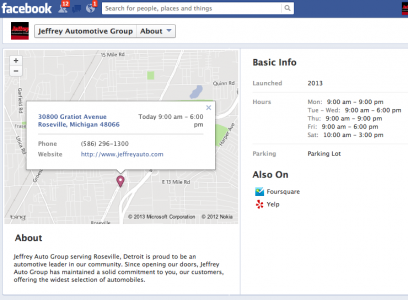
dealer_page_showing_description_fields.png

Dealer Page showing Description Fields

Since Facebook is using EdgeRank to prioritize search results, both dealership business pages and individual posts need plenty of likes. EdgeRank is Facebook’s proprietary algorithm for deciding which content will appear in people’s news feeds, and how it will be ranked.

EdgeRank examines the level of engagement for individual posts as well as the sources of that engagement. The more likes, shares, and comments a post receives, the higher it will rank. When consumers engage with a specific dealership, that dealership’s posts have a better chance of appearing in the news feeds of those car buyers.

For dealership business pages, the value of a Facebook like continues to grow. With Graph Search, places liked by your friends are weighted as more relevant than those liked by individuals you don’t know. Dealers should focus on not only growing the business page’s fan base, but generating an increasing number of likes from friends of fans.

There are many tried and tested ways to generate more fans and likes, including organic and paid promotional campaigns. Another great way to build your Facebook network as Graph Search evolves is to encourage more Facebook check-ins at your dealership. Visitors to your dealership end up notifying their social networks of your brand and physical location at no cost. Dealerships can encourage check-ins by building Facebook Offers that are redeemed with each check-in.

The goal for dealerships should be to drive your listing to the top of Graph Search. In order to do this, it helps to have increasing fans, likes and check-ins.
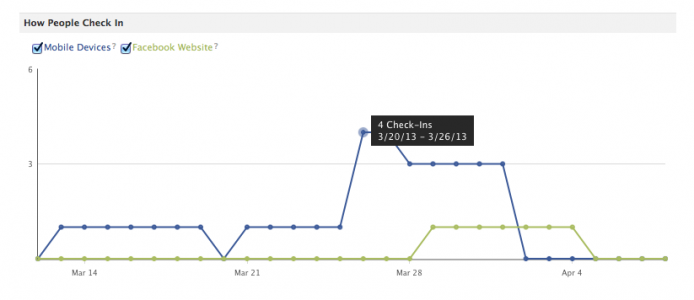
visitors_facebook_check-ns.png

Visitors from Facebook Check-ins

Think strategically about how traditional website SEO, along with Graph Search optimization, can create a successful marketing loop for your dealership. Strong website SEO can feed people into your Facebook page and generate more likes. Additional Facebook likes improve Graph Search ranking, which then channels new traffic back to the dealership’s website. Google brings in likes for Facebook. Facebook drives new visitors to your site.

Images continue to grow in importance in Social Media, and Facebook is no different. Posts and pages with images generate more attention, likes, comments, and shares. Geo-tag all uploaded images with city and state information so they can be found in location-based searches on Graph Search.

Regardless of whether or not a consumer indicates a location in Graph Search, Facebook automatically prioritizes businesses that are closest to the user’s location. This is especially evident on mobile devices. If customers or employees are posting images to your business page, ask them to geo-tag those images as well.
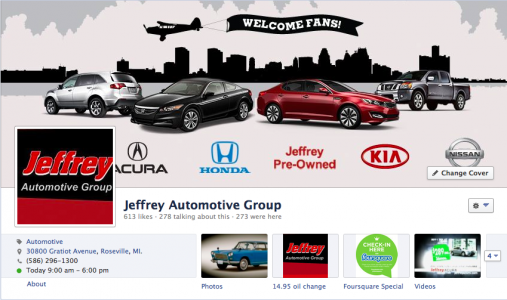
dealership_with_visitors_from_check-ins.png

Visitors from Facebook Check-ins

A potentially negative impact of Graph Search may lie within dealership employees. Specifically, current or former employees of your dealership, and what their individual online profiles reflect.

The natural language search function of Graph Search allows an endless number of combinations, meaning that employees of your store that like controversial interests, books, movies, etc, on Facebook could reflect back on your dealership.

A search like the one below reflects unfavorably on any store.
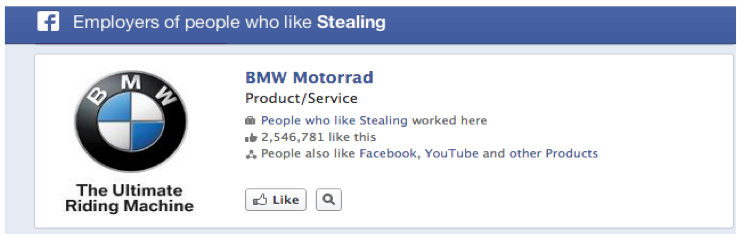
facebook_HR_nightmare.png

Possible HR Nightmare

This may call for future HR policies for your employees when it comes to tagging your dealership as their current or former employer.

While global adoption of Facebook Graph Search takes time, there are many who already find the tool extremely helpful. As with many other digital marketing strategies, the key is to focus on the low-hanging fruit; easy steps you can take to optimize your online presence.

The next step will be to create compelling strategies and campaigns to increase Graph Search engagement. To be successful with Graph Search, there’s no substitute for creating unique, engaging, and relevant content that will appeal to your current and future fans.

Are you ready for Facebook Graph Search?
 

Custom Content: A Conversion Machine

Hey Brian,
Love the direction we’re headed here.   The full “influence” of a conversion is what we’re all looking for right?  :) 
Quick note: I appreciate the disclosure that what you’re suggesting does not include phone calls.  We've been obsessed with this notion for a while now and the good news is MCSF can include phone calls.  The result of this obsession is our product CallConvert.  It takes our digital trakcing a next step and tells the full attribution story of a phone call in Analytics and AdWords. Imagine your fictitious example above but with a phone call as the payoff.
We’re getting some good feedback from folks on this digital piece of our http://wwm.carwars.com/platform_a/join/?CFID=10078313&CFTOKEN=45828907 product.  Let me know if you’d chat!

Custom Content: A Conversion Machine

How to track the influence of custom content

Last year I wrote a number of articles on how to setup Google Analytics Multi-Channel Sales Funnels (MCSF) to track assisted conversions. I was thinking about how dealers could use MCSF to show that their blogs and custom content helped in the lead submission process.

If we can show dealers that blog posts and customized content were part of the shopper’s journey PRIOR to submitting a lead, the content budget could be supported. There is always a struggle inside the dealership on the value of custom content despite numerous articles stating why unique content is important for search rankings and social citations.

The measurement system I am suggesting is not perfect because MCSF does not track phone calls. It can work well for tracking the influence of dealership generated custom content on form submissions. As quality content is indexed and read by consumers, I will tell you that it will show in the conversion path to the eventual triggering of a Google Analytics goal when a lead is submitted.

Here is the quick overview of what needs to be done:

  1. Make sure you have Goals set in Google Analytics for all your form submissions, here are a few suggestions:
    • Contact Us
    • Request E-Price
    • Service Appointments
    • Finance Applications
    • Trade-In Price Quotes
  2. Some website platforms have Goals preset. Dealer.com and KPA are two website platforms that have Analytics Events & Goals preloaded, so check with your website provider before you create goals.
  3. Identify the “root” URL of your blog.  This is the common text that starts all blog posts.  For Dealer.com websites, that root can be: /blog/. You will need to see what other website vendors have for your blog, this was just one example.
  4. Identify the “root” URL of all your custom content pages, if you have properly organized the pages in a single folder.
  5. Go into “Conversion” > “Multi Channel Funnels” > “Assisted Conversions” and create a “Custom Channel Grouping”.
  6. Setup a custom channel to identify blog content pages.
  7. Setup another custom channel for custom landing pages.
  8. Place your custom channels at the top of your channel grouping list.
  9. Save your custom channel grouping and start collecting data.

Examples of customized channel:

In the example below, I created a custom channel called “Blog Content” that is triggered when a consumer lands on any page that starts with /blog/. For Hyundai of St Augustine, this is the root URL for all blog posts on their Dealer.com website.

Your dealership blog may reside on a sub-domain or it could also be in a directory folder like the example shown here. In any case, once you find the root domain pattern, you can setup a custom channel like the image shown below.


Place custom channels at the top of your channel grouping:

Then, you can place your custom channel in the top position to make sure that other channel rules don’t override the influence of your blog content. Of course you can create other custom channels for all customized sources of traffic to dealership websites. A blog is just one content example, but you can create custom channels for microsites, social media investments, etc.

If you are creating custom landing pages for your website, you can also track those content investments as well. If you can store all your custom pages in a folder such as /custom/, create another custom channel to track when consumers hit those custom pages. The idea is to track the impact of customized content you add to your website on form submissions.

In the list below, you can see that I dragged my “Blog Content” custom channel to the top position.  All custom channels you create should go before any stock channels that Google provides.


Once this is setup properly, you can see how many leads were submitted that had a custom page of content or a blog post triggered BEFORE the lead was submitted. In the fictitious example below, the custom channel for the dealership blog was called “Blog” and each line represents a lead form being submitted. You can see how the dealership blog influenced two leads:


Syndicating your great content is another step in understanding how consumers utilize your website and how relevant your content is to shoppers.

  1. Good content should be easily found on your website navigation.
  2. Good content should be shared and optimized to be found on social networks and in organic search.
  3. Good content should differentiate your dealership and build value with local consumers.
  4. Good content should be posted on a regular basis.

Questions:

Are you a believer in custom content and it's influence on conversion and lead generation? 


[highlight color="#F7D358" font="black"]If you believe in creating high quality content for your car shoppers, and would like to learn more about setting up Google Analytics to show the INFLUENCE of that content on lead submissions then be sure to attend Brian's Google Analytics workshop at the 4th Annual Automotive Boot Camp.

The event will be held on May 14th, 15th and 16th at the Sheraton Philadelphia Downtown Hotel. For more information, visit www.automotivebootcamp.com or contact Carrie Hemphill at 908-601-6475.[/highlight]

What Your Toddler Can Teach You About Differentiating Your Dealership


Four-year-old Martina is about to teach you a lesson.

[highlight color="#F0F0F0" font="black"]You: Martina, it's time for bed, sweetie.
Martina: Why?
You: Because you've had a long day and you're going to be getting sleepy soon.
Martina: Why?
You: Well, because you played outside and ran around the house all day.
Martina: Why?
You: Because you're four!
Martina: Why?
You: [Sigh][/highlight]

If you've ever worked a gig as a parent (or babysitter, for that matter), you know about the "Why Game." Even though it originates with kids, it can also be heard played out in conversations in your dealership too. My buddy Brian Pasch warns us about avoiding what he calls “white noise" when playing the "Why Game."

What's white noise? Here are some examples...
[highlight color="#F0F0F0" font="black"]You: Why should someone buy from us?
Eddie: Because we're the best dealership in the area. (WHITE NOISE!)
You: Why?
Eddie: Um, because we sell in a consultative manner, effectively helping people buy and not selling them.
You: Better! Why?
Eddie: We work on salary and bonuses, not commission, so we deliver a no-pressure sales experience.
You: Ha – that's what I’m looking for![/highlight]

Or...
[highlight color="#F0F0F0" font="black"]You: Why should someone buy from us?
Angela: Because we take care of our customers. (WHITE NOISE!)
You: Why?
Angela: Well, because we don't just want them to do business with us one time. We want customers for life!
You: Better!
Angela: That's why employees get a Hawaiian vacation when they reach ten years. We just think there's something nice about the same person who sold you your first "married couple" car also selling you your first minivan when junior comes along... knowing that you'll see the same friendly face through life's biggest changes.
You: Perfecto![/highlight]

Drilling down to define your dealership's unique "why buy" message can help you win the "Why Game" and stand out from the white noise that's constantly competing for the attention of your prospective customers.

The new eBook by Cobalt, Defining Your Dealership Why, helps explain how you can answer the "why buy" question, and how doing so can help you attract and retain like-minded customers.

Does "why buy" messaging still feel warm and fuzzy, but not practical for your bottom line?
Do you still think you don't need to bother differentiating because the OEM does it for you?

Check out these startling stats from our automotive-shopping activity study:

  • The study shows that shoppers visit a minimum of eight dealer websites. That’s the minimum! Your “why buy” messaging is the key to separating your dealership from the competition.
  • The same study tracked the purchase journey of one family and revealed that they had been exposed to a total of 329 dealership ads over their 90 day shopping journey. Injecting your advertising with a healthy dose of your “why buy” messaging can differentiate your impression from the hundreds of others competing for that family’s attention.

dealership_online_ad_exposure_avergage_shopper.jpg


  • It also tracked the online activity of one brand loyal shopper who shopped his favorite brand exclusively, but did not show loyalty to any one dealership. In fact, he shopped his brand across 20 dealership websites in a single day!

online_car_shopper_shops_20_dealers.jpg


His journey illustrates that brand alignment is the baseline, but it's not the full equation. This is further supported by the fact that of the 75% of shoppers who visited OEM websites, most of those visited the OEM website and the dealer website within the same 30 minutes.

Moral of the story: The OEM only starts the “why buy” equity; it's your job to finish it.


"Why" is the reason they buy

What's YOUR dealership why? Learn how answering the "Why Buy?" question can transform your dealership today.
Download eBook

Change: The Comfort of Constant

This is so good. 
"often their efforts center essentially around trying to make their new system into their old system" - I like the idea of a 30 Day Normalization agreement with a combative user. Instead we frequently build backward to accommodate clients who get overwhelmed by new stuff. I'm surprised at how often this is required.
I can understand why this is so frustrating to John in particular. I had the pleasure of working with him (in his previous life a few years ago), and he was one of the few dealer leaders who openly welcomed a new vendor with a "show me what ya' got!" attitude.
Great article - thanks for sharing, John!

Change: The Comfort of Constant

Dog-meme.png

How does your dealerships adapt to change?

Recently, the wife took the kids for a small spring-break vacation before school started back up. Me and the pooch had the house to ourselves for a while.

That Saturday morning, I was inspired: the dog was getting up there in age; she’d been with me a long, long time. She deserved a reward. I decided right then that I was going to upgrade her doghouse – no, build a new doghouse – the best doghouse the world has ever seen!

So I ran to Lowes and loaded-up, and spared no expense. By Sunday afternoon, I had constructed the Mother of All Doghouses: a Skylight, Central Air, Running Water, Carpet so thick the princess would not have felt the pea, and an automatic Treat Dispenser with Unlimited Treats! Robin Leach would have been at a loss for words describing this Ultimate Doghouse.

I was sooooo excited to show man’s best friend! I ran in the house the get her, we strolled out onto the back deck. I proudly surveyed the back yard as she took it all in. She went down the steps, took a good look and…

…went straight into her old doghouse and laid down. She was familiar with her old doghouse; that’s where she was comfortable.

Working with many dealers and a brand new CRM system, I see similar patterns. The paradox is that dealers want something new, something better – something easier to use that will produce improvements and positively affect the bottom line. But as soon as the opportunity is presented, often their efforts center essentially around trying to make their new system into their old system.

It’s human nature: familiarity breeds comfort. As often as we experience “Change” in the automotive landscape, it’s still hard to embrace. So I offer a couple of tips to help ease that transition in your next major process or systems overhaul.

30 Days of Normalization

Set the expectation with the staff that it is absolutely normal and should be expected that any major change will be implemented with a certain level of unease – even fear – but that’s OK. It’s amazing to see how users interact with familiar systems. They can look you in the eye and their hands are moving their mouse to a spot on the screen unconsciously.

With a new system, for a short while, the eyes will need to “search” the screen and your hand/mouse will have to catch-up to your eyes. But with every “click” and every day using the system, familiarity starts to set-in, and comfort will follow. It just takes a little time and practice.

Set the expectation that this “unease” is normal and that it may take up to 30 days for this new system to feel normal, but it absolutely will happen.

New = Fresh Start

You have a new system – explore what it does new and better than your old system! If all of your time is spent looking in the rear-view mirror, trying to make your new gizmo do all the old stuff with which you were familiar, then you might miss the opportunity to do something better.

You made the leap – you signed the contract because you wanted something better – you wanted this change. You now have the perfect opportunity for a Fresh Start. Embrace the change and try something new. Remember the definition of ‘insanity:’ doing the same thing repetitively and expecting a different result.

Expedite Familiarity

One sure-fire way to prolong the unease of a new system or process is to grant access to the old system or process for any length of time. In other words, the longer you let them access the old system, the longer it will take to get familiar and comfortable with the new system. Institute a Clean-Break policy: no longer than 1 week access to the old system. Sooner is even better. Your goal is to be comfortable after 30 days – keep that in-mind if you think restricting access after a day or two sounds like tough-love.

Change is a constant in our business: people, product, technology. Setting the right expectations and properly managing the process of change itself can really help ease frustrations and lead to a better experience in the long run.

Trust me, after I got rid of that old doghouse, my pooch has never been happier.

When was the last time you built a new Dog House for your dealership? 

Filter