• This thread is just the tip of the iceberg.The people ahead of the curve aren't Googling for answers — they're already in here, having the conversations you haven't found yet. DealerRefresh is free.Get the full picture →

Is Mobile Reshaping Your Dealerships Marketing Plan For 2012

OK -- I think we can concede that the non-smart phone can call-up the 8-Track for retirment advice...  Great info, Ben.  Thanks!
 
Wonder where "Pads" fit into this?  Setting aside the iGeeks, I can't see mainstream carrying smart-phones and pads simultaneously for their mobile needs.  Will Pads replace laptops and PC's?  Or will (maybe) Smart-Phones and Pads "merge" into one unit?

Is Mobile Reshaping Your Dealerships Marketing Plan For 2012

Girl-iphone.jpg

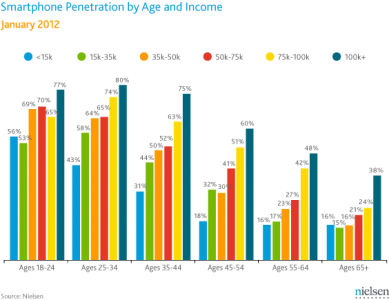
Nielsen recently released interesting data on the typical U.S. smartphone user. Targeting age and income, we learn that the smartphone is quickly transitioning from luxury to necessity.

Let’s dig into the numbers. Nielsen’s sample size is 20,000 mobile consumers, segmented by age and income. My three takeaways from the data.

  1. The younger generation considers a smartphone a necessity, including those just above the poverty level.
  2. When they can afford it, the older generation is adopting to new smartphone technology.
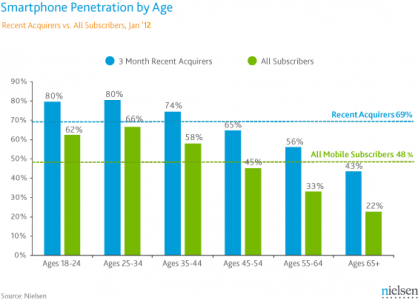
  3. Younger subscribers, new within the last 3 months, are choosing smartphones 8 out of 10 times. Compare this number with current subscribers of which less than 50% are smartphone owners.

NielsenData1.png

1. Younger generation: Smartphone = must have.

Let’s examine the 18-24 and 25-34 age group. While it’s no surprise that young high income earners choose smartphones, what should stand out is that 56% of 18-24 year olds and 43% of 25-34 year olds making less than $15k per year have a smartphone. That’s right, roughly half of young individuals surveyed who are only a few thousand dollars short of the 2011 poverty level of $10,890 made room in their budgets for the luxury known as a smartphone.

While income earners in the <$15k bracket should not be our focus demographic, I think there’s an important overall message:

The future generation considers smartphones a necessity. Period.

2. Older generation: I’ll adapt if I can afford it.

Age group 45-54 shows income earners in the $75k-$100k range opt for smartphones 51% of the time while 55-64 year olds in the same bracket choose a smartphone at a rate of 42%.

Takeaway? Smartphones aren’t just for the younger generation. Desirable demos in the older age bracket are increasingly considering this new technology essential.

NielsenData2.png

3. New subscribers are choosing smartphones rather than traditional mobile phones.

Nielsen’s graphic on smartphone penetration by age gives us an overwhelming look at new subscriber habits and their taste for smartphones.

Across all age ranges, new subscribers choose smartphones at a rate of 69% compared to 48% adoption for current subscribers. Segmenting the younger age ranges of 18-34 we see an adoption rate of 80%. That’s 8 out of every 10 new mobile phone subscriber between the ages of 18 and 34 choosing to purchase a smartphone over a traditional mobile phone. Wow.

I think this helps solidify the “trend” of smartphone penetration.

Compare Nielsen’s data to your dealerships and franchise’s demographics. Is the adoption rate high?

Compare your target age demo in the penetration by age graphic. How much have recent subscribers adopted smartphones compared to current?

Post your comments:

What steps has your dealership taken recently to cater to your customer on the go?
How has mobile shaped your marketing plan for 2012?

Lost in Translation

 @Mark Hilger They do!  But be careful of considering it "dumbing it down."
 
If I ran into someone tomorrow who could describe to me the intricacies of the transistor, I'd consider that person a smart dude ( or dudette), even though the technology is no longer relevant.
 
Similarly, "Reach & Frequency," perhaps now being replaced by Share of Voice and  leading to discussions of CTR and VDP's, is no more relevant or less relevant to an advertising discussion as the person who assigns a legitimate value to the terms being discussed.
 
Here's where my degree in English is serving me well:  Language, like Advertising, is an EVOLUTION: you are wise to consider the past when assessing the future.
 
Thanks for reading!!!
 

Lost in Translation

 @JohnGQuinn many of us get mad when a Dealer doesn't get it.  I see IT oriented people all the time talking in highly technical jargon that often comes across as gibberish to the lay person.
I don't know about you but I have often thought that a person that can "dumb" it down while explaining complex topics has a real talent.
 

Lost in Translation

 @Joe Mescher Wow... what a great way to phrase it!!  (I think... I have to go look-up those words... BRB)  ;)
 
There's a reason Dealers are comfortable spending $50K per month in the newspaper, but can't imagine spending $20K a month on Display -- if we understand that reason, and TRANSLATE everything to equal terms, we give Dealers the opportunity to make a truly informed decision.

Lost in Translation

blahblahblah2.jpg

As a complete Noob to the vendor world, I am constantly afforded the opportunity to learn new and amazing things... sometimes on an hourly basis. Talk about a One-Eighty: 15 years in the dealership, then to one of the most progressive automotive software solutions provider in the industry. When I’m lucky enough to get invited to a meeting, I have to admit that half the time, I have no idea what the hell they are talking about!  I’m still learning the language.

Complimenting my new friend Joe Mescher (@joemescher) the other day on his article discussing the Google Cookie Monster, I think we both got that “hmmm.... that might make a good snippet” look. I’m a huge fan of Joe’s writing and won’t pretend to be able to add much depth to any conversation about digital marketing from the vendor side, but let me know if this sounds at all familiar in your store:

After seeing a few discussions over in the forums, I (my dealership’s E-Commerce Manager or ISM) get an idea.  I do some research, and I get excited! I dig-in and really do my homework, and I am convinced that, for about $5000 a month, and with very little effort, I can completely own share of voice with a display campaign in my market.  I CAN’T WAIT  to get in front of the GM!! I set a meeting. I get-up a little earlier... dress a little nicer... stop at Dunkin and bring-in a Box O’ Joe, and when it’s time, I proudly Release The Hounds with:

“I’ve found a new display product that will make it easy for us to develop a contextual display campaign across the Google ad network while helping us build a pixel pool for those high-ROI re-marketing campaigns.”

In all likelihood, what my Dealer just heard:

(that’s Charlie Brown’s Teacher for the You Tube impaired)

GM says, “How much?”

I say, “Only about $5000 a month!”

GM, after forcibly pushing his eyeballs back in his socket and and wiping-up the coffee he just spit all over his table, politely says, “Uh, yeah. Good work. Lemme mull that over a bit and get back to you.” (This is a very polite GM).

So what was the problem? Was it my research? No. Solid. Is the dealership out of money? Nope. Solid. Maybe the GM just doesn’t like me? Doubt it, I seem to be his go-to for a lot of stuff.  Maybe the GM just doesn’t get it? That must be it.

“These guys just don’t get it!”  The mantra of a many a frustrated ISM....

But I have news for you: your dealer may actually get it. But he doesn’t understand your language. Like the noob in the midst of vendor genius, your Dealer spent most of his career with a certain “language” that is both comfortable and familiar. Newsflash: your Dealer is not going to learn your language. It’s your job to learn his/hers. And your paycheck reflects your ability to master this language.

The point is, if you can make your Dealer understand your point on his/her terms, you’ve done your job. To do this, you need to understand their world; step 1, their language.

Back to our example. We’re talking about advertising, right? My dealer spends A LOT of money on advertising, so he should know something about advertising... So what does he know?

Well, we’ve done a lot of TV and radio advertising, so he probably understands a little about “Reach” and “Frequency” and has an understood value surrounding those campaign numbers. So maybe if I can describe the Google Ad Network in terms of Reach (how many will see the ad) and Frequency (how often my ads will be seen), my guy can begin to make a valid value comparison in his mind. Next, ad-in the idea that instead of these “commercials” appearing on the evening news, or the game on Sunday, these ads will appear on websites where the context of the site matches the context of your ads; we have cars to sell, the people seeing these ads are interested in cars. I now let my GM know that this new product does all of this in about 5 clicks so we won’t have to pay the agency to produce these ads like radio and TV ads, and now perhaps he starts to see the light.

Am I really saying anything different above then in the first example? Nope -- just used another language: translated Digital Speak into Dealer Speak.

Dealers do a lot of print advertising too. Would it make sense for ISM’s to be able to translate dollars-per-column-inch to CTR to SRP to VDP’s?

Of course, some Dealers do get it, many of which are readers of this blog.  I imagine a few can hold a Digital Speak conversation with their ISM or even their Vendor Rep without the need of a translator.  But I’m really wondering how many of the “new” breed of ISM and E-Comm Managers have taken the time to learn the language of their predecessors.

Are you multi-lingual?.

The Reputation Score You’re Not Checking and Should Be

How to find the ip address your email is sent from: Step 1: locate a sample email sent from the server you want to monitor. Step 2: Locate the header of that email. How to find the header in the email depends on what email program you use. This link should be helpful: http://whatismyipaddress.com/find-headers. Step 3: Locate the IP address in the header of the sample email. The IP address consists of four groups of numbers separated by periods and look something like 127.90.40.15. Step 5: Plug this IP number into any of the free lookup tools.

The Reputation Score You’re Not Checking and Should Be

bigstock_desperate_manager_27477212.jpg

You’re probably monitoring your dealership’s online reputation with customers on DealerRater and Google, but did you know there is another element of your dealership’s reputation that is being scored that can dramatically impact your store’s sales? This is the email reputation your dealership has with Internet Service Providers (ISPs) such as Hotmail, Yahoo, AOL, etc.

If you have a bad email reputation with the ISPs then the next time you hit the “send” button on an email campaign to your customers you’ll find a growing percentage of your emails delivered to your customers’ spam folders rather than their inbox. Customers can’t respond to messages they don’t know that they have so inbox delivery is critically important to generating the sales prospects we’re all looking for.

Here are a couple of free resources that will help you monitor your email reputation:
1. Senderscore.org – This ranking measures your email volume, complaint rates, unknown users (hard bounces) and spam trap hits. (Spam traps are email addresses that have been inactive for a long period of time that the ISPs monitor. The theory is that if John Smith’s email has been inactive for two years and you’re sending email to that address then John probably didn’t request your email and it is most likely spam.)

2. Senderbase.org – This ranking will deliver a good, neutral or poor rating as well as tell you if you are on any DNSBL listing (blacklists).

3. AOL post master reputation - This tool will let you know what AOL thinks of you with a good, bad or neutral rating.

4. SNDS - Windows Live Hotmail Smart Network Data Services is a Hotmail-based report that displays daily delivery metrics by IP. With this tool you first need to sign-up and prove you have authorization to view the stats for your IP. This report includes delivery into all Hotmail-owned domains. I wish every ISP gave this detailed feedback that includes:

  • Date: The day your IP address sent at least 100 messages to the Hotmail portal
  • Sent/Delivered: Volume received by Hotmail and accepted by Hotmail
  • Color: Your total content delivered as likely spam, organized by color:
a. Green: 0-10% likely the message(s) are spam
b. Yellow: 11-90% likely the message(s ) are spam
c. Red: 91-100% the message(s ) are spam
  • Abuse Rate
  • Spam Traps

Sign-up information is at: Announcements

According to Microsoft, in the last few years they’ve reduced the amount of spam from almost 35% to less than 3% of the messages you see in your mailbox. They accomplish this by filtering out 5.5 billion spam messages out of Hotmail every day. That was BILLION and that was every single day.

Monitoring your email sender reputation will help you gauge whether or not your dealership’s emails are getting included in this group. Next month we’ll look at some ways you can improve your email reputation.

Technical note: to use the free lookup tools above, you’ll need to know the IP address your dealership is sending your emails from. If you don’t know the IP address, you can locate it in the header of one of the emails sent by your dealership.

For help go to: http://whatismyipaddress.com/find-headers

Facebook / Pet Rock Analysis

Haha love the pet rock analogy.

I read the same article that you have posted here. I can certainly vouch for this. I use a fake name on Facebook so I don't have to be friends with my extended family members. I still haven't adapted to the "everybody and their mom uses Facebook" mentality, so I can understand why kids would want to use something else.

The thing about Facebook is that they dictate how you are supposed to use their service. Every new change they implement adds additional features that trespass even further into our lives for the sake of obtaining marketing data regarding anyone and everyone. Does Google do this too? Of course, but I think they pull it off a bit more candidly.

Facebook / Pet Rock Analysis

pet_rock.png

Where will Facebook “be” in 10 Years?

Certain recent research and articles have me thinking about the long-term sustainability of Facebook as a viable Marketing/Advertising platform. I’m curious to learn the opinions of the learned followers of this forum.

Where will Facebook “be” and what will it look like in 10 years? (For our post-70’s born readers, a quick read on the Pet Rock fad: http://en.wikipedia.org/wiki/Pet_Rock)

You can’t argue the social and marketing significance of Facebook in today’s marketplace (Advertising Rule #1: Fish Where the Fish Are!), and we’re not discussing if your dealership should advertise on Facebook (it should). This is a discussion about the “patterns” and ebb-and-flow of societal phenomena in the context of today’s Dealers in a Social World.

I will summarize (poorly) the research I’ve recently encountered followed by my own takeaway:

Research Item #1: In the 90’s, Email became an accepted and even a preferred method of communication. In the Dealer World, the promise of Special Treatment & Incentives had consumers eagerly completing forms and offering their email addresses. However, email communication as a viable marketing channel is now and has been in decline for several years.

The promise of “Special Treatment & Incentives” never quite panned-out. Consumers still had to come to the dealership to buy a vehicle, and the incentives were basically the same as if you walked through the door.

Research Item #2: In the 2000’s, the use of Portals soared in popularity; i.e., Yahoo and eBay, etc. Consumers flocked to these portals as a result of the promise of Special Treatment & Incentives. While many of these portals are still viable consumer channels, the use of such is in decline.

At the Dealership, the promise of “Special Treatment & Incentives” never quite panned-out. Consumers still had to come to the dealership to buy a vehicle, and the incentives were basically the same as if you walked through the door.

Research Item #3: Facebook is ROCKIN! 15% of the people ON THIS PLANET use Facebook and usage is on the rise. It’s presence as a significant cultural game-changer cannot be denied. Dealers are encouraged to attract fans by offering Special Treatment & Incentives.

Do you see where I’m going with this?

OK -- in addition to consideration of the above research comparisons, add some recent articles, such as this: Kids, Google + And The Increasing Speed Of Innovation | To Write Is To Think

Summary: the author was shocked to learn that his teen daughters and friends not only prefer Google+, but they view Facebook as intended for old people. My takeaway, quoted by the article:

“Teenagers eschewing their parents’ ways is as certain as the sun rising tomorrow.”

So, today, Facebook is the Shiny Pet Rock. What is history telling us it will be in 2022?

Actually, there’s probably little debate about the answer: it will either be Gone, or it will be Different.

It will be Texas Instruments, or it will be Apple. Remember when HBO only played movies? Or better yet... MTV played Music Videos (do you youngsters know that MTV, at one time, ONLY played music videos??)

So maybe that’s the better conversation: how will Facebook adapt to keep itself relevant? Because it has to, right?

And then back to the same ‘ol question: how do we, as dealers, keep-up with this constantly changing and expanding landscape?

Not gonna get any easier, is it?

Filter