• This thread is just the tip of the iceberg.The people ahead of the curve aren't Googling for answers — they're already in here, having the conversations you haven't found yet. DealerRefresh is free.Get the full picture →
Ok, Dan not sure if it will change your mind or John's, but I figured this would be good for everyone to read. I have spent enough time with lawyers over the last couple of years trying to interpret the law and here are my thoughts. Let me say first I am NOT a lawyer and I don't represent one on DealerRefresh or any other place on earth. I threw some background in there just to help people understand this from a larger perspective.

Background

The TCPA, or Telephone Consumer Protection Act, was originally passed by Congress in 1991 to regulate the use of auto-dialers and pre-recorded messages in order to protect consumer privacy. Now, the TCPA regulates text messages, telemarketing calls, auto-dialed calls, prerecorded calls, and unsolicited faxes. This is also the authority that creates and maintains the National “Do-Not-Call” list.

In 2015, the Federal Communications Commission (FCC) released its TCPA Omnibus Declaratory Ruling and Order in order to clarify the rules and regulations of the TCPA.

Key Terms

TCPA
—Telephone Consumer Protection Act

FCCFederal Communications Commission. The regulatory force behind the TCPA.

ATDSAutomatic Telephone Dialing System or Auto-Dialer.

Any technology with the potential capacity to dial random or sequential numbers, regardless of whether the technology has the current capacity to make the call in issue & equipment to send internet-to-phone text messages.

Text Messages— In the TCPA, text messages are “calls”.

Telemarketing— telephone solicitation.

“Telephone solicitation” means the initiation of a telephone call or message for the purpose of encouraging the purchase or rental of, or investment in, property, goods, or services, which is transmitted to any person, but such term does NOT include a call or message

To any person with that person’s prior express invitation or permission

To any person with whom the caller has an established business relationship, or

By a tax-exempt nonprofit organization


Overall, car dealerships can ensure they are TCPA compliant by following a few outstanding principles. Below are key takeaways for businesses regarding the TCPA and its recent ruling.

Prior Express Written Consent

Previously, the secondary portion of the “telephone solicitation” definition of the TCPA allowed businesses to text consumers purely on the basis of an “established business relationship”. Now, businesses must receive “prior express written consent” before telemarketing, advertising, or texting from an ATDS (auto-dialer), prerecorded device, or any kind of software solution. Written consent can be captured through email, with a written signature, by checking a box on an online form, or by voice recording. However, you may not send an ATDS text to request a recipient to opt-in.

Text Messaging Software vs. Personal Phones

The FCC’s current definition and interpretation of an ATDS is extremely broad, and not limited by how the equipment actually functioned when making a call or sending a text message. Text Communications Solution software as well as an employee’s personal smartphone can both be considered an ATDS; several other factors, including the content and frequency of the messages, come into play. Because of this vagueness, it’s prudent for businesses to assume that their method of communication most likely falls under TCPA regulation, and seek out the proper authorization prior to initiating text conversations with consumers.

Transactional and Informational vs. Marketing Texts

There is some gray area between what is an informational text, and what could be construed as a marketing or sales solicitation text. For example, some Text Messaging Solution Providers explain that if a business sends a non-commercial text to an individual, specific to an agreed-upon relationship such as the consumer providing their mobile phone number, they do not need specifically required written consent. This is only 100% in cases concerning services that have already been purchased.

Example

Imagine a service department customer bringing in their car for an oil change, but a dealership employee texts them to notify them that they also need new tires. Technically, it could be argued that this message is not within the scope of the exception, and count as marketing messages to sell other automotive services or products.
@todd.smith The entire statute is confusing and courts state this repeatably in my searches. I would also point out that I can't find a single instance of litigation regarding a single instance or even a hundred instances where human action violated TCPA rules. Can you reference one? Everything I've found is tied to class action against large corporations employing automation of high volume (thousands) phone or text activity. My issue in this conversation is the balance of fear vs reality. The 2011 Lithia Ford lawsuit puckered up everyone and then we all clamped down on all texting without understanding what they did vs. what we were doing (I fell in that camp). It happened again this spring at Grieco Ford but they did the same thing Lithia did so shame on them. Again, someone used a 3rd party with no indemnification SMH.

Not advocating a blind eye. Employing common sense and awareness to what level may cross the line of comfort/risk for your dealership is still key.

I would still not use a robo dialer or use an automatic texting tool. Regardless, we are still a target...

View attachment 5067
 
I don't know about this.....the Example and how it applies to the other stuff in your post really just doesn't make sense. A Text is considered a Call. A phone call to that service customer is absolutely not a violation. However, if a Text is sent from device that is utilizing an Internet to Phone api it is a violation. If the message had been sent from a Business Cell Phone, no violation. If the message had said "Your Oil Change is done", no violation.

I personally believe that as long as we stay away from the mass or bulk text messaging arena, we should be just fine. Just my opinion.

I believe the most important thing is that any communication you do on behalf of the dealership (Business) falls under the rules of TCPA. Sending any message from an individual personal phone without a legal opt-out function puts the business at risk. Also, let us just assume you are ok with that. Your employee sends a customer a text message from there personal cell phone (Very common) and the customer says STOP for whatever reason. The employee never texts the customer again. You fire the employee and they leave with that message on there phone and most likely they just delete it. Three months from now you send a text message to that shopper for whatever reason not knowing they have opted-out on your previous employee's phone. You absolutely now have a potential legal problem. I think maintaining an opt-out list of everyone who comes in contact with the dealerships is a must-have in this day and age similar to the DO NOT CALL registry. We can split hairs all you want but all it takes is one lawyer who is looking for a payday. I think we would both agree there are more than a few of them out there so why risk it.
 
Ok, Dan not sure if it will change your mind or John's, but I figured this would be good for everyone to read. I have spent enough time with lawyers over the last couple of years trying to interpret the law and here are my thoughts. Let me say first I am NOT a lawyer and I don't represent one on DealerRefresh or any other place on earth. I threw some background in there just to help people understand this from a larger perspective.

Background

The TCPA, or Telephone Consumer Protection Act, was originally passed by Congress in 1991 to regulate the use of auto-dialers and pre-recorded messages in order to protect consumer privacy. Now, the TCPA regulates text messages, telemarketing calls, auto-dialed calls, prerecorded calls, and unsolicited faxes. This is also the authority that creates and maintains the National “Do-Not-Call” list.

In 2015, the Federal Communications Commission (FCC) released its TCPA Omnibus Declaratory Ruling and Order in order to clarify the rules and regulations of the TCPA.

Key Terms

TCPA
—Telephone Consumer Protection Act

FCCFederal Communications Commission. The regulatory force behind the TCPA.

ATDSAutomatic Telephone Dialing System or Auto-Dialer.

Any technology with the potential capacity to dial random or sequential numbers, regardless of whether the technology has the current capacity to make the call in issue & equipment to send internet-to-phone text messages.

Text Messages— In the TCPA, text messages are “calls”.

Telemarketing— telephone solicitation.

“Telephone solicitation” means the initiation of a telephone call or message for the purpose of encouraging the purchase or rental of, or investment in, property, goods, or services, which is transmitted to any person, but such term does NOT include a call or message

To any person with that person’s prior express invitation or permission

To any person with whom the caller has an established business relationship, or

By a tax-exempt nonprofit organization


Overall, car dealerships can ensure they are TCPA compliant by following a few outstanding principles. Below are key takeaways for businesses regarding the TCPA and its recent ruling.

Prior Express Written Consent

Previously, the secondary portion of the “telephone solicitation” definition of the TCPA allowed businesses to text consumers purely on the basis of an “established business relationship”. Now, businesses must receive “prior express written consent” before telemarketing, advertising, or texting from an ATDS (auto-dialer), prerecorded device, or any kind of software solution. Written consent can be captured through email, with a written signature, by checking a box on an online form, or by voice recording. However, you may not send an ATDS text to request a recipient to opt-in.

Text Messaging Software vs. Personal Phones

The FCC’s current definition and interpretation of an ATDS is extremely broad, and not limited by how the equipment actually functioned when making a call or sending a text message. Text Communications Solution software as well as an employee’s personal smartphone can both be considered an ATDS; several other factors, including the content and frequency of the messages, come into play. Because of this vagueness, it’s prudent for businesses to assume that their method of communication most likely falls under TCPA regulation, and seek out the proper authorization prior to initiating text conversations with consumers.

Transactional and Informational vs. Marketing Texts

There is some gray area between what is an informational text, and what could be construed as a marketing or sales solicitation text. For example, some Text Messaging Solution Providers explain that if a business sends a non-commercial text to an individual, specific to an agreed-upon relationship such as the consumer providing their mobile phone number, they do not need specifically required written consent. This is only 100% in cases concerning services that have already been purchased.

Example

Imagine a service department customer bringing in their car for an oil change, but a dealership employee texts them to notify them that they also need new tires. Technically, it could be argued that this message is not within the scope of the exception, and count as marketing messages to sell other automotive services or products.
@todd.smith The entire statute is confusing and courts state this repeatably in my searches. I would also point out that I can't find a single instance of litigation regarding a single instance or even a hundred instances where human action violated TCPA rules. Can you reference one? Everything I've found is tied to class action against large corporations employing automation of high volume (thousands) phone or text activity. My issue in this conversation is the balance of fear vs reality. The 2011 Lithia Ford lawsuit puckered up everyone and then we all clamped down on all texting without understanding what they did vs. what we were doing (I fell in that camp). It happened again this spring at Grieco Ford but they did the same thing Lithia did so shame on them. Again, someone used a 3rd party with no indemnification SMH.

Not advocating a blind eye. Employing common sense and awareness to what level may cross the line of comfort/risk for your dealership is still key.

I would still not use a robo dialer or use an automatic texting tool. Regardless, we are still a target...

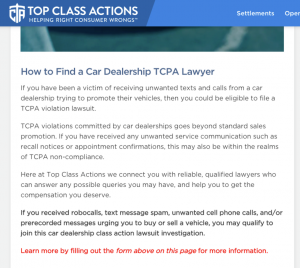
Car_Dealer_TCPA.png
 
  • Like
Reactions: john.quinn
@todd.smith The entire statute is confusing and courts state this repeatably in my searches. I would also point out that I can't find a single instance of litigation regarding a single instance or even a hundred instances where human action violated TCPA rules. Can you reference one? Everything I've found is tied to class action against large corporations employing automation of high volume (thousands) phone or text activity. My issue in this conversation is the balance of fear vs reality. The 2011 Lithia Ford lawsuit puckered up everyone and then we all clamped down on all texting without understanding what they did vs. what we were doing (I fell in that camp). It happened again this spring at Grieco Ford but they did the same thing Lithia did so shame on them. Again, someone used a 3rd party with no indemnification SMH.

Not advocating a blind eye. Employing common sense and awareness to what level may cross the line of comfort/risk for your dealership is still key.

I would still not use a robo dialer or use an automatic texting tool. Regardless, we are still a target...

View attachment 5067

Hey Dan I agree that using a bulk texting tool is a huge risk that no dealers should engage in it. I believe the point I have been trying to make it to give your salespeople a dedicated number to do all there texting with customers from instead of doing it from there personal phones. Here is why.

1. Data lose- You would need a court order to get info held on someone's personal phone so you will have no visibility into what your team is communicating with customers.

2. Compliance- We can debate all day about TCPA but operating on personal phones without an opt-out functionality is an unnecessary risk.

3. Experience- Consistency means everything during the sales process but when you get texts from one number(CRM) or the salesperson's personal phone, calls from the dealership phone system or again the salesperson's cell the shoppers are hesitant to engage. I believe equipping your team with a dedicated tracking number for all phone and text communication creates a uniformed experience that is missing at virtually every dealership I have shopped.

Finally, I am more than happy to set you up with Mike Semanie from Killgore Pearlman Semanie Denius Squires, P.A who is a top dealership attorney and friend who has represented multiple dealerships on TCPA compliance cases both individual and class action.

Just my two cents on Saturday morning. I hope you are doing great and we still need to make time for a catch-up call soon.

Todd
 
@todd.smith The entire statute is confusing and courts state this repeatably in my searches. I would also point out that I can't find a single instance of litigation regarding a single instance or even a hundred instances where human action violated TCPA rules. Can you reference one? Everything I've found is tied to class action against large corporations employing automation of high volume (thousands) phone or text activity. My issue in this conversation is the balance of fear vs reality. The 2011 Lithia Ford lawsuit puckered up everyone and then we all clamped down on all texting without understanding what they did vs. what we were doing (I fell in that camp). It happened again this spring at Grieco Ford but they did the same thing Lithia did so shame on them. Again, someone used a 3rd party with no indemnification SMH.

Not advocating a blind eye. Employing common sense and awareness to what level may cross the line of comfort/risk for your dealership is still key.

I would still not use a robo dialer or use an automatic texting tool. Regardless, we are still a target...

View attachment 5067

Hey Dan I agree that using a bulk texting tool is a huge risk that no dealers should engage in it. I believe the point I have been trying to make it to give your salespeople a dedicated number to do all there texting with customers from instead of doing it from there personal phones. Here is why.

1. Data lose- You would need a court order to get info held on someone's personal phone so you will have no visibility into what your team is communicating with customers.

2. Compliance- We can debate all day about TCPA but operating on personal phones without an opt-out functionality is an unnecessary risk.

3. Experience- Consistency means everything during the sales process but when you get texts from one number(CRM) or the salesperson's personal phone, calls from the dealership phone system or again the salesperson's cell the shoppers are hesitant to engage. I believe equipping your team with a dedicated tracking number for all phone and text communication creates a uniformed experience that is missing at virtually every dealership I have shopped.

Finally, I am more than happy to set you up with Mike Semanie from Killgore Pearlman Semanie Denius Squires, P.A who is a top dealership attorney and friend who has represented multiple dealerships on TCPA compliance cases both individual and class action.

Just my two cents on Saturday morning. I hope you are doing great and we still need to make time for a catch-up call soon.

Todd
 
  • Like
Reactions: Jeff Kershner

✨ AI Highlights

The thread begins with a case for dealership texting as a key conversational commerce channel, citing high open rates and shifting consumer preferences accelerated by COVID-19. The discussion quickly pivots to a detailed debate about TCPA compliance, with participants—none claiming to be lawyers—parsing whether human-initiated texts to leads who provided their number require explicit opt-in, and how automated or bulk texting poses the real legal risk. The key takeaway is that while mass/automated texting campaigns carry clear TCPA liability, individual human-to-human texts to customers who submitted contact information are widely seen as low-risk, though the statute remains genuinely ambiguous.

Replies Views 34 9,584 Started Last Reply